The Streets of Newcastle – The Quayside

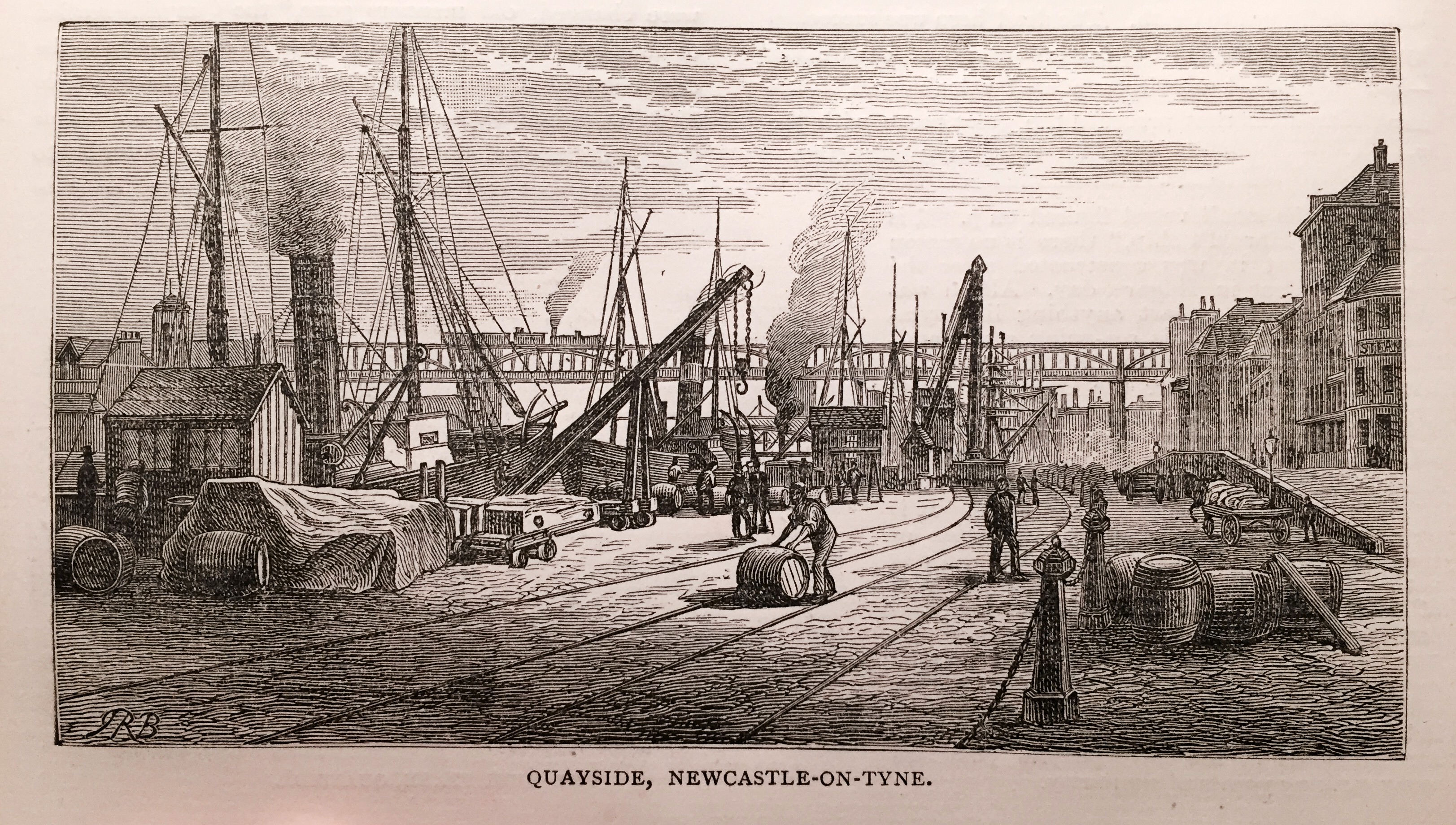
Quayside, Newcastle-on-TyneMany centuries back, the Quayside was a fortified place. Before the town walls were built, there can be no doubt that the Danes often enough paid their undesirable visits to the banks of the Tyne. Indeed, tradition hath it that they were accustomed to lie, at such time, at the part of the river known long after their day as Dent’s Hole; that is, the Danes’ Hole; though we now know that Dent’s Hole was named after the local family of Dent, who owned the adjoining manor. Then, later on, we had our good friends the Scots paying us attentions that were sometimes found to be more free than welcome. It was, therefore, only prudent that, when our forefathers were about it, they should defend their town from hostile attacks, even on the water side. But when “old times were changed, old manners gone,” the Quayside section of the town wall was discovered to be an obstacle to the development of trade; and so it came to pass that, in 1763, workmen began to raze it to the ground. After they had knocked down the old wall, they proceeded to divide the east end of the Quay, from Spicer Lane to Sandgate, by iron rails, and to construct a descent to the portion adjoining the river by several steps. This arrangement answered for a while; but, some years after, the roadway was raised and levelled, and so transformed into a fine broad wharf. Since then our Quay has been continuously and watchfully strengthened and improved whenever the occasion seemed to arise for any such treatment.

The time was coming when this local Rialto was to receive its baptism of fire. Men of middle age remember that season of trouble and anxiety right well. Those of them at all interested in the Quay in the year 1854 will recollect the quaint, old-fashioned appearance which its buildings then presented. Queerest of them all, perhaps, was the Grey Horse public-house, with its bold projection seeking, and not in vain, to usurp part of the footpath. On the night of the 5th of October in that year, that great fire occurred which has already been described in the Monthly Chronicle. (See vol. ii., p. 549). As in so many matters more, out of this immediate evil came future good. In place of the old chares and time-worn houses and shops thus so decisively destroyed, there arose those handsome stone-fronted buildings which have so often attracted the attention of passing travellers along the High Level Bridge.
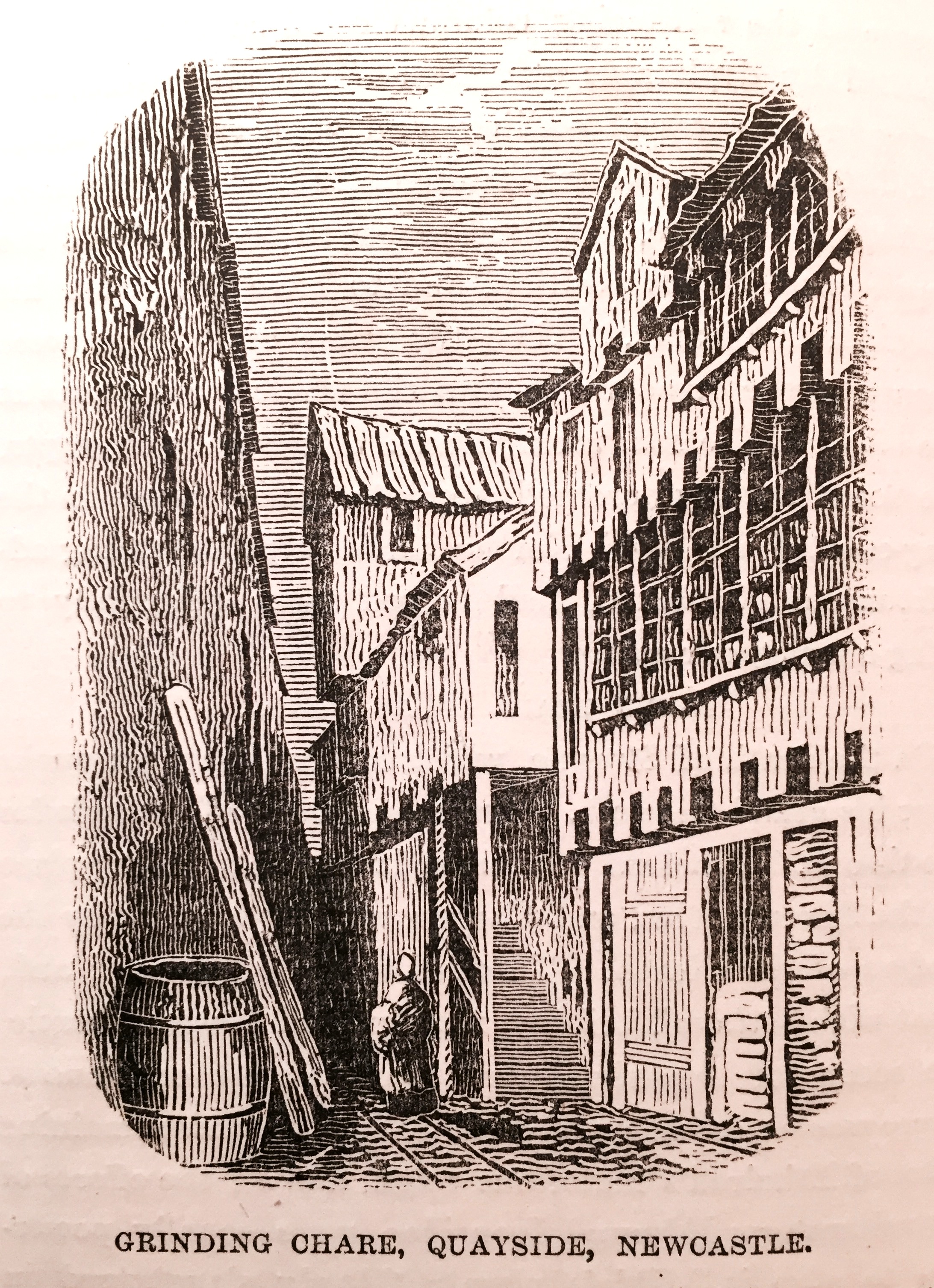
Grinding Chare, Quayside, NewcastleIf some chares were swept away by the calamity, it must be admitted that there are still plenty left. In former days there were no less than twenty of these narrow lanes leading from the Quayside to the streets on its northern boundary. It was difficult, long before this great fire, to identify the situation of some of these by their names as given in old documents; and of course the task is by no means easier now. But some of them, at any rate, we may recall to mind. Starting, then, from the west, we note the first of the number the Dark Chare. It was so close that the houses in it nearly touched one another at the top. Then there was Grindon, Granden, or Grinding Chare. In this chare stood the remains of a remarkable house, traditionally called St. John’s Chapel. It had suffered from the ravages of change prior to the explosion, which only completed what had thus been already begun. Then there were the Blue Anchor, Peppercorn, Pallister’s, Colvin’s, and Hornsby’s Chares all forgotten now. Plummer, or Plumber, Chare is still in existence, and is supposed to have been named after a Robert Plumber who in 1378 was one of the bailiffs of the town.
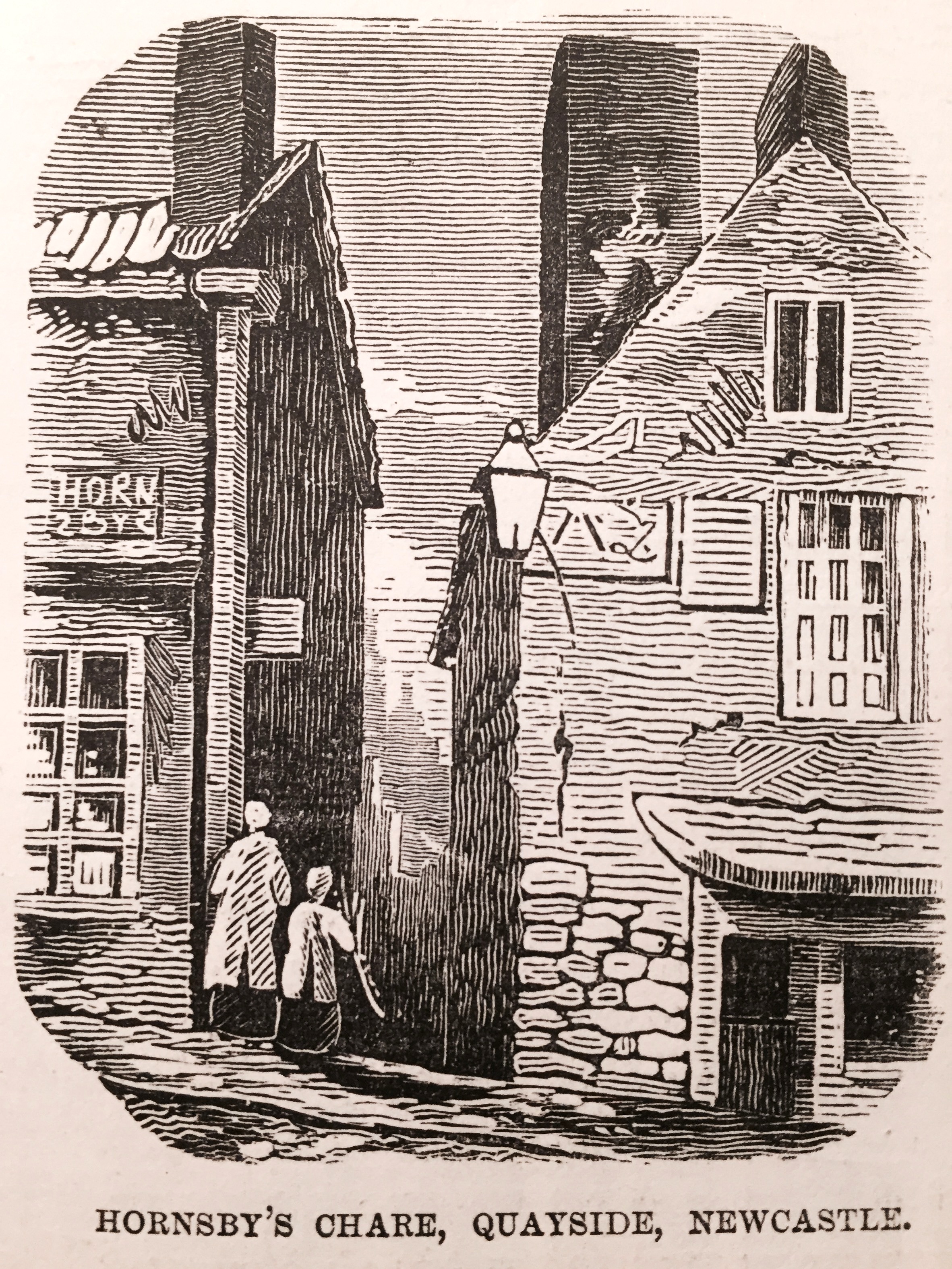
Hornsby's Chare, Quayside, NewcastleFenwick’s Chare, next in order, was so named after its owner, Alderman Cuthbert Fenwick, who had his residence in it; for it must be remembered that these chares had some of the best houses of Newcastle at one time, though warehouses of various kinds now are formed in their place. The Park, or Back Lane, occurred next. Bourne in his plan of the town calls this the true Dark Chare, and so illustrates the difficulty that the inquirer has at getting to the exact truth in regard to these obscure places. Broad Garth, which came next, is not to be confounded with the much better known Broad Chare, still to come to. And then there came Peacock’s Chare, or Entry, where that remarkable man, Thomas Spence, kept his school.

And now we have reached the Custom House, built in 1765, passing which we come to Trinity Chare, so-called because it is the back entrance to the Trinity House, which also has already been described (See vol. iii., p. 176. ). The window of the dining-room of the Three Indian Kings (a well-known Quayside hostelry) looks into Trinity Chare. The three kings are usually understood to be the three wise men from the East who brought gold, frankincense, and myrrh, in tribute to the infant Christ and his virgin mother. The sign is not an uncommon one with ancient inns.

Next to Trinity Chare is the Broad Chare. Though narrow enough to our modern notions, it is certainly the broadest chare in this locality, and almost the only one that will admit a cart. It was the common thoroughfare of the town in the olden days; now it is given up to huge warehouses and to establishments devoted to the refreshment of the inner man. Two houses figured in our illustrations were interesting specimens of the old architecture of the locality. Both pictures are copied from sketches in the late Mr. John Waller’s copy of Mackenzie’s “History of Newcastle,” now the property of Mr. J. W. Pease. The High Dykes Tavern is supposed to have somehow got its name from the fosse or ditch which surrounded the town walls, and which was called the King’s Dykes. The house shown in our other picture is alleged to have been the mansion of the Liddells of Ravensworth.
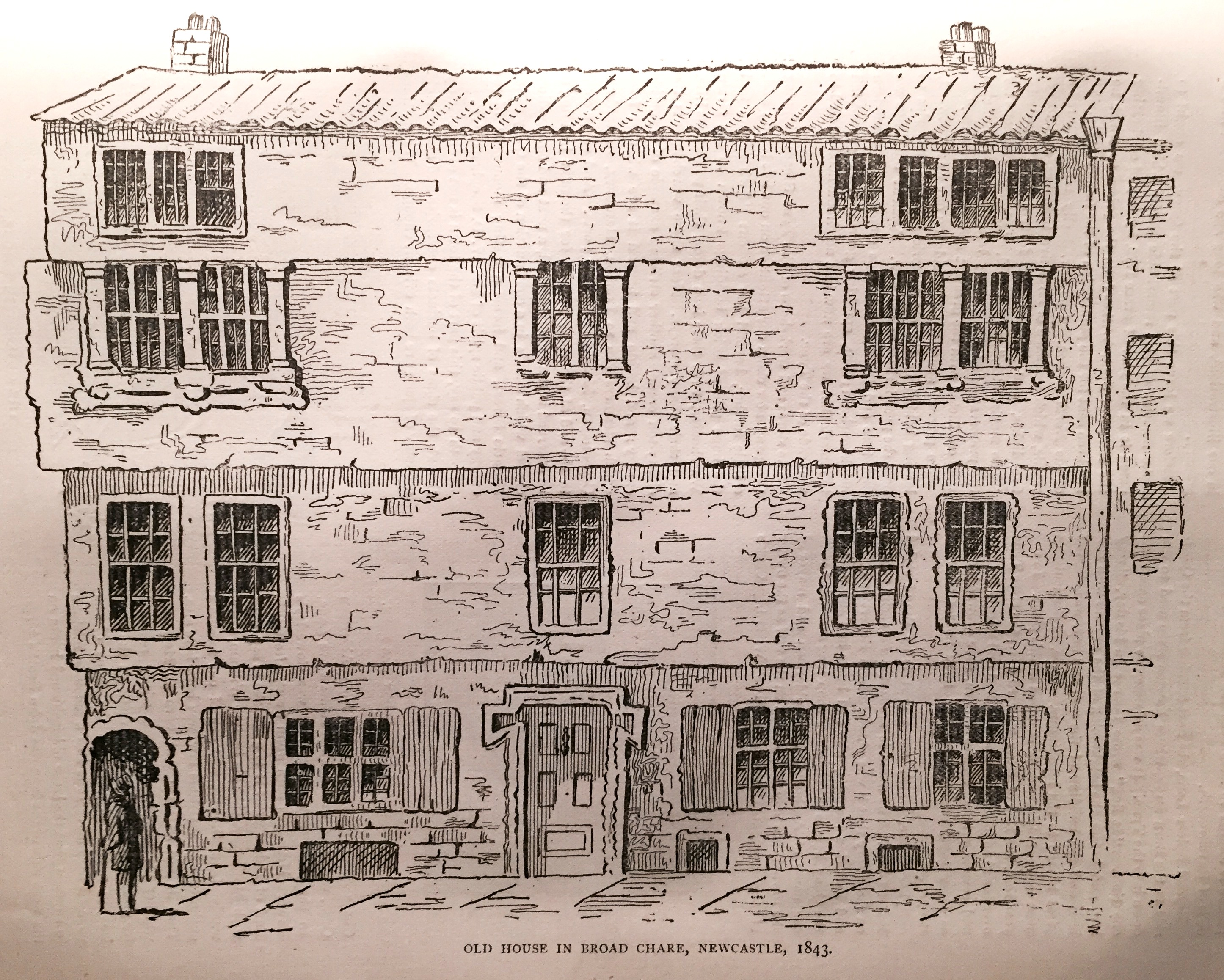
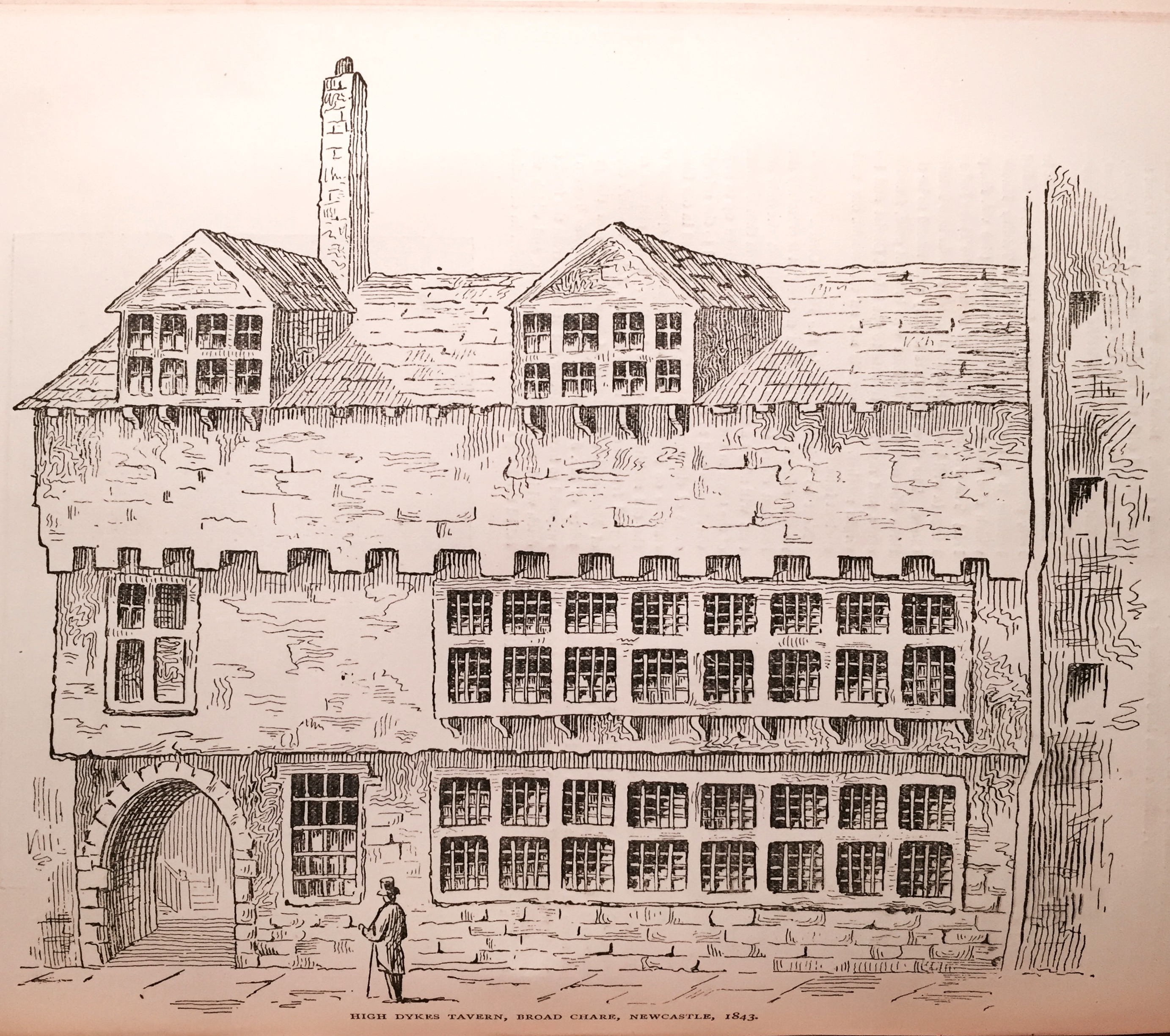
Old House in Broard Chare, Newcastle, 1843 High Dykes Tavern, Broard Chare, Newcastle, 1843

Beyond Spioer Lane, the next opening from the Quayside la the Burn Bank, where Fandon Burn used to run down into the Tyne. It was a dangerous place enough at one time. “It lies,” wrote Bourne in his day, “very low, and before the heightening of the ground with ballast, and the building of the wall and key, was often of great hazard to the inhabitants. Once, in particular.; a most melancholy accident occurred in this place. In the year 1320, the 13th of King Edward III., the river Tyne overflowed so much that one hundred and twenty laymen and several priests, besides women, were drowned, and, as Gray says, one hundred and forty houses were destroyed.’
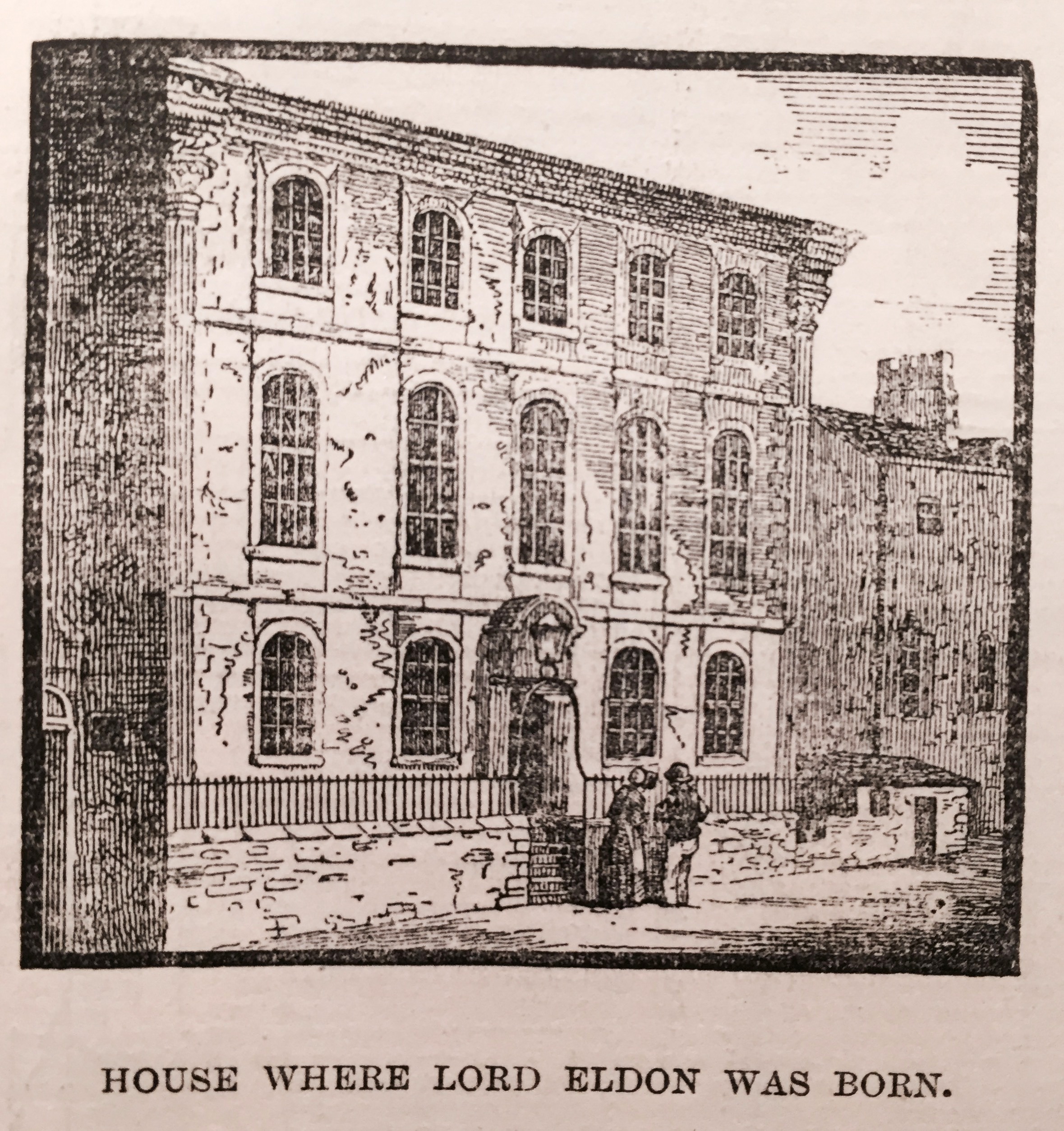
House Where Lord Eldon was BornByker Chare, which comes next, is by Brand styled Baker Chare. The name is accounted for easily enough on the theory that it was obtained from Robert de Byker and Laderine his wife, who had lands in Pandon. On the Quay here is the chemist’s shop long associated with the name of Anthony Nichol, alderman and mayor of the town in his day, and known on the turf as the owner of the celebrated race-horse, The Wizard. Cock’s Chare comes next: so named from Alderman Cock, who lived in it. Then comes Love Lane. In the seventeenth century it was Gowerley’s Rawe. Here was born John Scott, afterwards Earl of Eldon. But it is a mistake to say, even with Mackenzie, that his brother William, afterwards Lord Stowell, and one of our foremost authorities in maritime law, was born here also. That is not so. He was born at Heworth, whither his mother had been wisely removed for greater safety, as all Newcastle at the time was in a state of alarm at the rising of the young Pretender. It is also a common mistake to suppose that the large old-fashioned house on the west side of the lane was John Scott’s birthplace. It was on the east side (faithfully depicted in our illustration), and was long ago converted into a granary.
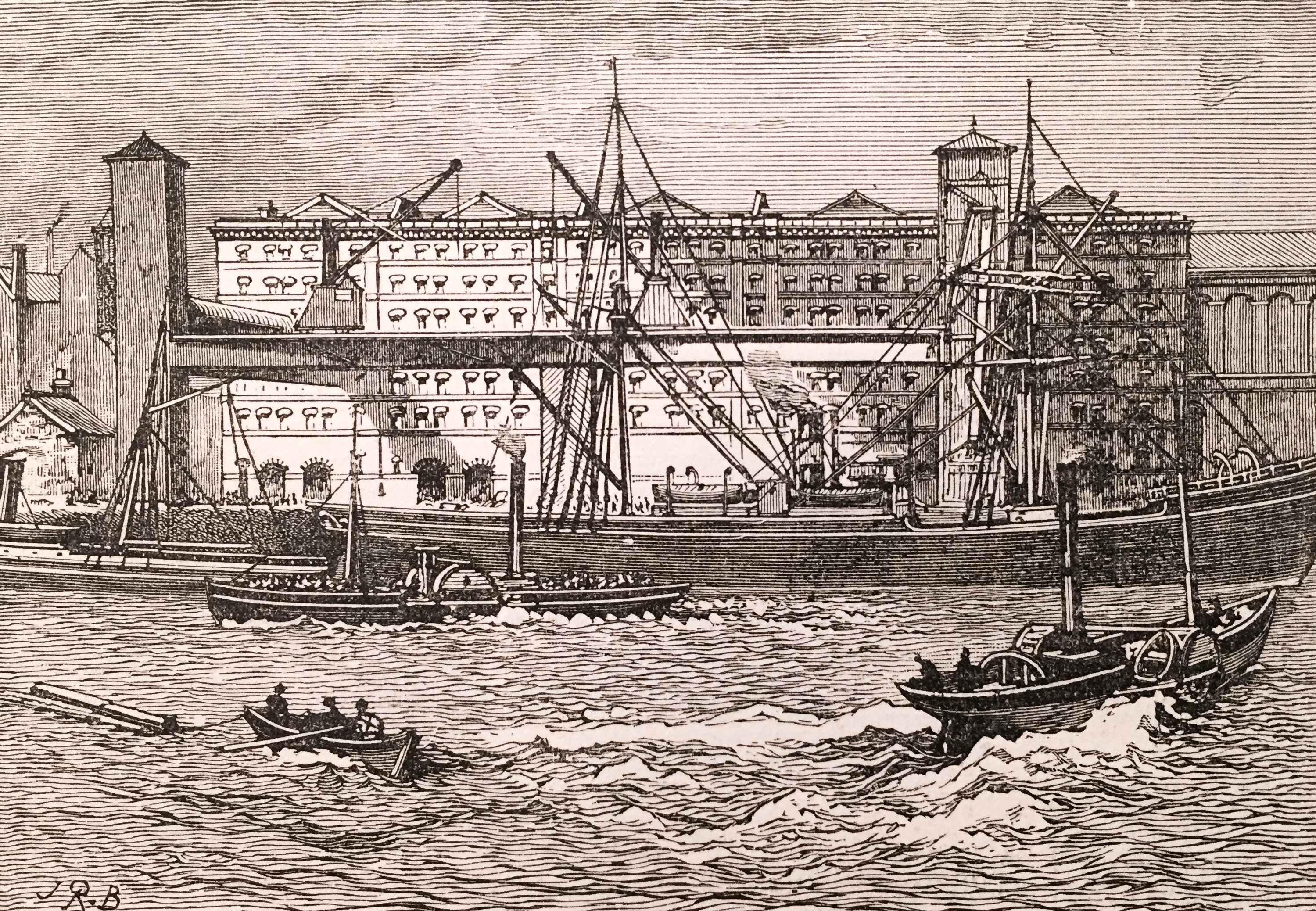
Grain Warehouse, Quayside, Newcastle-on-TyneBefore we leave this part of the Quay, we ought to make mention of that remarkable candle which illuminated it in the year of grace 1770, by way of celebrating the release of John Wilkes from the prison to which he had been sent for the publication of the famous” No. 45″ of his North Briton. One Mr. Kelly manufactured a candle, which consisted of forty-five branches, cast forty-five lights, and weighed just forty-five half pounds. “The magistrates,” we are told, “adopted cautions for the preservation of the peace; but the entertainments were conducted with the greatest order and decorum.”

We proceed along the riverside on our way eastward, leaving behind us the old historic Quay of centuries to note the peculiarities of the new. Ancient buildings we find here and there also in this comparatively modern neighbourhood; but, speaking generally, we cannot fail to remark that we are now in a neighbourhood sacred to the trade of the Tyne.

The stores and workshops of the Tyne Steam Shipping Company now claim our attention on our left hand; and, a little further, beyond the ancient “Swirle,” we find the huge pile of brick buildings known as the Grain Warehouses, with their iron doors, their ponderous lifts, and their many storeys. Near these warehouses is the eighty-ton crane another striking example of Tyneside energy; and beside and beyond it are wharves from which steamers run to London, Hamburg, Rotterdam, Copenhagan, Malmo, and other ports. And so we come to the end of the Quay proper, for the next building to be observed is the Sailors’ Bethel, a neat and commodious chapel which stands in a continuation of the Quay called Horatio Street, and forms a lasting monument of the energy and public spirit of Mr. W. D. Stephens, J.P.

Sooth to say, this part of the town is not over inviting, though the signs of business enterprise and also of rigid economy of space are both evident enough. We continue on until we come to the little bridge across the streamlet called the Ouseburn, which gives its name to the district. The road by the river, from the end of Sandgate to this bridge, is called the North Shore, and is devoted to business purposes strictly. The roadway over the stream is usually known as the Glasshouse Bridge, and consists of one arch of stone. We gather from Bourne that it was originally a wooden structure. “But,” says he, “in the year 1669, when Ralph Jennison, Esq., was mayor, it was made of stone by Thomas Wrangham, shipwright, on account of lands which the town let him. The passage, however, over it was very difficult and uneven until the year 1729, when Stephen Coulson, Esq., was mayor, [and] it was made commodious and level both for horse and foot.” The little bridge was so named from the circumstance that the glass trade had long been carried on in its vicinity.

We continue onwards, and find ourselves next at the River Police Station. Then we turn away at right angles to the Mushroom, and, proceeding northwards, speedily find ourselves in St. Lawrence Street, the end of our journey, where there is nothing to detain us. For only a very small portion of the ancient “fre chappell of Saynt Laurence in the Lordshippe of Byker” remains to give us pause. This chapel was founded, according to a document issued when the monasteries were suppressed, “by the auncesters of the late erle of Northumberland toward the fyndinge of a prieste to pray for their sowles and all christen sowls and also to herbour such (sick) persons and wayfaring men in time of nede.” Edward VI. granted this chapel to the Corporation in 1549; in 1782 Brand found its remains converted into a lumber-room for an adjoining glasshouse.
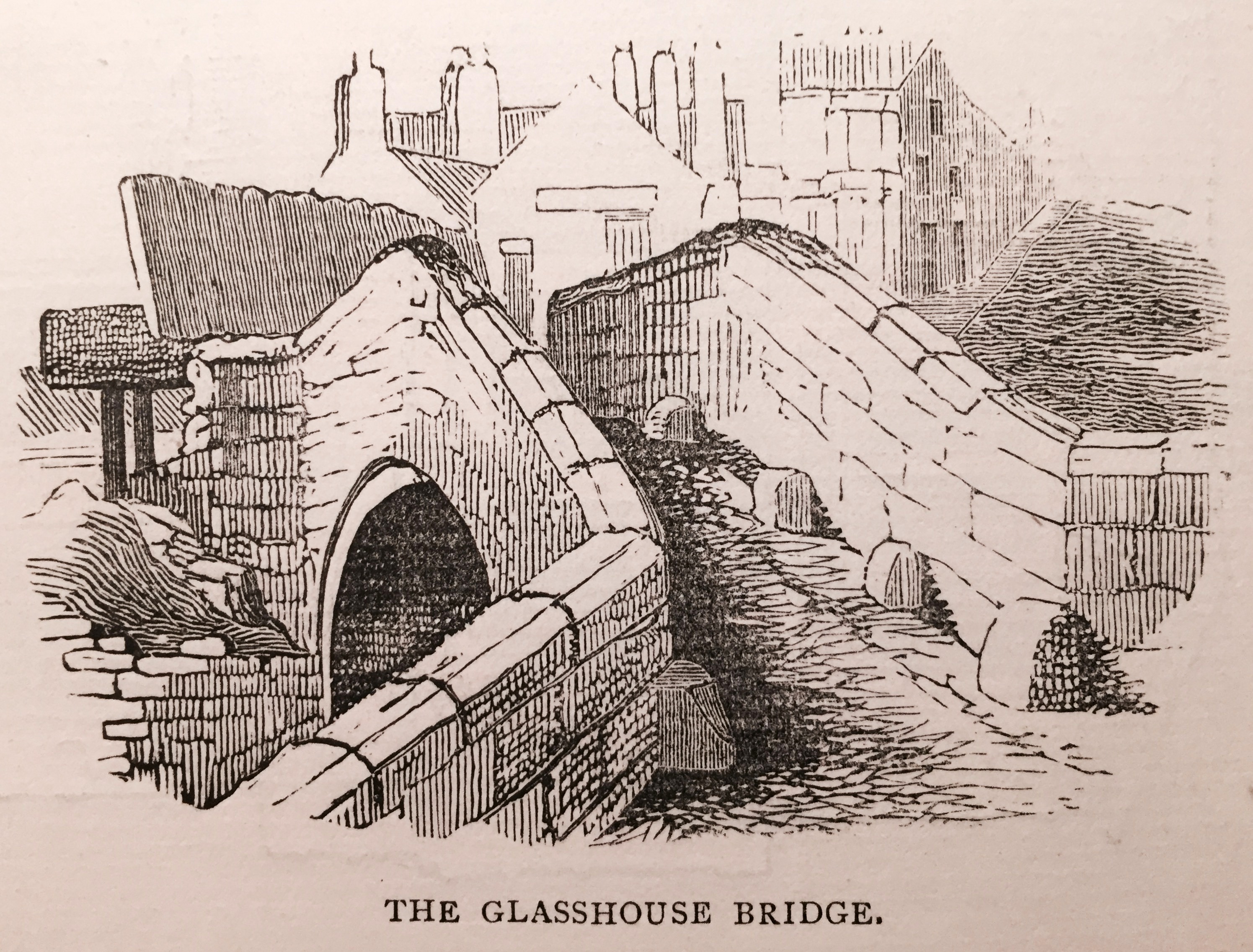
The Glasshouse BridgeOur engravings of the High Crane, Grinding Chare, Homsby’s Chare, and the Glasshouse Bridge are reproduced from Richardson’s “Table Book.” The High Crane was situated near the Guildhall at the west end of the Quay.
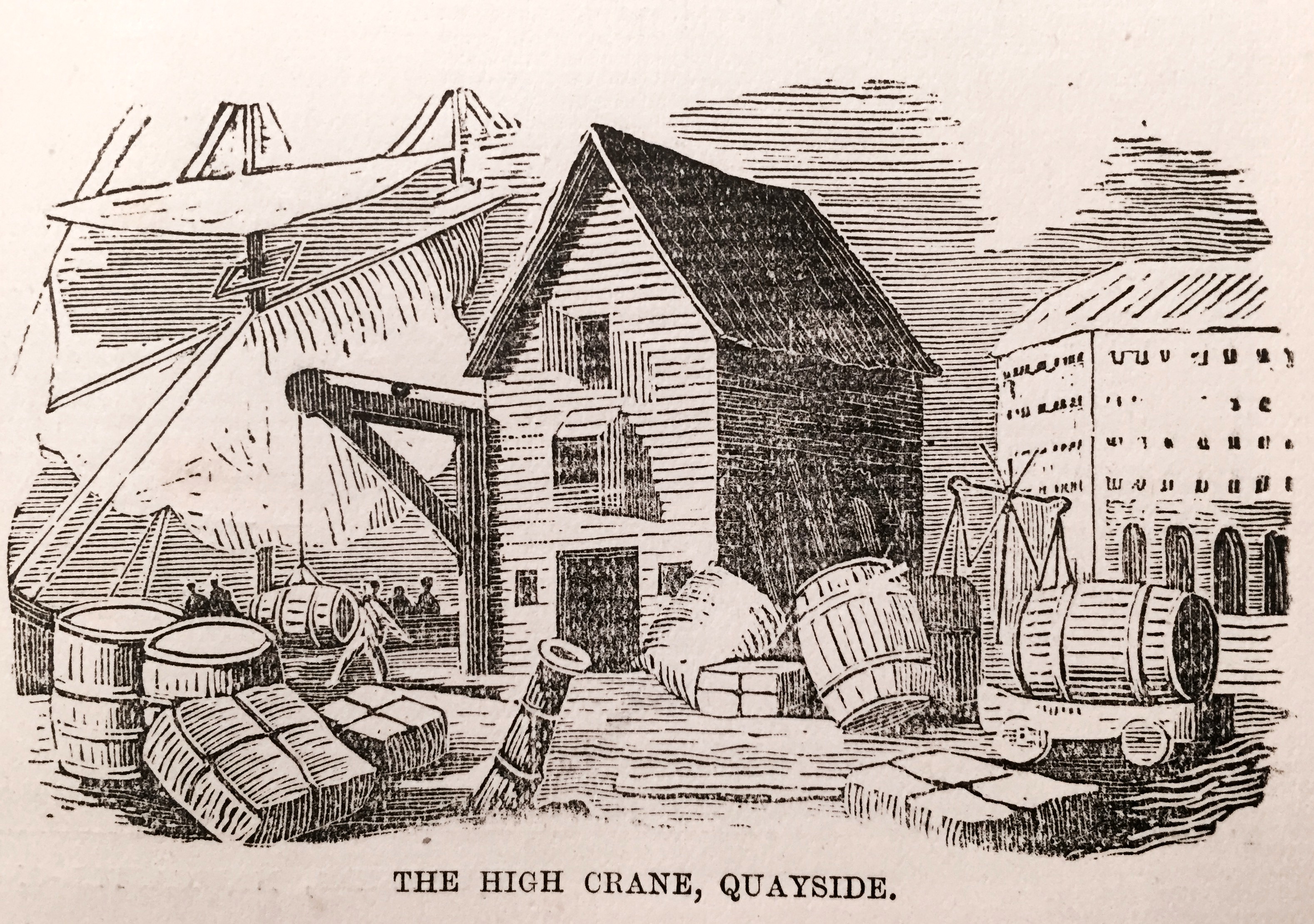
The High Crane, Quayside

The Streets of Newcastle – Grey Street

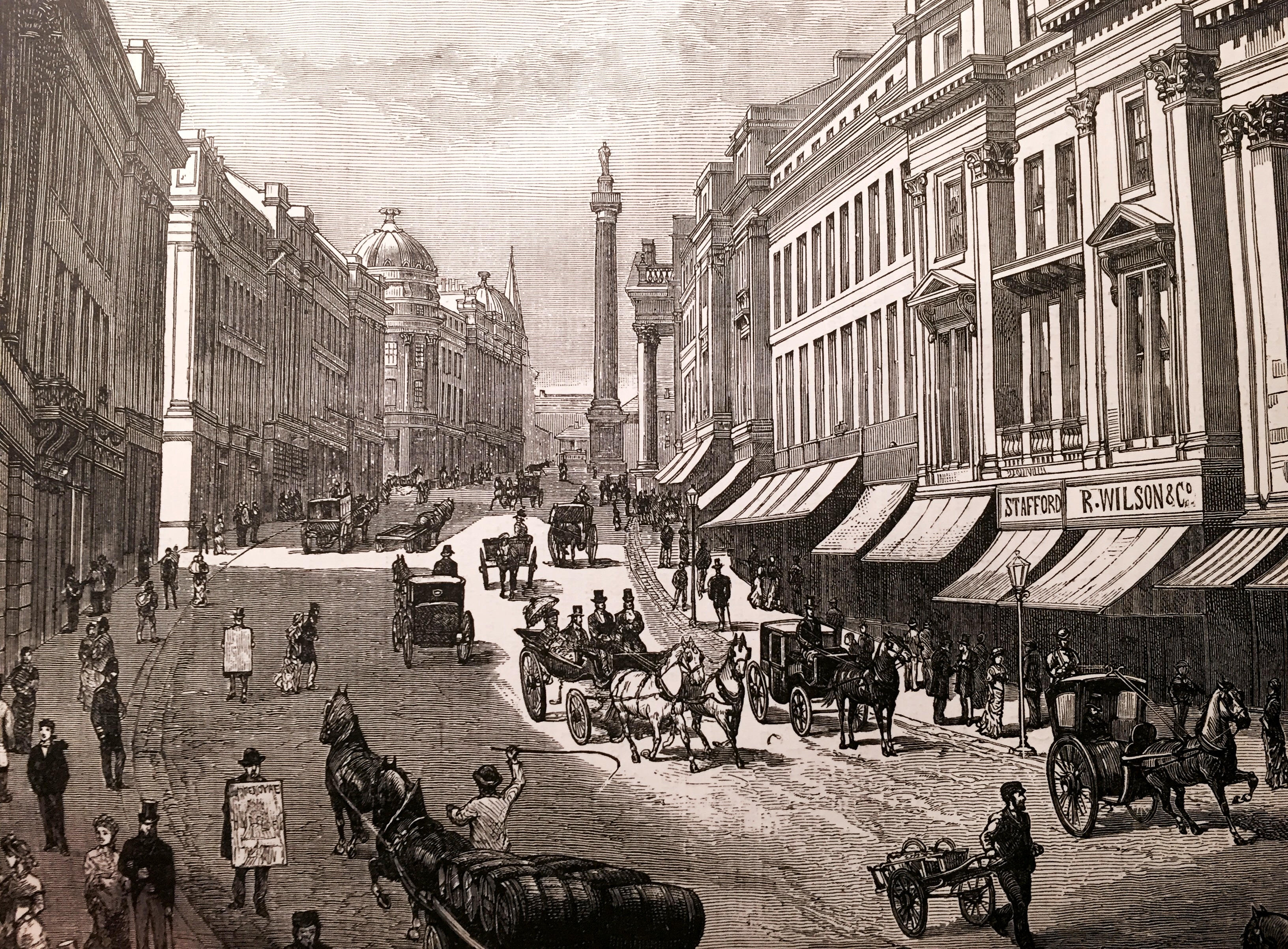
Grey Street, Newcastle-on-Tyne, 1889Grey Street is generally regarded as a noble monument to the genius of Richard Grainger. To trace its origin we must go back in thought to the spring of 1834, for then it was that Mr. Grainger entered into arrangements with the representatives of Major Anderson for the purchase of the celebrated Anderson Place, at a cost of £50,000. Other property, including the old theatre in Mosley Street, probably cost him about £45,000 more. Having made this costly venture, his next step was to lay his plans for projected new streets before the Town Council; and this was done on March 27th of the above named year. He desired to remove the Butcher and Vegetable Markets, then comparatively new, and to build on the site a magnificent thoroughfare which should connect Blackett Street with Dean Street. Many were the difficulties he had to encounter. The owners of the threatened property, and other persons who had invested their money in the neighbourhood, sang out lustily against any change being made. Grainger was not disposed to yield to this clamour if he could possibly help it. Accordingly, he exhibited his plans in the Arcade on the 29th of May. They were eagerly inspected by the public, and obtained such general approval that about five thousand signatures were appended to a memorial in their favour. A counter-petition only obtained some three hundred signatures. Expressions of approval were also obtained from a parish meeting in St. Andrew’s, the Chamber of Commerce, and other bodies. The Council met on the 12th of June to consider the whole question, when, by twenty-four votes against seven, it was resolved to treat with Grainger. On the following 15th of July, sanction was formally given to the plans. Great were the rejoicings when the news was made known. The parish churches rang out merry peals; Mr. Grainger’s workmen were regaled in the Nun’s Field; in fact, the town was en file.

Then Grainger set to work with all his characteristic energy. He began to lay out his new streets on the 30th of July. The levelling of the ground was a most expensive undertaking. Nearly five trillions of cubic feet of earth had to be carted away, at a cost of upwards of £20,000. In the course of the excavations, portions of an ancient crucifix and a gilt spur were found, as well as a quantity of human remains, on the supposed site of the burial ground of St. Bartholomew’s Nunnery. The work was not without its perils. On the 11th of June, 1835, for instance, about three o’clock in the afternoon, three houses on the south-west side of Market Street suddenly fell with a tremendous crash whilst in course of erection. The buildings had nearly reached their intended height. At least a hundred men were at work upon and immediately around them, several of whom were precipitated to the ground with the falling materials, and were buried in the ruins. Many more had almost miraculous escapes from a similar fate. As soon as the alarm had subsided, the other workmen, upwards of seven hundred in number, devoted themselves to the relief and rescue of the sufferers. Of those disinterred, one, the foreman of the masons, died in a few hours; four were dead when found; fifteen were got out alive, but greatly injured, and two of them died, making seven in all. Grainger himself had a narrow escape. He had inspected the houses but a few minutes before; when they fell, he was standing upon the scaffolding of the adjacent house.

Let us see if we can realise something of the general appearance of this locality before Grainger converted it into a palatial thoroughfare. The higher part of what is now Grey Street was a place of solitude and retirement. Waste ground surrounded Anderson Place. One of our local poets has recalled the time when Novocastrians could: –

Walk up the lane, and ope the Major’s gate.
Pass the stone cross, and to the Dene we come,
Then, halting by the well where angels wait
To bathe the limbs of those in palsied state,
(So saith the legend), gaze in musing mood
On the time-honoured trees where small birds mate.
Unlike the nuns, build nests and nurse their brood,
And prove that Nature’s laws are tender, wise, and good.

Outside the Major’s boundary there was plenty of life, and plenty of noise, especially on Saturday nights. Itinerant vendors indulged in their quaint cries. Women and children (mostly the latter) sang: –

Silk shoe ties, a penny a pair:
Buy them, and try them, and see hoo they wear.

Others made known their vocation by the cry: “Good tar-barrel matches, three bunches a penny.” The air re-resounded with the invitation : “Nice tripe or mince tonight, hinnies; gud fat puddins, hinnies, smoking het,” concerning which savoury viands the lines recur to the veteran’s memory: –

And now for black puddings, long measure,
They go to Tib Trollibags’ stand;
And away bear the glossy rich treasure,
With joy, like curl’d bugles in hand.

The side adjoining Pilgrim Street was devoted to the sale of poultry and eggs; that opposite, and therefore nearer the Cloth Market, to the stalls of the greengrocers. The intervening space was given up to the butchers, whose shops ran in rows from north to south. These shops had stone fronts, with tiled roofs, and an overhanging canopy in front.

Such, then, was the general character of this part of the good old town in the past. We may turn now to its features in the present. Let us start from Blackett Street, and walk quietly down to Dean Street. At once our attention is arrested by the noble column usually known as the Grey Monument. On October 6th, 1834, a public meeting was convened to consider the propriety of commemorating, by the erection of a statue, the services rendered to the cause of Parliamentary Reform by the then Earl Grey. William Ord, Esq., presided, and the idea was unanimously approved. A sum of £500 was subscribed in the room. On February 13th, 1836, a model of a Roman Doric column by John Green was adopted, to cost £1,600; and it was resolved to commission E. H. Baily to provide a suitable statue of the earl, at a further cost of £700. The construction of the column was entrusted to Joseph Welch, builder of the Ouseburn Viaduct, and Bellingham Bridge across North Tyne. The foundation stone was laid by Messrs. J. and B. Green, architects, on September 6th, 1837, and the column was finished on August 11th, 1838. Baily’s statue was placed on the summit thirteen days later.

The monument is 133 feet high, and contains 164 steps in the interior. A glass bottle, containing coins and a parchment scroll, was deposited in the foundation stone. The scroll records: “The foundation stone of this column, erected by public subscription in commemoration of the transcendent services rendered to his country by the Right Hon. Charles Earl Grey, Viscount Howick, Knight of the most noble Order of the Garter, and Baronet, was laid on the sixth day of September, one thousand eight hundred and thirty-seven, by John Green and Benjamin Green, Esqrs., Architects. Building Committee: The Rev. John Saville Ogle, of Kirkley, in the county of Northumberland, Clerk, A.M., Prebendary of Durham; Edward Swinburne, of Capheaton, Esq.; Thomas Emerson Headlam, of Newcastle-on-Tyne, Esq., M.D.; John Grey, of Dilston, Esq.; Thomas Richard Batson, of Newcastle-upon-Tyne, Esq., and Alderman; Armorer Donkin, of Newcastle-upon-Tyne, Esq., and Alderman; Ralph Park Philipson, of Newcastle-upon-Tyne, Esq., and Town Councillor; John Fenwick, of Newcastle-upon-Tyne, Esqr.; James Hodgson, of Newcastle-upon-Tyne, Esq., and Alderman; Emerson Charnley, of Newcastle-upon-Tyne, Esq., and Town Councillor.”

On the exterior of the column is cut the following inscription: “This Column was erected in 1838, to commemorate the services rendered to his country by Charles Earl Grey, K.G., who, during an active political career of nearly half-a-century, was the constant advocate of peace and the fearless and consistent champion of civil and religious liberty. He first directed his efforts to the amendment of the representation of the people in 1792, and was the Minister by whose advice, and under whose guidance, the great measure of Parliamentary Reform was, after an arduous and protracted struggle, safely and triumphantly achieved in the year 1832.”

Near the Monument is the Victoria Room, formerly used as a music-hall. In its early days, political meetings were occasionally held here, whereat Thomas Doubleday, John Fife, and Charles Larkin were usually the chief speakers. Later on, an effort was made to popularise cheap Saturday and Monday evening concerts in this room. Amongst others who took part in them were Mr. William Gourlay, the talented Scotch comedian, who sang comic songs here when the theatre, a little lower down Grey Street, was not open; Mr. Fourness Rolfe, also of the same theatre; the sisters Blake; and Miss Goddard, afterwards Mrs. Gourlay.

At the corner of the little lane just a step or so further down Grey Street, the Newcastle Journal had its printing and publishing offices at one time. Mr. John Hernaman was the editor of this paper for some years, and got into several scrapes owing to the violence with which he attacked his political opponents. On one occasion he fell foul of Mr. Larkin, who, in return, made mincemeat of him (metaphorically) in a scathing pamphlet, entitled, “A Letter to Fustigated John” the word “fustigated” being an old synonym for “whipped.” It was, in fact, Mr. Hernaman’s unpleasant experience to have to endure corporal chastisement more than once in the course of his journalistic career. One of his whippings occurred at the Barras Bridge. In another case, several Sunderland men came over to Newcastle to avenge themselves for what they considered an unfair criticism on certain of their transactions. They suddenly burst in upon the editorial presence, and asked Hernaman for the name of the writer of the objectionable article. The latter declined to furnish them with any information on the subject. On this refusal, he was attacked with walking sticks and horsewhips. The case came up in due time at the Sessions, where the defendants were “strongly recommended to mercy on account of the very great provocation they had received.” They were each called upon to pay a fine of £50. Fortunately, the days of such journalistic amenities in Newcastle may be safely enough regarded as over now for good.

Across the way is the Central Exchange Hotel, with its handsome dining-room, its rooms for commercial travellers, &c.; and on our left hand there is another of a similar character, also devoted to commercial men and their customers, named the Royal Exchange. The latter is at the corner of Hood Street, so called after an alderman of that name. In this street is the Central Hall, used for Saturday evening concerts, teetotal gatherings, and revival meetings. It was originally a Methodist New Connexion chapel, in which Joseph Barker used at one period of his career to hold forth to large congregations.

Passing Hood Street and Market Street, we come to the Theatre Royal, the successor of the establishment in Mosley Street. The portico of the Theatre Royal is a striking feature of the street, though unfortunately it remains incomplete to this day. The design is taken from the Pantheon at Rome. Six noble Corinthian columns, with richly executed capitals, support the pediment, in the tympanum of which it a sculpture of the royal arms, the work of a Newcastle artist who died all too soon for the ripening of his fame. This work of his has often won the approval of critics in such matters. It is here that the Theatre Royal front has been suffered to remain unfinished, for it was originally intended to place a statue of Mrs. Siddons as the Tragic Muse (after Sir Joshua Reynolds’s famous portrayal of that great actress), on the top of the pediment. The building was opened in 1837, under the management of Mr. Penley, with an address from the pen of Thomas Doubleday, the “Merchant of Venice,” and an ephemeral afterpiece. The house has remained a popular home of the drama ever since. Most of the great players of their day have fretted and strutted their little hour on this stage; and some of them laid the foundation of their future fame and fortune here. Macready (who first appeared in the old theatre at the foot of the street, of which his father was manager for about twelve years) was always a Newcastle favourite, alike in his youth and in his prime. He says himself of his first appearance here: “I was warmly received, and the partiality with which my early essays were encouraged seemed to increase in fervour to the very last night, when I made my farewell bow to a later generation.” The great tragedian appeared on March 15th, 1850, as Cardinal Wolsey (in “Henry VIII.”) and as Lord Townley (in the “Provoked Husband,” by Vanbrugh and Cibber). After playing these parts, Macready delivered his farewell address to his Newcastle friends. In the course of it he said: “When I retrace the years that have made me old in acquaintance and familiar here, and recount to myself the many unforgotten evidences of kindly feeling towards me, which through these years have been without stint or check so lavishly afforded, I must be cold and insensible indeed if time could so have passed without leaving deep traces of its events upon my memory and my heart. From the summer of 1810, when, scarcely out of the years of boyhood, I was venturing here the early and the ruder essays of my art, I date the commencement of that favourable regard which has been continued to me through all my many engagements, without change or fluctuation, up to the present time.”

Samuel Phelps and James Anderson, two of Macready ‘s trusty lieutenants in his great Covent Garden enterprise, have frequently played here with acceptance. So has Charles Kean, who, by the way, was hissed in Hamlet on his first appearance in that character in Newcastle, and cut up by the newspapers afterwards. He went, much astonished, to the manager. “Good gracious, Mr. Ternan, they’ve hissed me; what on earth have I done ?” “Well, Mr. Kean, you’ve cut out altogether the lines beginning,” &c. “Good gracious!” rejoined the discomfited tragedian, “who could ever have thought they would know Shakspeare so well down here!” “Oh, yes, Mr. Kean,” answered Ternan, quietly, “they know their Shakspeare here, I can assure you.” Ternan was a very able Shaksperian actor himself.

George Bennett and James Bennett were, among other popular tragedians, here in their younger days; and Barry Sullivan was always a warm favourite. Of comedians, Charles Mathews, Buckatone and his celebrated Haymarket company, Sothern (Lord Dundreary), Toole, and others, have fulfilled successful engagements in the Theatre Royal. Salvini has acted on the Royal boards also, as have Madame Ristori and Madame Sarah Bernhardt. Of our own queens of the stage since 1837, nearly all have appeared here at one time or another; but it is such an invidious task to pick and choose amongst them, that we are fain to shrink from it altogether. It would be very unfair not to make mention of the many years of managerial toil given to this stage by the late Mr. E. D. Davis, for, by common consent of all qualified to judge, he was ever, as actor, as artist, and as manager, a gentleman. Since his retirement, this house has been under the direction of Messrs. W. H. Swanborough, Glover and Francis, Charles Bernard, and Howard and Wyndham, who are the present lessees. Be the day far distant when the Newcastle drama, with all its honourable records, shall, to use Lord Tennyson’s words:

Flicker down to brainless pantomime,
And those gilt-gauds men-children swarm to see!

Probably this house held its largest receipts on Sept. 20, 1848, when Jenny Lind appeared in “La Sonnambula.” The prices were: Dress boxes, £1 11s. 6d.; upper boxes and pit, £1 1s.; gallery, 10s. 6d. The receipts amounted to upwards of £1,100. Sims Reeves and Madame Gassier, Grisi, and Mario, and all the great operatic stars have appeared here. Sims Reeves, indeed, came out on the Newcastle boards. Our sturdy fathers hissed him too. They stood no nonsense in those days, either from a Charles Kean or anybody else.

The Theatre, Grey Street, itself, and indeed all the streets and buildings in Newcastle, presented a strange appearance on the morning of March 3, 1886, owing to a great fall of snow on the previous day and night. Our artist’s sketch of the scene will convey a better idea of it than any mere description.

Great Snow Storm, March 3, 1886 - Scene in Grey Street , NewcastlePassing by Shakspeare Street, we find ourselves about to cross the High Bridge, which is another intersecting thoroughfare, running from Pilgrim Street to the Bigg Market. There is nothing specially remarkable about it, save that at least one somewhat remarkable man of his day has associated his name with it. James Murray, for so was he called, studied for the ministry, but he could not obtain ordination to any pastoral charge by reason of his peculiar views on church government. He came to Newcastle in 1764, and found friends who built him a chapel. And here he remained, preached, and laboured, until his death in 1782, in the fiftieth year of his age. The titles of some of his published discourses afford some indication as to his character. Amongst them are “Sermons to Awes.” “New Sermons to Asses.” “An old Fox Tarred and Feathered,” and “News from the Pope to the Devil.” On one occasion he gave the authorities a fright, and seems to have got frightened himself into the bargain. Thus runs the story. He announced his intention of preaching a sermon from the text, “He that hath not a sword, let him sell his garment and buy one.” Those responsible for the peace of the town, knowing their man, grew rather afraid when they heard of this ominous text. They sent some of the town’s sergeants to form a portion of the congregation. All passed off quietly, as it happened; but then it occurred to Murray that he had better find out how he really stood in regard to the powers that were. Forthwith he went up to London, and called on Lord Mansfield, the then Chief-Justice. He obtained for his application the conventional reply: “Not at home.” “Tell him,” was the sturdy rejoinder, “that a Scotch parson, of the name of Murray, from Newcastle, wants to see him.” He was admitted. What passed at the interview? We can only guess from the judge’s last words, quoting a simile in the Book of Job: “You just get away by the skin o’ your teeth.”

In 1780 the year of the Gordon riots in London, so vividly depicted in Dickens’s “Barnaby Rudge,” the year when there was danger of a general attack on the Roman Catholics Murray was to the fore again. In that year there was a contested election in Newcastle. Murray proposed a sort of test, or pledge, to each of the candidates aimed, of course, at the religionists, with whom he had waged a life-long war. Sir Matthew White Ridley would have nothing to do with it. Even Andrew Robinson Bowes, who was never in the habit of sticking at trifles, vowed that “he would be blessed” only that was not quite the exact word! “if he gave anything of the sort.” The third candidate, Sir Thomas Delaval, gave the required pledge; but he was unsuccessful at the poll.

We might add more concerning this curious cleric, but content ourselves with relating two anecdotes which reveal him on his better side. The first is, that, being on the highway leading to Newcastle on a rainy day, he overtook a labouring man who had no coat. He himself had two. He took one off, and put it on the wayfarer’s back, with the remark: “It’s a pity I should have two coats and you none; it’s not fair.” The second refers to an incident which occurred in his chapel here. A Scotch drover turned into the place one Sunday rather late, and was content to stand. Nobody offered him a seat. Murray waxed wroth. “Seat that man,” thundered he; “if he’d had a powdered head, and a fine coat on his back, you’d have had twenty pews open!”

The remainder of Grey Street, though made up of noble buildings, calls for little notice. In 1838, one of them was occupied by a Mrs. Bell, who kept it as a boarding house. One of her boarders was Mr. James Wilkie, who at the time held the office of house-surgeon and secretary to the Newcastle Dispensary. In a fit of temporary insanity this poor man threw himself out of an upstairs window, and injured himself so dreadfully that he died shortly afterwards. This victim of an o’erwrought brain had been connected with the institution for fifteen years. That he was held in general respect in Newcastle may be gathered from the fact that about a thousand persons followed his coffin to its grave in Westgate Hill Cemetery, where a monument was erected to his memory.

Amongst other establishments on the east side of Grey Street is that of the Messrs. Finney and Walker, whose premises were for many years the publishing office of the Newcastle Chronicle. Opposite is a noble pile, now the Branch Bank of England.

Nobody can take a thoughtful glance at the thoroughfare we have been traversing without admitting that it is a masterpiece of street architecture: a monument to the genius of the two men principally concerned in designing and erecting it John Dobson and Richard Grainger.

The Streets of Newcastle – The Bigg Market

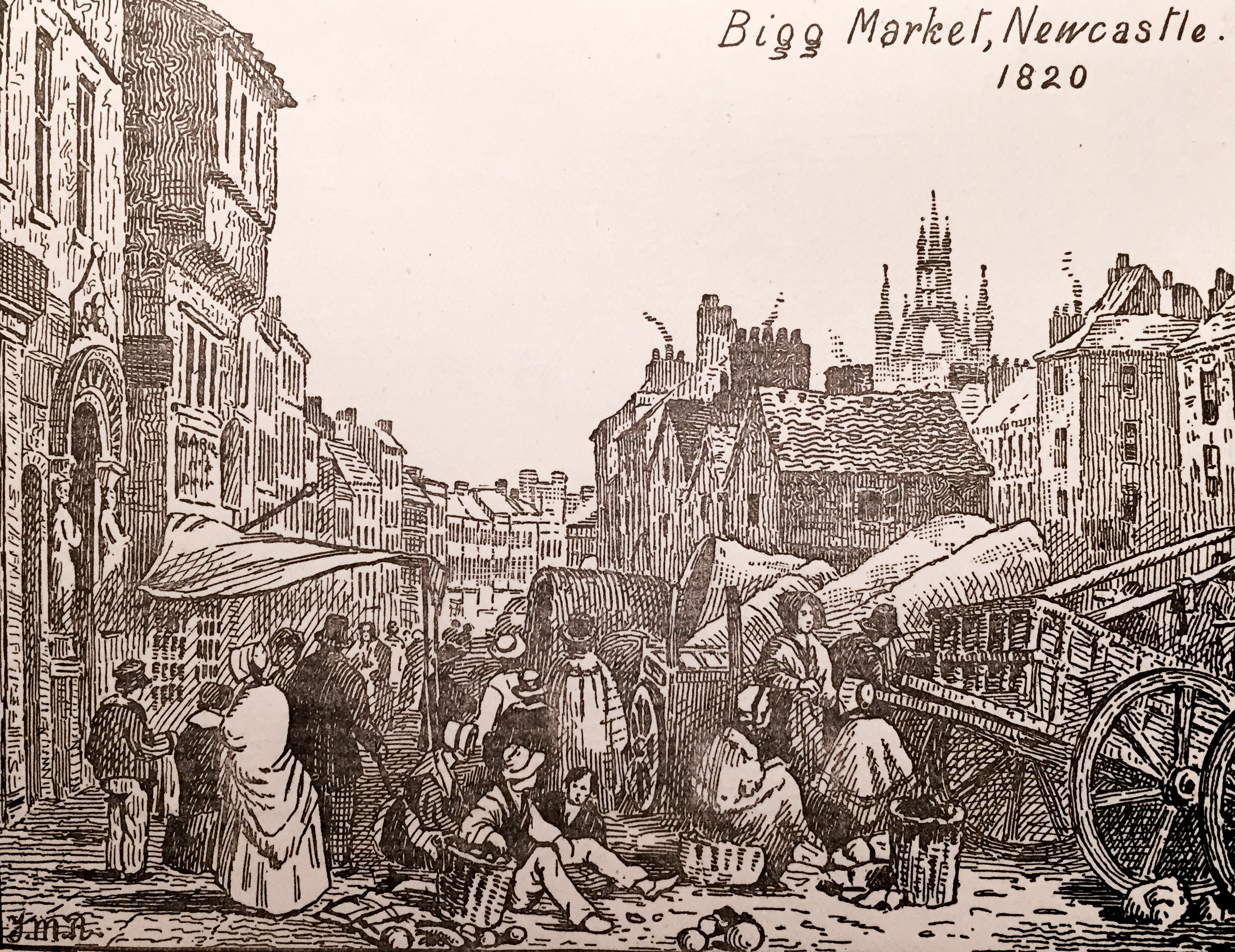
Bigg Market, Newcastle, 1820

When Grainger Street was extended along the line of St. John’s Lane to the Central Station, several houses in the Bigg Market were pulled down. In this way the ancient hostelry of the Fighting Cocks which gave its name to the pant that stood just in front of it, disappeared. On the same side were the Unicorn and the Golden Lion—ancient inns both of them; these also have disappeared. Gone, too, is the Old Turk’s Head, nearly opposite the Fighting Cocks, and described by Mackenzie as “a very commodious, well-conducted house, having the largest public room in the town attached to it”. With these old inns have disappeared also from the neighbourhood those ancient stone steeps provided for the help of travellers in mounting their horses. Gone also are the tubes for extinguishing the flambeaux, or links, which at one time it was the custom to carry for the assistance of pedestrians on dark nights. The last of these useful tubes in Newcastle was to be seen some few years ago at the right hand side of the door of a private house afterwards converted into Dickinson’s tobacco establishment. In this respect, at any rate, “the light of other days” has vanished from the Bigg Market for good and all.

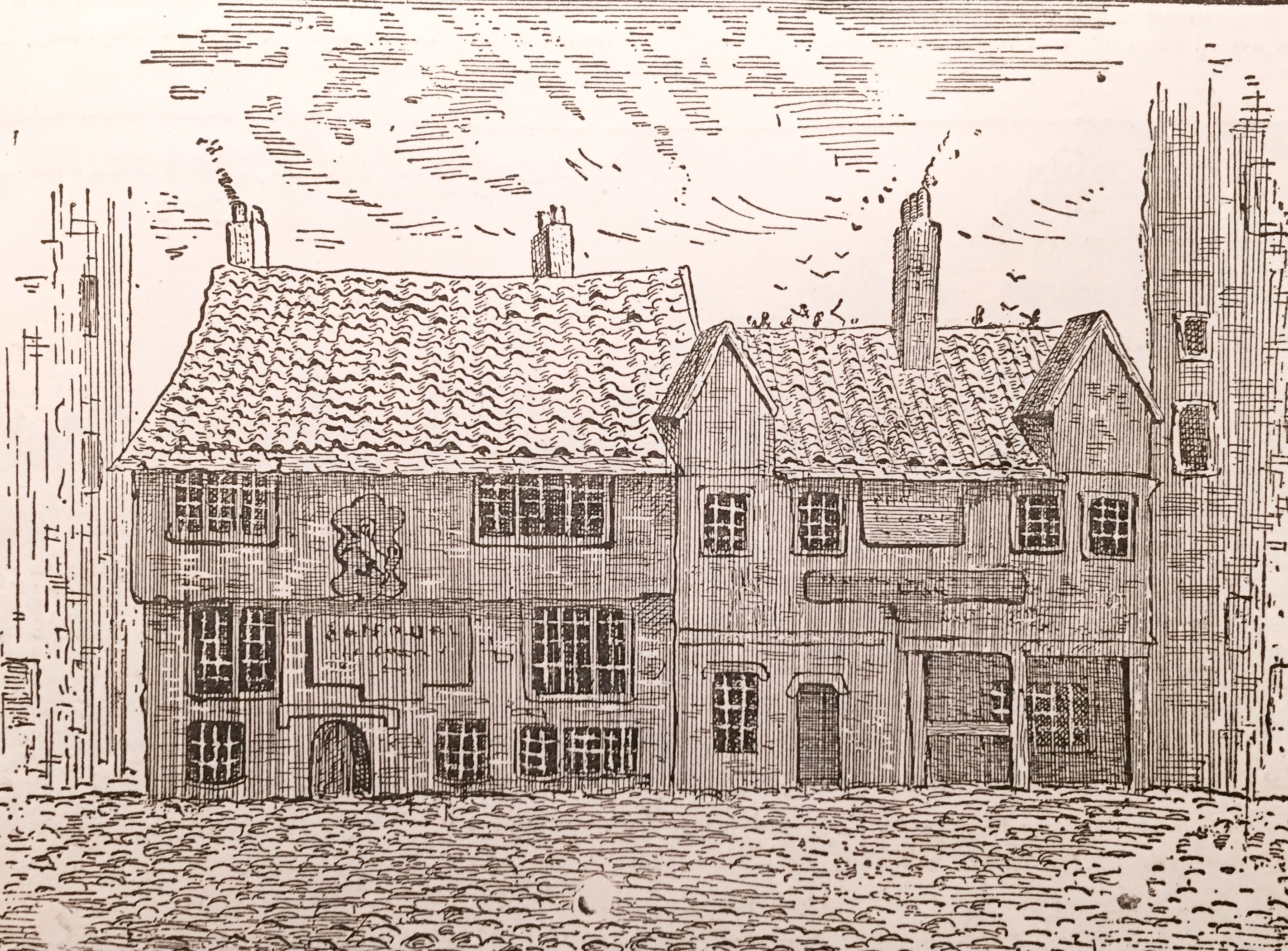
The Fighting Cocks Yard, Bigg Market, Newcastle, 1846Old Inns, Bigg Market, Newcastle, 1843The name Bigg Market simply means that, when it was given, this was the market for the sale of bigg, a particular kind of barley, properly that variety which has four rows of grain on each ear. It is now out of cultivation in England, and almost so in Scotland. But the street was also at one time called the Oat Market. It is now devoted to the sale of live poultry, rabbits, eggs, bacon, and butter on the mornings of Thursday and Saturday. There was a market for poultry also near at hand in the High Bridge at one time; “there are still,” Dr. Bruce tells us, “some remains of the piazza in which it was held.” This mart was called the Pullen Markets.

On the right hand, as we go down the street, we come to the Pudding Chare, near the corner of which stood the famous book shop of the Charnleys. The word chare, as we know, means simply a narrow lane. It is derived by some from the Saxon “cerre,” diverticulum, the turning or bending of a way. Brockett derives it from the Saxon “cyrran,” a turning. Others have it that it is simply the corruption of the word “ajar,” partly open. The story has often been told of the witness in a criminal case tried at one of our assizes, who said that “he saw three men come out of the foot of the chare.” Quoth the judge, pityingly, “Gentlemen of the jury this evidence is worth nothing. The witness cannot be in his right senses. How can a man, much less three men, come out of a chair foot?” But the jury assured my lord that they knew exactly what the witness meant and the case proceeded.

At one time there was a fine view of St. Nicholas’ Church from the Bigg Market. But the authorities chose to erect a huge Town Hall just in front of the grand old church. A terrible eyesore it has always been to many amongst us native and to the manner born. Its merits were some years ago tersely summed up in the satirical words: “We’ve got a corn market where we shiver with cold; a hall where we can’t hear anybody’s speech; and an organ that won’t play.” To erect the Town Hall the Corporation had to knock down Middle Street, Union Street, &c., and so went by the board some interesting specimens of old Newcastle. There were two rows of timbered and gable-ended houses. “They were low,” says the Rev. Dr. Bruce, “and perhaps, according to our modem notions, inconvenient, but they were highly picturesque.” As to the hall itself, the worthy doctor dismisses it with the dry remark that it is “a huge pile of buildings of modern erection, which greatly impedes the traffic of the street, and almost wholly obscures the view of St. Nicholas’.” The doctor is not alone in his evident dislike to the building. Several of our local satirists have had a shot at it now and again, just as an elder bard had lamented the destructiveness of the Corporation: –

Oh, waes me for wor canny toon,

It canna stand it lang –

The props are tumbling one by one,

The beeldin’ seun mun gan.  

A poet thus criticises the internal arrangements: –

A fine new Toon Hall there’s lately been built, Te sewt mountybank dansors an’ singors; It’s a sheym the way the munny’s been spilt, An wor Cooncil hez sair brunt their fingurs; For the room’s dull an cawd, tee, an’ ghostly an’ lang, An thor fine organ’s not worth a scuddick; An’ if frae the gallery ye want te heer a fine sang, Wey, ye might as weel be in a keel’s huddick.

Another critic is impressed with the appearance of the building from the north. “Looked at from the Bigg Market, the entire pile has a most mean and beggarly appearance. A terminating tower has been erected at the extreme north, which suggests the idea of a pigeon-ducket. An aperture has been left apparently for a clock, which would certainly be of considerable use in that quarter. But our Corporation always ‘finds it much easier to project than to carry out.” This critic is some what severe, but certainly the Bigg Market end of the New Town Hall is — well, not very impressive!

A third writes on the same subject as follows: –

THE CLOCKLESS CLOCK TOWER.

Aloft I raise my head in air,

High o’er Bigg Market and its pant,

Proclaiming to the world my want

As down I look on Pudding Chare –

A want so plain that all may see;

And as they gaze, the passers-by

To fish’s head without an eye

Compare the empty pate of me!  

How many thousand pounds were spent

On me is more than I can tell;

But this I know, and know too well –

The public use which I was meant

To serve, I am not like to meet.

There is not left, it seems, so much

Remaining in the old town’s hutch

As would the builder’s work complete.  

Ten thousand’s gone, there can’t be got

A hundred pounds the clock to buy;

An idle, wasted thing am I,

And on this busy town a blot.

‘Tis true I am “a thing of beauty,”

But I shall have no “joy for ever,”

If I, a silent tower, am never

Allowed to do my proper duty.  

Is there no councillor will rise

And in the Council Chamber ask

Why I’m not made to do my task

In all men’s ears, to all men’s eyes?

I fain would strike and show the hour –

Not made for ornament alone,

Like many another handsome drone: –

Save from that fate

The Town Hall Tower

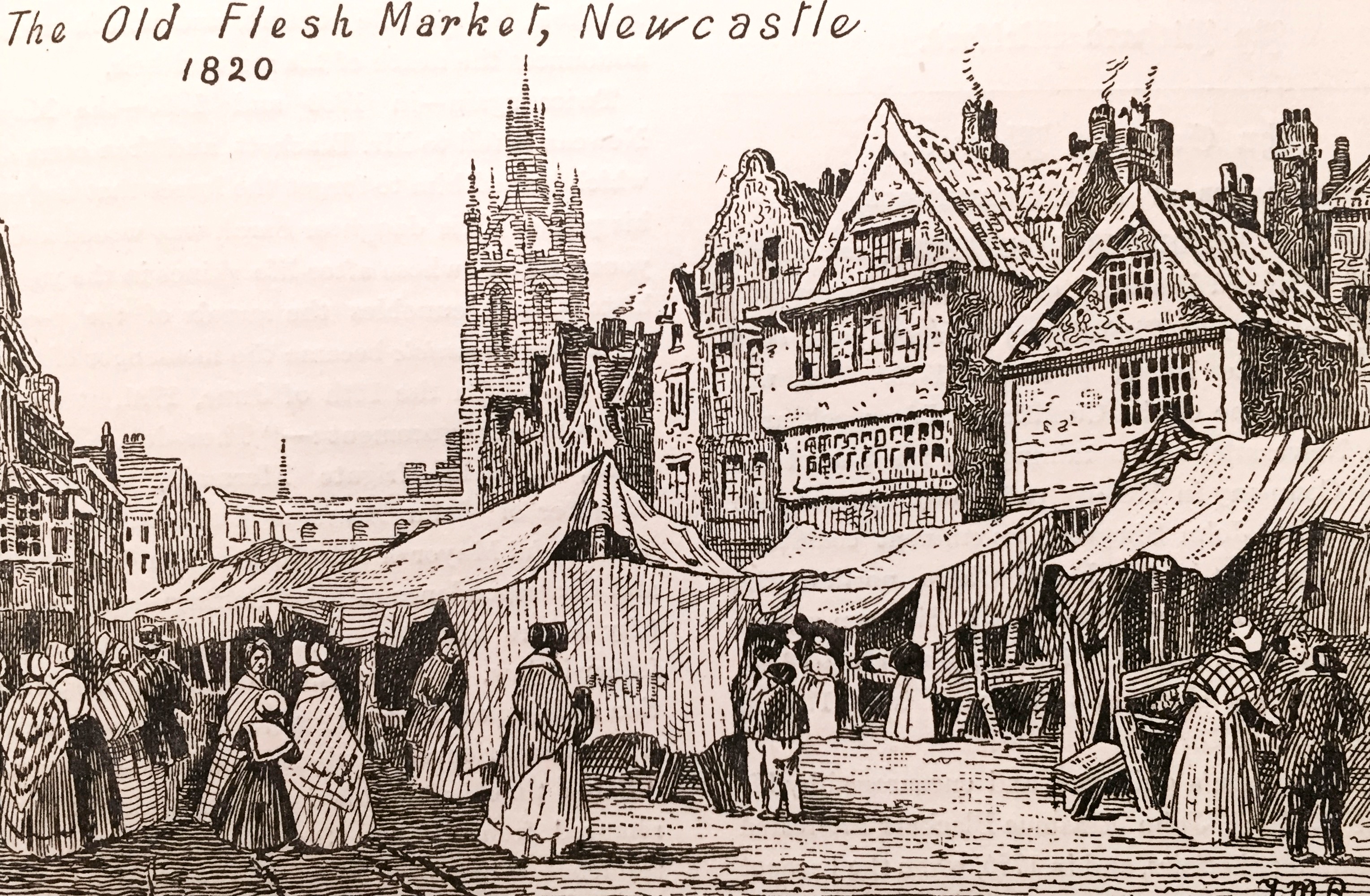
Having, then, this huge building in front of us, we must perforce tarry yet in the Bigg Market, whilst we look ahead and see what is before us, “in the mind’s eye, Horatio.” It stands, as we have said, on the site of what once was Middle Street. To our right is the Groat Market; the Cloth Market is on our left. Middle Street had formerly three names. Its upper part was called Skinner Gate; its lower parts Spurrier Gate and Saddler Gate. Bourne says of it :”It is a street as it was in Gray’s time, where all sorts of artificers have their shops and houses.” In particular, shoemakers much affected this street in former years. On the left hand of Middle Street was the Old Flesh Market, which consisted mostly of low old houses. The butchers were wont to erect their shambles here, each Friday night, for the next day market.

Cuthbert Ellison, founder of the great local family of that name, lived and pursued his calling of a merchant hereabouts. In the closing days of February, 1556-57, he was bidding farewell to municipal honours (he had been Sheriff and twice Mayor), and dividing his worldly goods among his family. “To my son, Cuthbert Ellison, my house, with the appurtenances, in Newcastle, in the Bigg Market, wherein I do now dwell.” “To my daughter, Barbara Ellison, my house, &c, in the Middle Street of Newcastle aforesaid.” So runs the record. A dozen years later, Barbara became the wife of Cuthbert Carr, of Benwell. She was married from the family dwelling place, and they had high festivities there, ending in a quarrel between some of the guests, and a charge of defamation in the Ecclesiastical Court at Durham.

Of the Old Flesh Market, Bailie writes : — “The market for all kinds of flesh meat, held here every Saturday, is probably the largest and best stored single market of any in the kingdom. A stranger is struck with surprise when he views the long and extended rows of butchers’ stalls, loaded with meat of the richest and most delicious kinds; the mutton, beef, &c., being mostly of the Scotch or Northumbrian breeds, and, gathered on the rich pastures of the graziers in the vicinity of Newcastle, possess a flavour unknown in the more Southern counties.” Mackenzie rarely indulges in humour he respects the dignity of history too much for that; but he unbends for once in mentioning the locality in the following delicious note: — “The Corporation has named this street the Old Butcher Market; but this appellation has been generally rejected, because it is in reality the Old Flesh Market, having for ages been used for the sale of flesh and not of butchers!”

Writing on this subject in the Newcastle Weekly Chronicle recently, Mr. Alderman Barkas tells us: –  “A large portion of the old buildings which formed Middle Street and Union Street were pulled down to make room for a new Corn Market, which was built by the Corporation in 1830 at an expense of about £10,000. Prior to that date Mr. Richard Grainger, who found Newcastle crumbling bricks and left it stone, offered the Corporation the freehold and exclusive use of the newly built Central Exchange Art Gallery, on condition that it should be used as a corn market. Mr. Grainger, I am informed, also promised to rebuild the front elevations of the houses in the Groat Market and the Cloth Market in a Gothic style of architecture, and remove all the old buildings in Middle and Union Streets, and thus open a magnificent area in the centre of the town. This, as it now appears, generous offer on the part of Mr. Grainger was rejected in the Council by 32 votes to 17, after a long discussion, and during the mayoralty of Mr. Joseph Lamb, October 4, 1837.”

Elsewhere in the same journal Mr. Barkas said:— “A new Butcher Market was opened on the 28th of February, 1807, and from that time the Flesh Market was known as the Old Flesh Market. Market Lane, now a cul de sac in Pilgrim Street, led into this new Butcher Market, which extended from the foot of Market Lane to the large open space in front of Watson’s foundry in the High Bridge, and down to Mosley Street, near the old Theatre Royal, and would thus cover a great deal of ground.”

The Old Flesh Market, Newcastle, 1820The sketches which accompany this article will enable the reader to form some idea of the ancient appearance of the Bigg Market and its neighbourhood. Fighting Cooks Yard is shown in the first of these sketches, while two other old inns which stood alongside it — the Unicorn and the Golden Lion — are represented in the second. Both sketches were made or copied by Mr. R. J. McKenzie. The views of the Bigg Market and the Old Flesh Market as they were seen in 1820, are copied from T. M. Richardson. Pudding Chare will be noticed on the right hand of the first, with the old houses opposite which then formed Union Street. As for the Old Flesh Market, we may gather from Richardson’s sketch of it that it must have been in his time one of the most picturesque corners of old Newcastle.

Near the Grainger Street end of the Bigg Market, and on the left hand side going to St. Nicholas’ Church, a handsome gateway (shown in Richardson’s sketch) led into Farrington’s Court. The Farrington Brothers were cabinetmakers, and for many years had their showrooms and workshops here. The brothers were excellent specimens of the old tradesmen of Newcastle, men of great honesty and integrity. They were both bachelors, and the latest surviving brother, when on his death-bed, sent for Mr. Fenwick, attorney, to make his will. There were present at the time the doctor, the attorney, and his old foreman, Mr. Kinnear. When asked to whom he intended to bequeath his property, he told the gentlemen present that, as he had no near relatives, they had better divide it amongst themselves, which was accordingly done.

The Streets of Newcastle – The Side

The SideThe SideOur illustrations of the Side, or rather the reminiscences they are calculated to awaken, carry us back to a period in the history of Newcastle when the commerce of the town had for its arena not the Tyne itself, but the Lort Burn, a stream which, according to Grey’s “Chorographia,” was navigable to the very doors of the Cloth Market, in the line of Dean Street and Grey Street, as far as the High Bridge. “In after times,” Grey adds, “the merchants removed lower down towards the river, to the street called the Side and the Sandhill, where the trade remaineth to this day.” This was penned in the seventeenth century, and a hundred years later, we learn from Bourne, the Side was “from one end to the other filled with shops of merchants, goldsmiths, milliners, upholsterers, &c.” Still another hundred years passed away, and we find Mackenzie, in 1827, speaking of the ascent being very steep; and “this, added to its extreme narrowness, and the dingy houses on each side, projecting in terrific progression, rendered the passage inconceivably gloomy and dangerous. Yet, before the erection of Dean Street, it formed the principal communication with the higher parts of the town.” At this date, we read, it was mostly inhabited by cheesemongers.

Hearing in mind the fact that the Lort Burn flowed down by the High Bridge, the Low Bridge, and the Sandhill, the origin of such names as Dean Street is easily explained. But the name of the Side, unless it be the side or steep bank of a river, has long been a source of perplexity.

There is a traditionary story of a stranger who, receiving a Newcastle letter dated “Head of the Side,” took it to be a slip of the pen, and wrote back: to the “Side of the Head” the Saracen’s or some other Head, as he imagined.

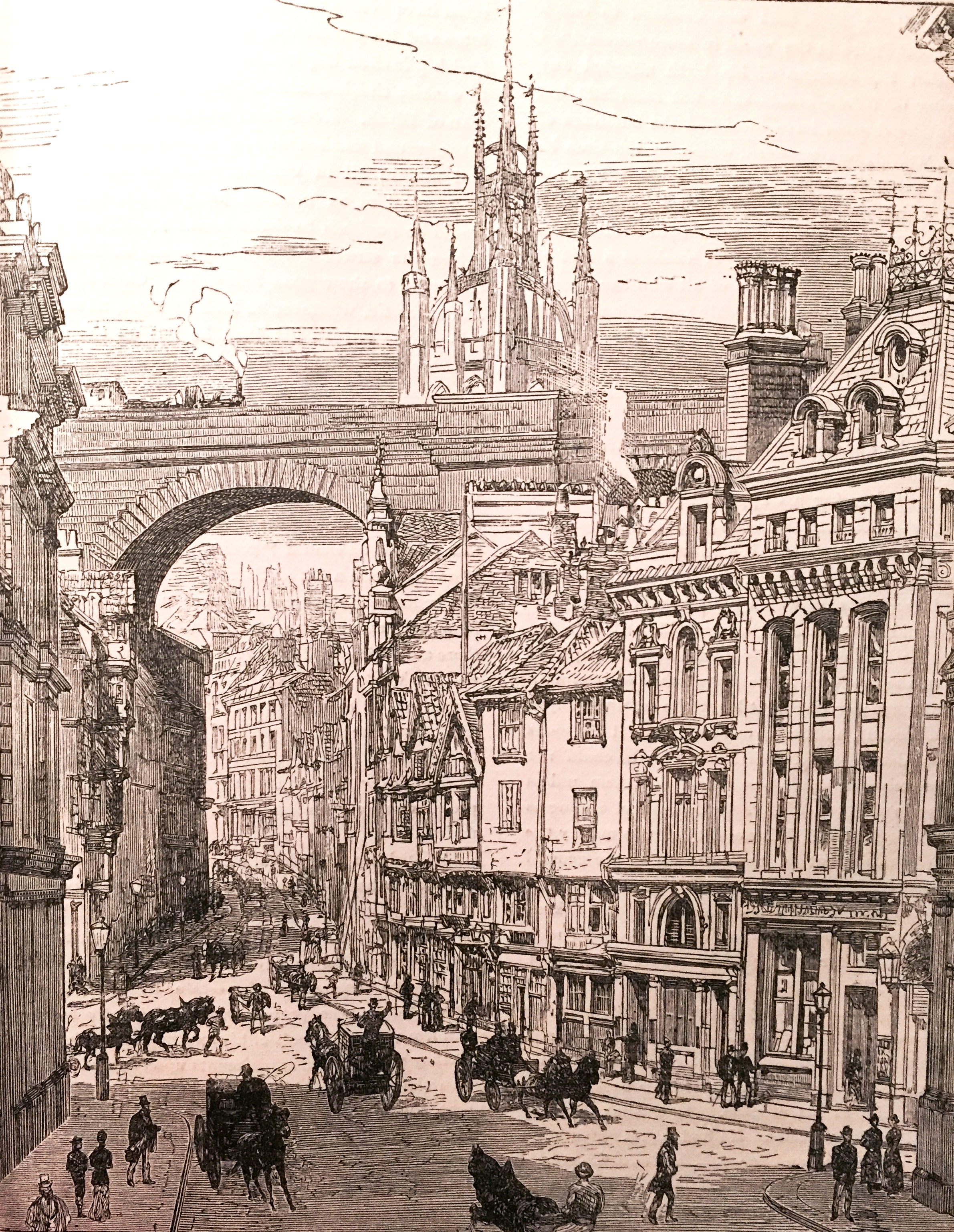
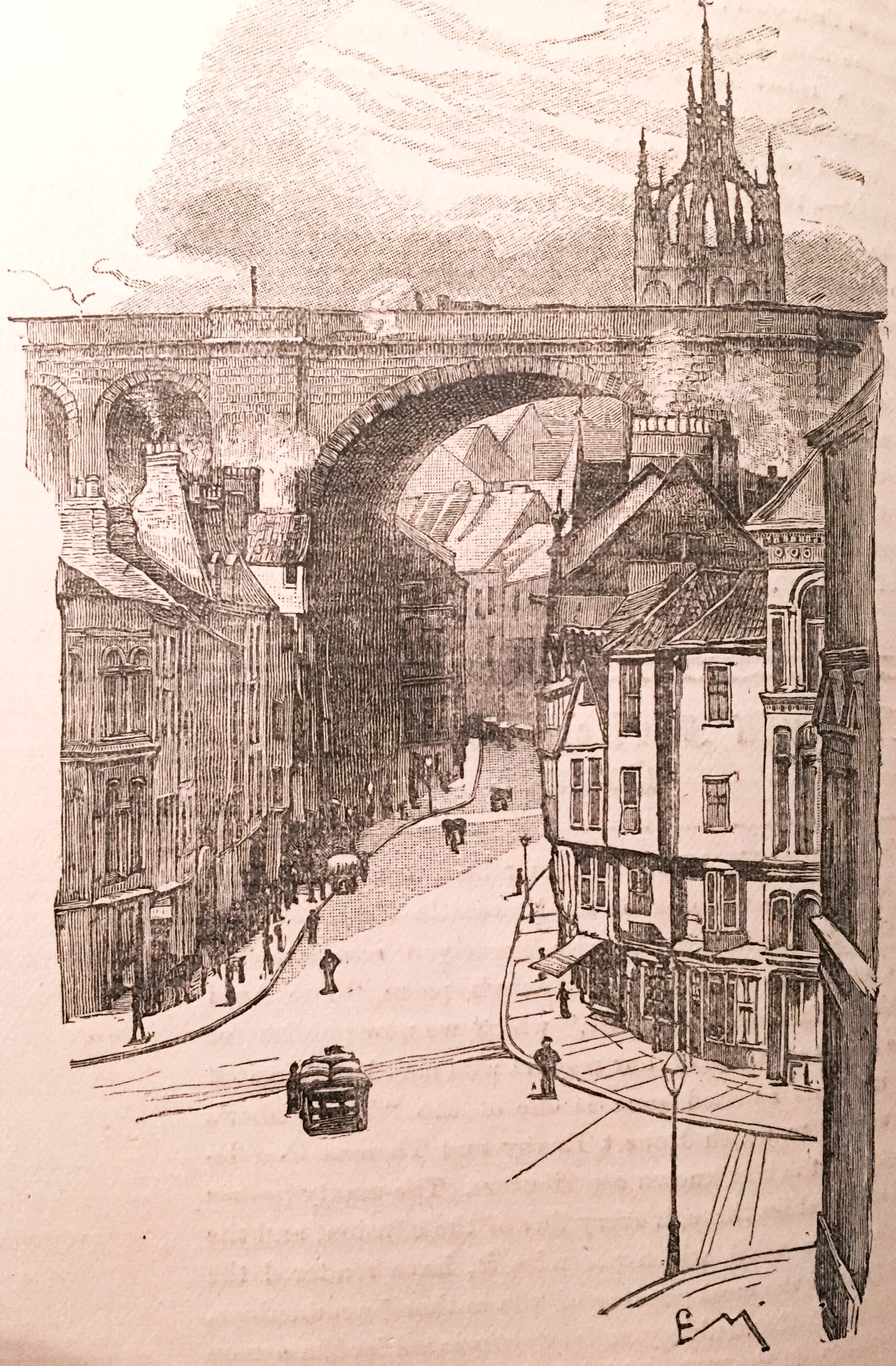
The Side as we know it is vastly altered; indeed, our view, one of which is taken from the entrance to Queen Street, looking towards the Old Grapes Hotel, represent a scene which is undergoing a constant process of change. Dean Street, spanned at the foot by the imposing Railway Arch, has invaded it, and year by year old buildings give place to new; yet some of the projecting houses and gabled roofs still survive to awaken recollections of the time when the; principal traffic of the town passed this way, over the Old Tyne Bridge, and up the steep scent. Here, too, were witnessed State progresses between the English and Scottish capitals. The two illustrations which we give are substantially the same, the only difference being that the one represented with little or no traffic is taken from a higher elevation at Queen Street. Perhaps, with the lantern tower of St. Nicholas’s in the background, it would be difficult to find, in less space, so many distinct architectural features, the peculiarity being that palatial buildings, worthy of the most noble thoroughfares, are here mingled with the picturesque remnants of long ago.

In proof of the interesting historic character of the scene, we may conclude with the following, culled from Grey’s “Chorographia,” that small quarto of a few precious pages printed in the year 1649:

“In the lower part of the street called the Side standeth a faire crosse, with columnes of stone hewn, [the roof] covered with lead, where is sold milk, eggs, butter. In the Side is shops for merchants, drapers, and other traders. In the middle of the Side is an ancient stone house, an appendix to the Castle, which in former times belonged to the Lord Lumleys before the Castle was built, or at least coetany with the Castle.”

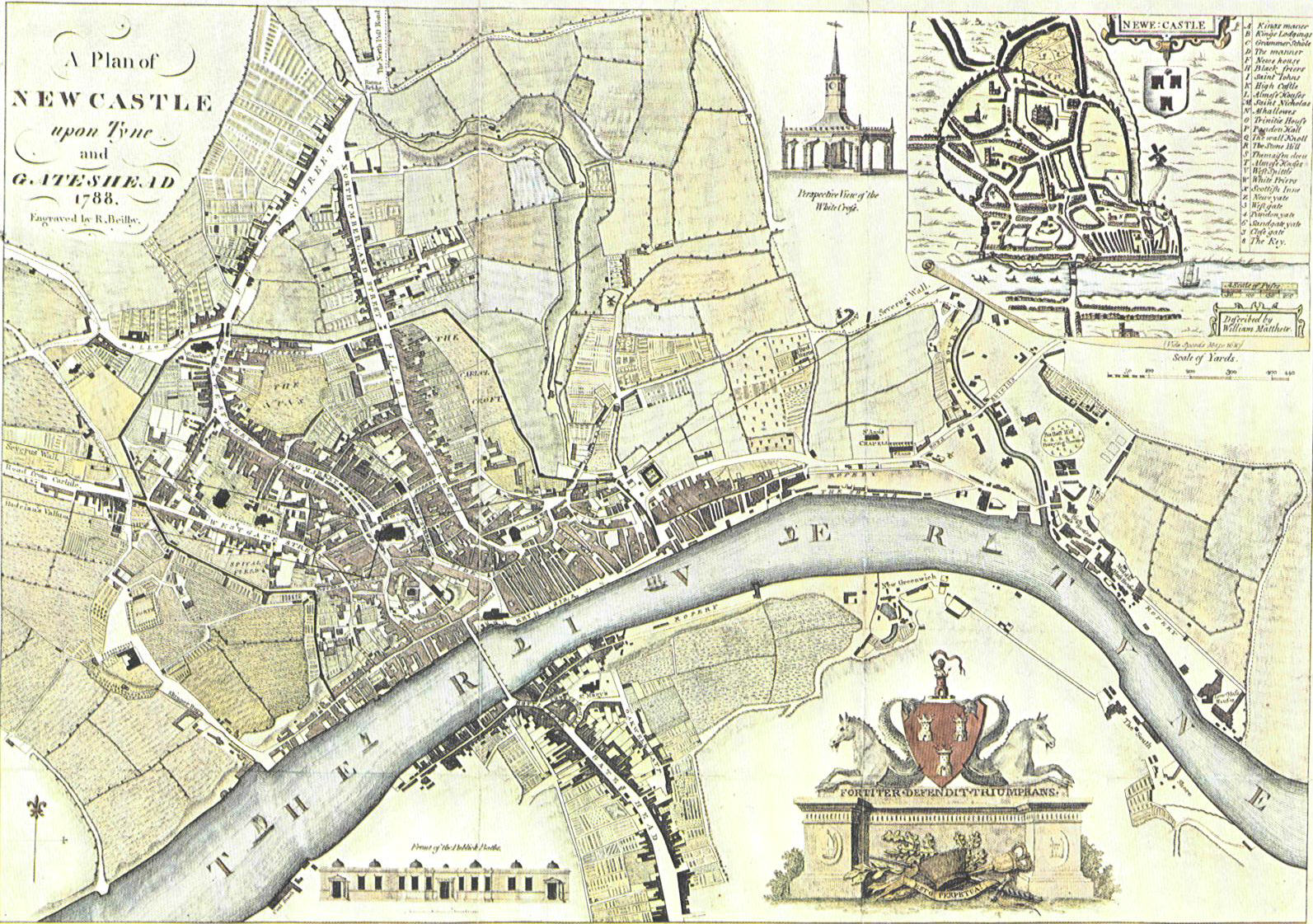
Vol 2 – No.11 – January, 1888 – “The Streets of Newcastle” – Introductory

Map of Newcastle 1788The ancient town and county of Newcastle-upon-Tyne is interwoven with the political, ecclesiastical, military, and social records of the country. Shaven priests have chanted their psalms in its streets; grim soldiers have bivouacked in its impromptu barracks; kings are associated with its history, sometimes as conquerors, sometimes as captives; scholarly men have in quiet pursued their labour in seclusion at one period; fierce mobs have rejoiced, after their fashion at another, the while the red wine ran like water through its gutters. Truly, a wonderful microcosm is this good old town and county of ours. Now, its history is written in its streets; and yet it is not too much to say that many of its inhabitants know comparatively little about them. It may not be amiss, then, for us to survey, with the mind’s eye, and with the aid of patient historians of the past, some of the more interesting highways and by-ways whose pavements we so often unthinkingly tread.

We shall find much to interest, something to amuse, not a little to appal, in the record we propose. Old traditional forms may seem to start again into shadowy life. Roger Thornton, for instance, Newcastle’s great benefactor in the middle ages, cannot be forgotten as we wander up and down the Westgate or study the busy life of the Sandhill. Eldon, Stowell, and Collingwood will revisit us again. Friars of all colours, black, white, and grey, will return to the scene of their former labours. The ancestors of our county families of today will look pridefully on the quaint old shops and warehouses where they laid, by honest toil and skill, the foundations of their families’ prosperity. In the mind’s eye we shall note honest sportsmen carrying along our ancient streets the heads of foxes slain within one or other of the four great parishes of Newcastle, to nail them to the church door, and receive for so doing a shilling a head. We shall discover that the great ones of the past were very human; that Bishop could wrangle with Mayor, and Mayor with the Queen’s Justice of Assize; and that even the sacred person of the Town Clerk could not escape buffets at times. We shall note, moreover, that in the olden days kind hearts beat under sober coats, as well as under the gay trappings of others in authority. Unfortunately, we shall find also that the charities founded by these benevolent ones have, in some cases, been swept away for good and all. We shall wend our way in the company of pilgrims to the shrine of the Virgin at Jesmond, and anon watch a melancholy procession set forth with a criminal from the Castle, by way of the Back Row, to the West Gate, there to be unceremoniously done to death. Another grim procession shall we note from time to time on its way to the Town Moor, and so giving cause for the ugly name of Gallows’ Gate. Again, we shall find that our citizens of old were not averse to hard blows, and that their Mayors had enough to do to keep them in good order. We shall peep, too into the books of the incorporated companies, and remark their quaint devices for the due ordering of trade. As we stand on the site of our ancient markets, we shall note how Acts of Parliament sought to regulate their prices in the days of old, and how unavailing all such interference was.

Especially shall we observe how certain districts of Newcastle scarce known to ears (and noses) polite were of brave reputation in the olden time. In the neighbourhood of Pandon was the burial place of the Northumbrian kings, “an acre sown with royal seed.” Royalty had its temporary abode in this district when going to and from Scotland. Charles I. was for nine months a prisoner in Pilgrim Street, whence he unsuccessfully endeavoured to make his escape, and where at last he was given up to the Scots for £400,000, whilst playing at chess. Oliver Cromwell dined at Katy’s Coffee-House on the Sandhill, when going to or returning from Scotland. James II’s statue was unceremoniously kicked into the Tyne on the arrival of William of Orange, while the coronation of George IV. was celebrated by a drunken saturnalia. We shall see, too, how the town has been gradually changed in character — by water (as at the time of the great flood in 1771); by fire (as in 1854); by the enterprise of builders; by corporate negligence; and by the advance of civilization.

In fine, it is impossible to wander through the streets of Newcastle without coming upon suggestive contrasts of the past and present. Here the Britons have congregated to stem the tide of invasion, and to receive the blessing of the Druids. Saxons and Danes have contended here. The polished Romans have left their impress here, deeply marked. The cannon of Newcastle has thundered against the legions of the Solemn League and Covenant; and fierce was the fight between the combatants. Those times are past and gone now; yet still we may not unprofitably consider from month to month, as we propose to do,

The memories and things of fame.

That do renown this city.

Thanks Again!

Thank you (again) to everyone who has read, liked and shared these stories. I’m really enjoying posting these. As always, your feedback is much appreciated. 

I hope you don’t mind but I’ll be concentrating on a single topic over the next couple of weeks or so – “The Streets of Newcastle”. There’s about 30 articles so it’ll keep me going for a bit. Sorry to all the Sunderland people…….you’ll get your fix soon! Hope you like them.

Vol 3 – No.31 – September, 1889 – Durham University

Garden Party in the Castle GroundsOne of the most interesting transactions in the time of the Commonwealth, so far as the North of England was concerned, was the proposed erection of a College at Durham. In 1650, “several persons of fortune” in the city and county of Durham, the county of Northumberland, and the town and county of Newcastle-upon-Tyne, addressed the Lord Protector, Cromwell, setting forth the disadvantages arising from the great distance of this part of the country from Oxford and Cambridge, and praying that the houses of the dean and prebendaries, which were going to decay, might be converted into a college for the instruction of youth. Cromwell’s answer came from Edinburgh, just before the “crowning mercy” of Dunbar. He highly approved of the suggestion, which he recommended to Parliament in a letter to Lenthall, the Speaker, in which he said it was “a matter of great concernment and importance which (by the blessing of God) might much conduce to the promoting of learning and piety in these poore, rude, and ignorant parts, there being also many concurring advantages to this place, as pleasantness and aptness of situation, healthfull aire, and plenty of provisions, which seeme to favour and plead for theire desires therein.” “And besides the good, so obvious to us, which those Northern Counties may reap ‘thereby, who knows,” continued the Protector, “but the setting on foot this work at this time may suit with God’s present dispensations, and may, if due care and circumspection be used in the right constituting and carrying on the same, tend to, and by the blessing of God produce, such happy and glorious fruits as are scarce thought on or forseen.” The subject was again pressed upon the Parliament in the following year, by petition from the grand jury at the Durham county assizes; and thereon a committee of the House reported “that the said houses (of the Dean and Chapter) were a fit place to erect a college or school for all the sciences and literature.” It was not, however, till 1657 that “Oliver, Lord Protector of the Commonwealth of England, Scotland, and Ireland, and the dominions thereto belonging,” issued his letters patent for the erection of the new college. It is a remarkable document, showing no small skill on the part of its author. A synopsis of the proposed constitution, which is too long to give here, may be found in the Rev. J. L. Low’s “Diocesan History of Durham.” That gentleman says: “It was in many respects an admirable scheme, not the least of its merits consisting in giving an interest to the nobility and gentry in carrying it out. “But the new college soon excited the jealousy of the ancient Universities, both of which protested against its establishment, and particularly against the power of conferring degrees being granted to it. This protest would have had no weight with the Lord Protector, but his death unhappily prevented the completion of the scheme. The provost and fellows of the new institution made application to his son and successor, Richard, for power to carry it out, alleging that it had been “left au orphan scarce bound up in its swaddling clothes,” though it had been “planted by a hand which never miscarried in any of its high and magnanimous achievements.” But, as. is well known, Richard’s power lasted only a very short time; and at the Restoration, the new seminary, from which so much good was expected, shared the fate of the Commonwealth itself.

It is a singular fact that George Fox, the founder of the Society of Friends, assumed to himself the consequence, and what he sincerely thought the merit, of having been the means of preventing Durham becoming the seat of a University during the interregnum. He tells us in his journal that, when he came to Durham in 1567, he found a man there who had come down from London “to set up a college there to make men ministers of Christ, as they said.” And he goes on to say: “I went with some others to reason with the man, and to let him see that to teach men Hebrew, Greek, and Latin, and the seven arts, which was all but the teachings of the natural man, was not the way to make them ministers of Christ; for the languages began at Babel; and to the Greeks, that spake Greek as their mother-tongue, the cross of Christ was but foolishness; and to the Jews, that spoke Hebrew as their mother-tongue, Christ was a stumbling-block; and as for the Romans, who had the Latin and Italian, they persecuted the Christians; and Pilate, one of the Romans, set Hebrew, Greek, and Latin a-top of Christ when he crucified him; and John the Divine, who preached the Word that was in the beginning, said that the beast and the whore had power over tongues and languages, and they are as waters.” Thereupon said he to the man: “Dost thou think to make ministers of Christ by the natural and confused languages which sprang from Babel, are admired in Babel, and set a-top of Christ by a persecutor? Oh, no! So the man confessed to many of these things, and, when we had thus discoursed with him, he became very loving and tender, and after he had considered further of it, he never set up his college.”

After a lapse of one hundred and seventy years, the idea of a Northern University was revived. Bishop Van Mildert, the last of the prince-bishops who filled the see of St. Cuthbert, in conjunction with the Dean and Chapter, made application to Parliament in 1832 for leave to appropriate lands for the foundation and maintenance of a University, for the training of divinity students and conferring degrees in other faculties. The application was successful, and the Dean and Chapter were empowered to give up for this purpose an estate at South Shields of the net annual value of £1,710. The Bishop also gave temporary assistance to the extent of £1,000 for the first year, and of £2,000 for subsequent years, until his death in 1836. Besides these benefactions, his lordship gave up the Castle of Durham, for the use of the one college of which the foundation at first consisted. But the intentions of Dr. Van Mildert respecting the endowment were not for some years fully carried out, in consequence of the appointment in 1833 of the Ecclesiastical Commission, whose duty it was to render the property of the Church more available than it had hitherto been in promoting the purposes for which it was intended. In 1841, however, on the recommendation of these Commissioners, an order in council was procured, by which other Chapter estates, situated in the immediate neighbourhood of the city of Durham, and of the average net annual value of £3,700, were made over for the same object. This order attached the office of Warden permanently to the Deanery, and annexed a canonry in the Cathedral to each of the professorships of Divinity and Greek, so that the institution had thenceforward at its disposal a net sum of £5,410 annually, exclusive of the fees of students and other benefactions subsequently made to it.

The University was first opened for the reception of students on the 28th of October, 1833, when forty-five young men were entered upon the books. It consisted at this time of a Warden (Archdeacon Thorpe), a Professor of Divinity (Rev. H. F. Rose), a Professor of Greek (Rev. H. Jenkins), a Professor of Mathematics (Rev. James Carr), and readers in natural philosophy, moral philosophy, chemistry, languages, law, and medicine.

The Act of 1832 had vested the government of the University in the Dean and Chapter, empowering them, with the consent of the Bishop, to frame all necessary regulations for its establishment and continuance. In pursuance of this power, a statute was made in July, 1835, by which the Bishop was declared visitor, and the Dean and Chapter governors, the affairs of the University being ordered to be arranged by a Warden, a Senate, and a Convocation.

In 1837, the work of the institution was completed by a Royal Charter, which made the University a body corporate, with perpetual succession and a common seal. The document was formally received in Convocation, sitting in the magnificent Castle Hall, which was characterised by Sir Walter Scott, on his visit to Durham, as a room which in proportion and beauty was equal, if not superior, to the finest halls in either Oxford or Cambridge. This was on the 8th of June in the above year; and a number of degrees were granted on the occasion.

Convocation consisted originally of the Warden, and of a certain number of doctors and masters in the faculties of divinity, law, medicine, and arts, from the Universities of Oxford and Cambridge. At present it consists of all such persons, besides such of the original members as have been regularly admitted to the like degrees in the University of Durham, and have conformed to the regulations thereof. The Senate, as at present composed, consists of the Warden, the Professors of Divinity, Greek, and Mathematics, the two Proctors, and live other members of Convocation, one of whom is elected by convocation, one by the fellows of the University, one by the Newcastle College of Medicine, and one by the Newcastle College of Physical Science, while one is appointed by the Dean and Chapter.

The University now contains four teaching faculties: those of Arts and Theology being carried on at Durham itself, and those of Science and Medicine at Newcastle-upon-Tyne; and, roughly speaking, the number of students at each place is about two hundred. There are many valuable foundation scholarships, private foundations, exhibitions, fellowships, and prizes attached to the University; and there has been a long succession of eminent professors and tutors, some of whom occupy or have occupied very prominent situations.

The University has the power of founding as many colleges or halls as may be necessary. It contains at present one college and one hall. University College occupies the Castle of Durham and the buildings adjoining. Bishop Hatfield’s Hall, with its chapel, is situated in the North Bailey, and is in near proximity to the Cathedral, Castle, University Libraries, and Lecture Rooms. The members of each society are subject to the same discipline, are under the same tutors, and are eligible generally to the same endowments. The average annual expenses of a student at University College, including those of the University as well as the College, are calculated at £80 to £85; at Bishop Hatfield’s Hall at £70 to £77.

No subscription or test is required of any member of the University, with the exception that no person can become a licentiate in theology, or take any degree in theology, unless he has previously declared in writing that he is bona fide a member of the Church of England as by law established. The public divine service of the University is that of the Cathedral Church of Durham, but no student who is not a member of the Church of England is obliged to attend the services.

There is an excellent library attached to the institution. It was founded by Bishop Van Mildert, and has since been largely increased by the addition of other collections, particularly that of the late Dr. Routh, the learned President of Magdalen College, Oxford, consisting of upwards of 20,000 volumes. It is accommodated partly in the same building as Bishop Cosen’s, which also serves as the Convocation House, and partly in the adjoining building, erected for the Exchequer of the Palatinate by Bishop Neville. With the library of the Dean and Chapter, Bishop Cosen’s, and the University library, few places are better supplied with the means of study and research out of London and the two ancient Universities. There is likewise a Museum attached to the institution, and an Observatory besides.

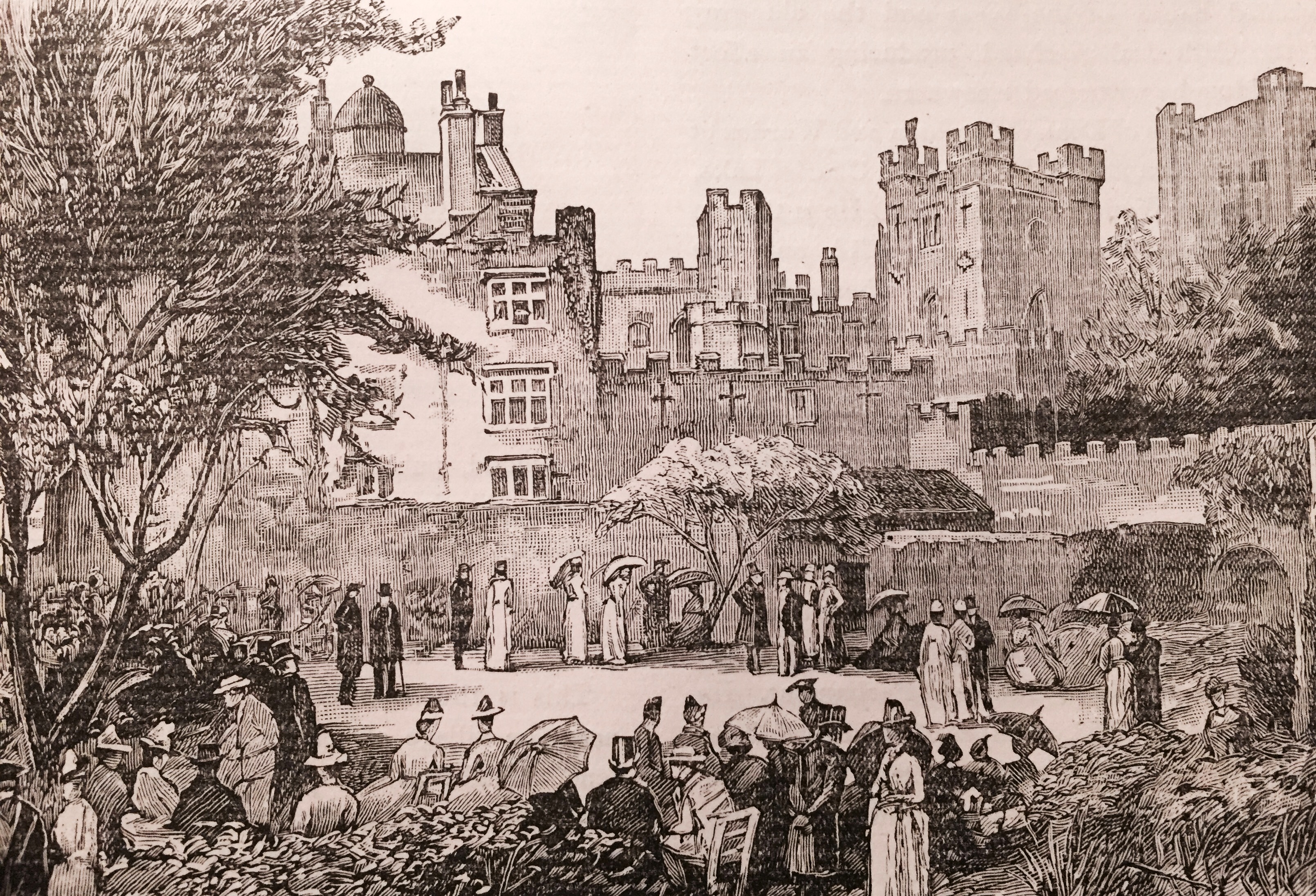
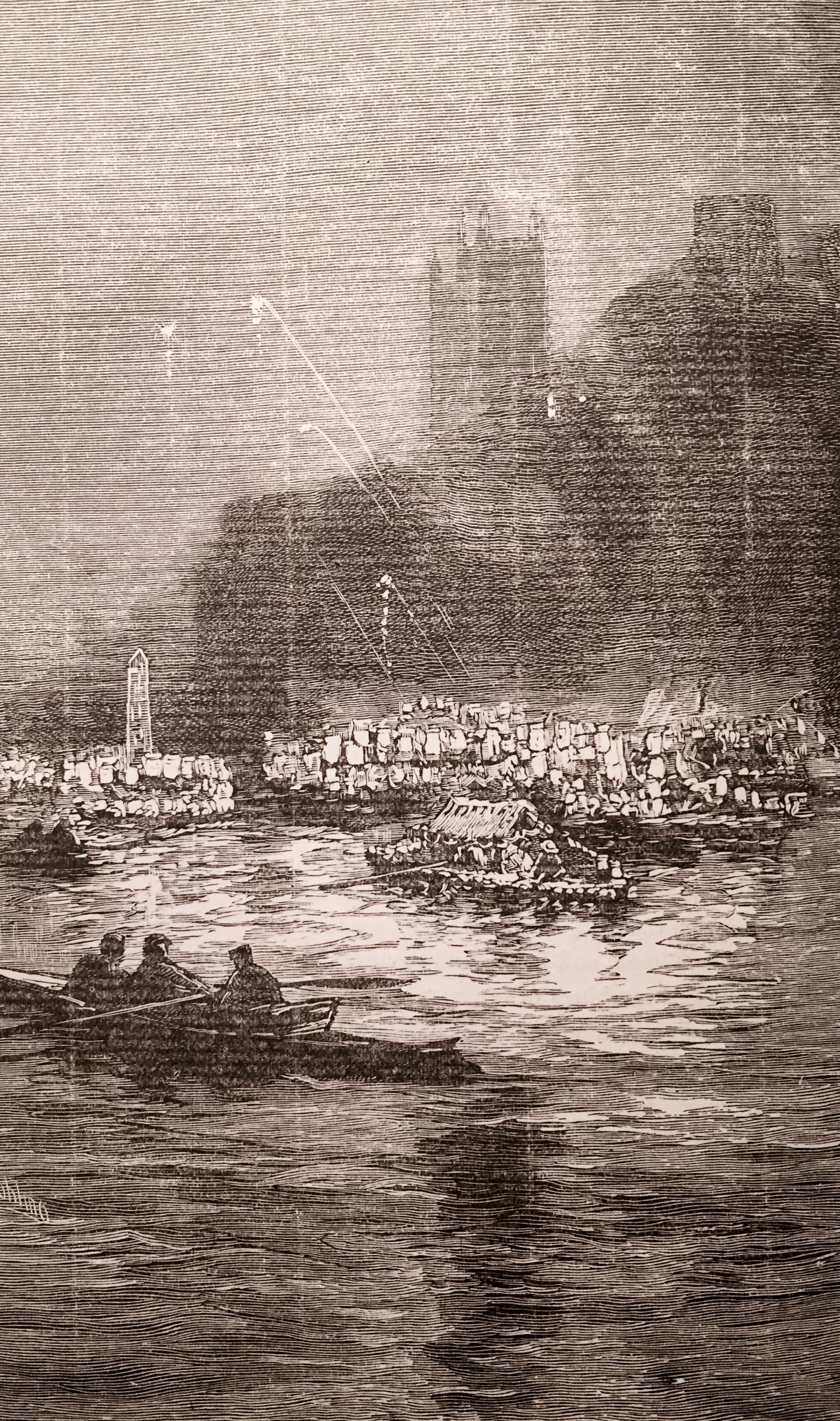
The undergraduates of the University, having this year resolved on holding a Commemoration Day, so as to rid themselves of what they have for some time regarded as a sort of reproach, seeing that Oxford has its world-famous Commemoration, Cambridge its May Week, and every public school in the kingdom its Speech Day and other annual galas, it was duly celebrated on the 24th and 25th of June. Nearly a thousand tickets were issued for the various events connected with it. The proceedings began with a cricket match against Old Harrovians, when the “Varsity ground, the finest in the North of England, presented a very animated and pleasing appearance, being thronged with students in their many-coloured blazers,” and their lady friends in their quite-as-many-coloured dresses. The match had a most exciting finish, and finally ended in a win for the home team by five runs. In the evening, the University concert attracted a large gathering; and next day Convocation was held in the magnificent Castle Hall, which has recently been enriched with a fine oak screen and a dado of oak. The proceedings lasted about an hour, after which there was a garden party in the Castle grounds, at which was present a large gathering of both University and Chapter dons. In the evening, between nine and ten o’clock, there was a procession of boats on the Wear, to see which the townspeople turned out in great numbers; and a pretty sight it was, as the boats, decked with Chinese lanterns and flambeaux, passed and repassed between Hatfield Hull and the Prebend’s Bridge. Several of the gondolas were exceptionally attractive, much ingenuity and skill having been brought to bear on their decoration. The grand massing of the boats took place immediately below the bridge, from which the view was both weird and bewitching. As the craft crowded together, with one containing a representation of Cleopatra’s Needle in the centre, the scene was one blaze of light, whilst the occasional burning of coloured lights, and the sending up of rockets, lit up the wooded banks of the Wear and the old grey towers of the Cathedral overhead, producing an effect such as can seldom be witnessed elsewhere.

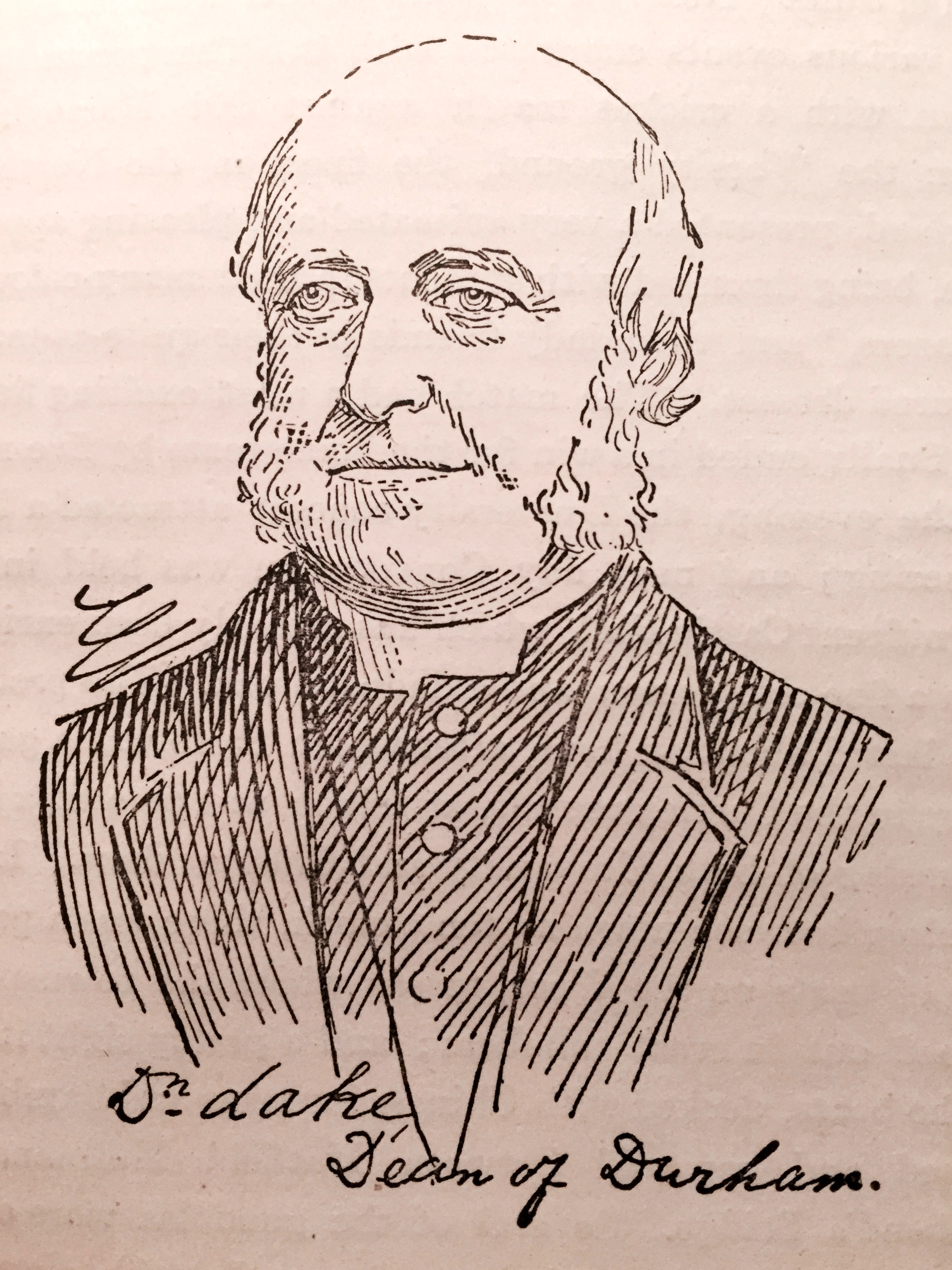
Procession of Boats on the WearThe combined offices of Dean of Durham and Warden of the University are occupied by Dr. William Charles Lake, who succeeded Dean Waddington in 1869. He is the son of Captain Lake, was born in January, 1817, and was educated at Rugby under Dr. Arnold, whence he was elected, in 1834, to a scholarship at Balliol College, Oxford, where he graduated B.A., taking first-class honours in classics. He also obtained the Latin Essay, became fellow, and tutor of his college, proctor, and assistant preacher and public examiner in classics and in modern history. He was appointed by Lord Panmure member of a commission to report on the state of military education in France, Piussla, Austria, and Sardinia, and submitted, in 1856, conjointly with Colonel Yolland, R.E., a report on the subject to both Houses of Parliament. He was again appointed, in 1858, member of the Royal Commission, under the presidency of the Duke of Newcastle, to report on the state of popular education in England. In the same year, he was presented by his college to the living of Huntspill, Somersetshire; and was appointed by the Bishop of London preacher at the Chapel-Royal of Whitehall. On the death of Dr. Waddington, in July, 1869, he was chosen to succeed him. The dean has his residence in the College.

WILLIAM BROCKIE.

Dr William Charles Lake

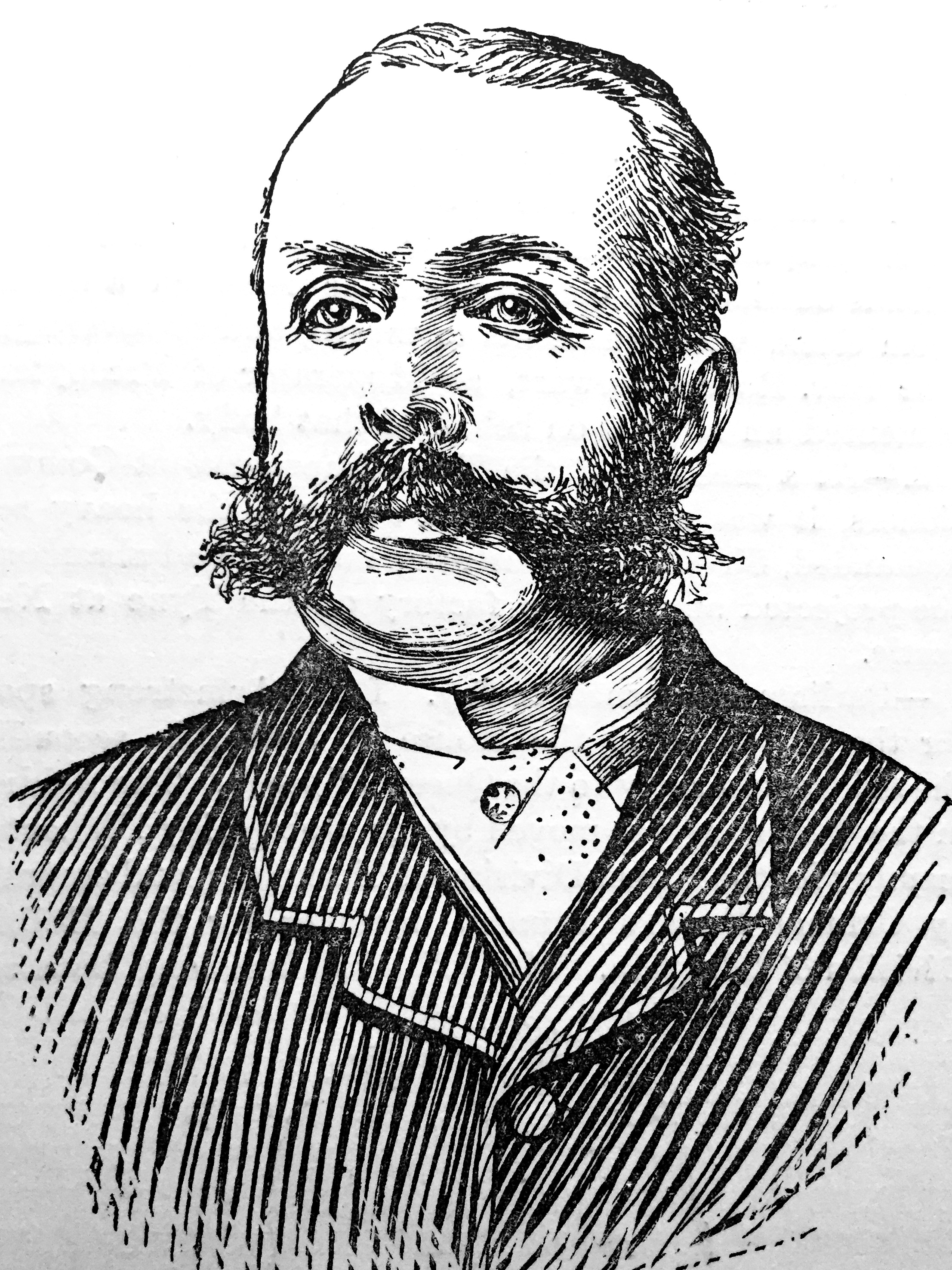
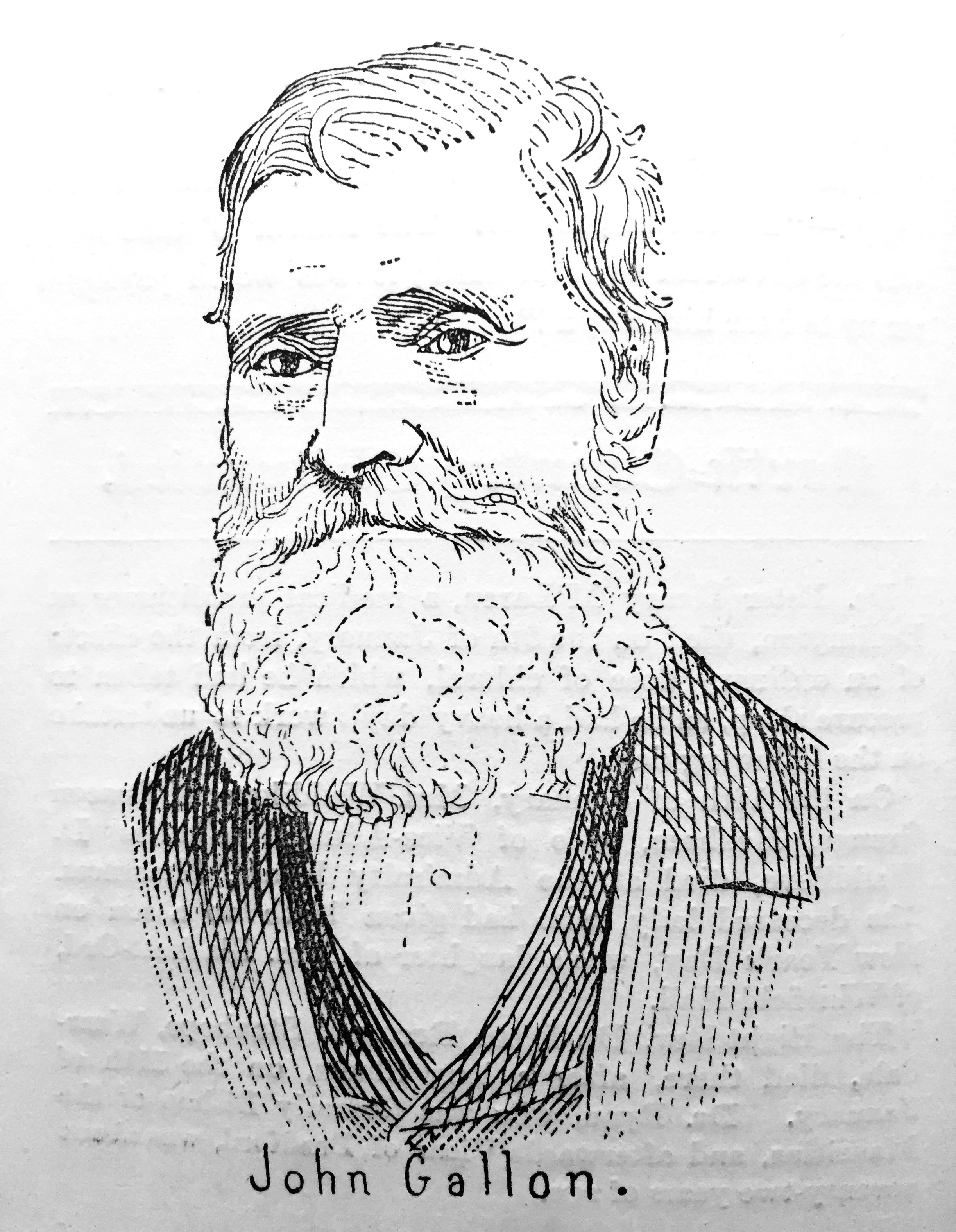
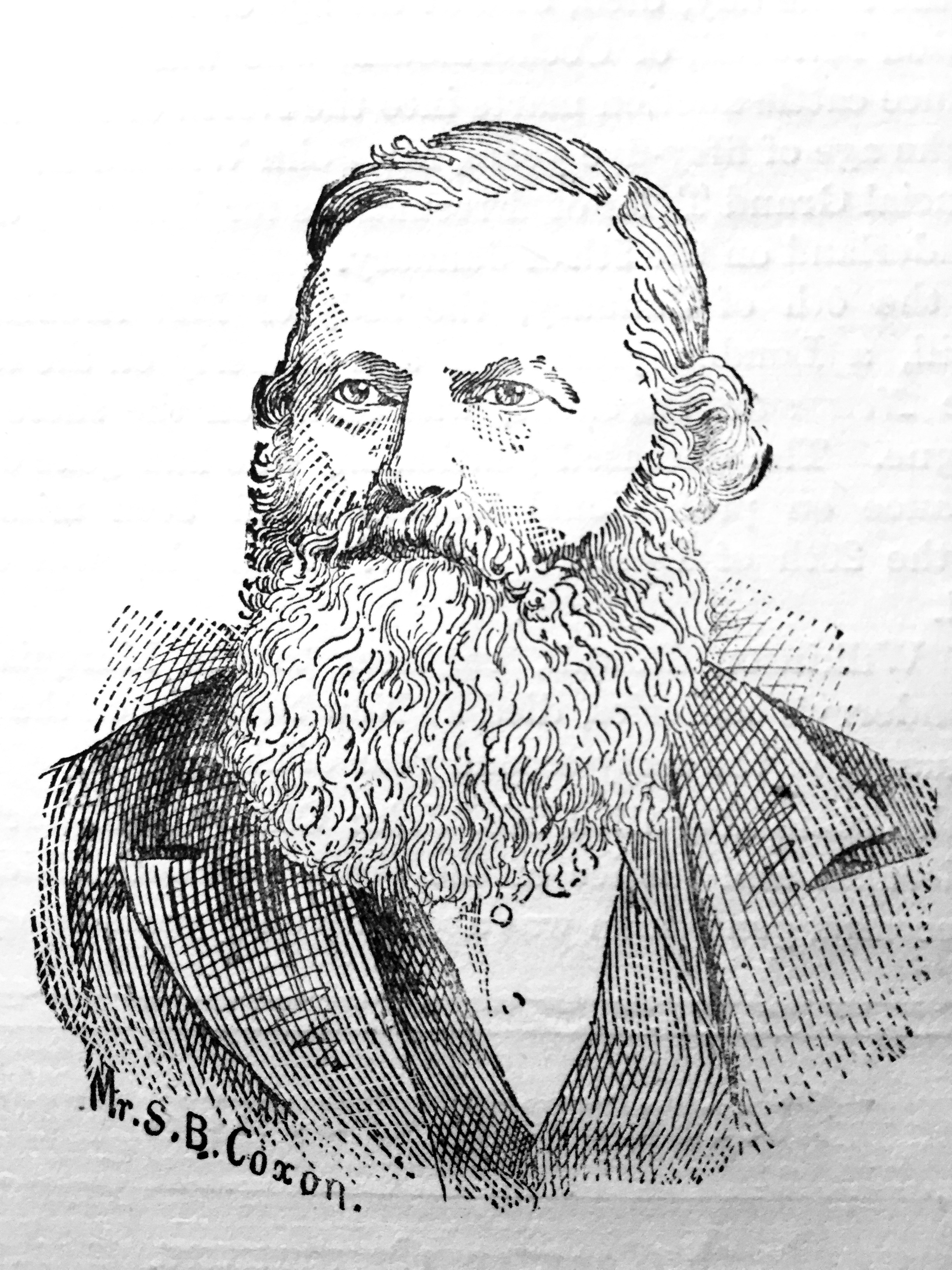
Just for Fun! “Beard of the Month”

I will be beginning a new and very serious feature on Northeastlore………..

A celebration of the Victorian Gentlemanly art of pogonotrophy (google it!). To clarify this will also include moustaches and whiskers of note.

Just to get us kicked off I will feature four outstanding examples to put the modern hipster to shame!

Beard4Mr James Clephan, journalist & antiquary (d. 25/02/1888)

Beard3Colonel Duncan M.P., Artillery Officer

Beard2Mr. John Galleon, Member of Newcastle Board of Guardians, d. 9/02/1888

Beard1Mr. S.B. Coxon, Mining Engineer, d. 28/12/1887

Vol 2 – No. 18 – August, 1888 – Grainger’s Plan of Newcastle Improvements

Grainger's Plan of Newcastle Improvements

Many people in Newcastle, by no means very old, will be able to remember the Nun’s Field, a vacant piece of ground now covered by East Clayton Street, Nelson Street, Nun Street, and the Markets. As a lad, Richard Grainger formed his own opinions with regard to this splendid site. The conceptions of the young genius were not castles in the air, but spacious streets and useful public buildings, and his young ideas were ultimately carried out almost to the letter. The old inhabitant will also remember the stately mansion Anderson Place, perhaps the finest house within a walled town in England, which to the great regret, and even indignation, of many, was swept away by Mr. Grainger’s army of workmen in 1834. This property was purchased by Mr. Grainger for £50,000; and when he exhibited his plans to the public, their daring character created much excitement; but the great majority of the inhabitants approved of them, and, supported by the popular voice, he changed the whole appearance of the town in an incredibly short time.

The accompanying plan is copied from an isometrical drawing by Mr. Thomas Sopwith, and we can get from it, in a small compass, a capital idea of the improvements which took the town by storm fifty-four years ago. Considering the stupendous changes which these plans effected, it seems very singular how little the original design has been departed from. It is scarcely necessary to explain the drawing. The proposed new street, 80 feet wide, is, of course, Grey Street; the proposed new street, from Pilgrim Street to Grainger Street, is Market Street; and the short street to the left is Shakespeare Street. The cathedral-like structure at the corner of Grainger Street was never erected; the theatre was built on the east instead of the west side of Grey Street; and the Central Exchange occupies the triangle formed by Grainger Street, Grey Street, and Market Street. With these exceptions, the design of 1834 has been carried out most faithfully.

From east to west, Clayton Street would have been a noble thoroughfare had not Mr. Grainger’s plan been interfered with by vested interests. This accounts for its divergence from the straight line, and its want of breadth. “Vested interests” will also explain the reason why so many eyesores were left standing in close contiguity to handsome streets, as, for example, High Friar Street, the High Bridge, Nun’s Lane, &c.

There is, perhaps, no other town in the empire that has been so much altered and improved by the efforts of one individual as Newcastle. In a wonderfully short time Mr. Grainger erected more than eight hundred houses, not including important public buildings, such as the banks and the Theatre in Grey Street, the Central Exchange, the Markets, &c. With Richard Grainger “to see was to resolve, and to resolve was to act,” and Newcastle is now reaping the benefit of his courage, industry, and his wonderful foresight.

Vol 2 – No. 13 – March, 1888 – Body-Snatchers

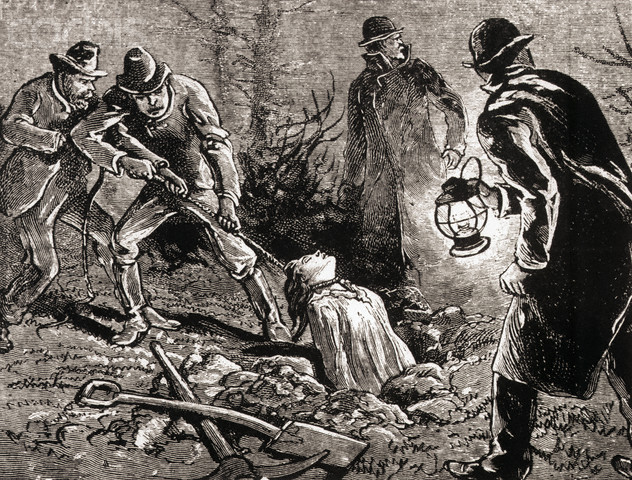
Original caption: Picture shows body snatchers stealing a corpse from the grave. Undated engraving. BPA2# 1023. --- Image by © Corbis
Original caption: Picture shows body snatchers stealing a corpse from the grave. Undated engraving. BPA2# 1023. — Image by © Corbis

Half a century and more ago, people were being every now and then horrified by tales of bodies of the newly-buried dead having been stolen at night out of their graves stolen by vile miscreants whose object it was to make money by selling them to the doctors for anatomical purposes, and who were commonly known as Resurrectionists or Body-Snatchers. These fellows usually travelled about, it was said, in gigs, so that, in country places, every stranger using that mode of conveyance was looked upon with suspicion. It was not a new thing, indeed, but new to that generation. For, during the long French war, professors, schools, and students of anatomy had as plentiful a supply of subjects as they could well desire from the bloody continental battlefields. But, after the general peace, this supply was, of course, cut off, and they had to resort to body-snatching in default of legitimate purchase, the number of bodies obtainable by fair means being quite insufficient for the wants of science, and the strong prejudices of the time preventing the friends of deceased persons from even suffering post-mortem examinations to be made.

Parties of young students, therefore, were alleged to go forth to suburban graveyards on nocturnal expeditions, furnished with shovels, ropes, sacks, &c., having hired a gig, and probably preconcerted arrangements with the gravedigger. Lecturers on anatomy employed mercenary agents, who undertook to procure what they wanted at a certain price. Loose characters took up the trade on adventure, and carried such bodies as they were able to snatch to the nearest medical college, by which they often realised handsome sums. Neither, if all tales were true, did they confine their robberies to the dead, for they were sorely belied if they did not occasionally seize and carry off the living as well. Common report said they used to supply themselves with pitch plasters, which they would clap on the mouths of such unfortunate wretches as encountered them in lonely places, and either were taken unawares or could not defend themselves. There was at last scarcely a gravedigger in the kingdom who was not more or less generally suspected of being an accomplice with the violators of the tomb, if not himself an actual body-snatcher. And to the common terrors of death, which are to the majority of mankind great enough, was added the terrible dread of being dragged at midnight out of one’s coffin, thrust into a sack, thrown into the bottom of a gig, and sold to the doctors.

Never, perhaps, was the public mind more violently excited than it was from this cause. Every suspicious looking person observed near a churchyard was at once set down for a resurrectionist. In most parishes meetings were held to devise measures to stop outrages. The male parishioners, armed with guns, took watch by turns. Watch-houses were built for their accommodation. The walls of the cemeteries, like those of flower gardens and orchards, were raised to keep out robbers, and fenced at the top with broken glass, iron spikes, or sharp palisading. A heavy iron frame, box, or safe, made for the purpose, was laid on each grave, immediately after interment, so as to ensure the dead lying there undisturbed. But even this precaution was believed to be insufficient, as the rascals devised instruments wherewith they could still reach the coffin, lay hold of the corpse, and drag it out. And then, to prevent the robbery from being found out, they spread sheets on the ground, and laid the earth and sods upon them till they had effected their purpose, after which they re made the grave with more or less neatness.

A case of this kind which occurred in Sunderland made a great sensation at the time. On Monday, the 29th of December, 1823, Captain Hedley, of Burleigh Street, whose daughter, aged ten years, had been buried on Christmas Eve, wishing to remove her body to another part of the churchyard, found the coffin empty. Further examination being made, it was discovered that the body of an infant, two years old, which had been buried at the same time, near the same spot, had also been removed. Suspicion immediately attached to two strangers, whose frequent visits to the churchyard, particularly at funeral times, had been observed; and one of them was apprehended that afternoon. It was with difficulty he was got through the streets to the police court room, for the mob which gathered, eager to take the law into its own hands, would have stoned him to death; and it was not till he was threatened with being handed over to the infuriated populace for summary punishment that he would acknowledge where he lodged. On his at length doing so, the constables proceeded thither, and secured his accomplice too. Hedley’s daughter’s corpse was found in a corner of the room, covered with straw, but carefully packed up, and addressed to Mr. James Jamieson, Leith Street, Edinburgh. On another part of the package the address was Mr. Alex. Anderson, Leith Street, Edinburgh. A number of human teeth, and some memoranda of the men’s daily expenditure, were also found in the room. It appeared from these that they had been about a month in Sunderland, and had during that time paid for six boxes, several mats, and a quantity of oakum and twine; and as the body of Mrs. Corner, aged forty-two, was the only one missing from the churchyard, in addition to the two already mentioned, it was presumed that their nightly visitations had not been confined to Sunderland, but had been extended into the country round, particularly as one considerable item of their expenditure was cartage. On the Tuesday morning they were brought before the magistrates, and committed to Durham Gaol. One of them represented himself to be Thomas Thompson, of Dundee, and the other John Weatherley, of Renfrew both names, there was reason to believe, fictitious. Tried at the Durham Sessions in the ensuing week, they were sentenced to three months imprisonment, and ordered to pay a fine of sixpence each. The lenity of this punishment caused much surprise, and simply increased the popular alarm.

Sunderland Churchyard was suitable hunting ground for the body-snatchers, because it was not overlooked by any dwelling-houses, and was close to the Town Moor. Besides, it was more than whispered that one of the parish officials was an active co-agent in such affairs. Further, one of the bellringers, a pipemaker to trade, but who kept a public-house, had the reputation of being a regular body-snatcher. Under such circumstances the plan began to be generally adopted of interring the dead in coffins secured by iron bars. It was likewise very common to fill up the grave with straw, weighted down with a long heavy plank, secured by strong wooden stakes. As additional security, the friends of buried persons used to watch all night with lanterns, both in Sunderland Churchyard and the Gill Cemetery, where they might have been seen from the road making their melancholy and weary round.

One Sunderland resurrectionist was caught in his own trap. He had got a body, said to be that of a young woman, put it into a sack, fastened a rope round the middle, and carried it to the churchyard wall, in order to drop it over. The wall was only about three feet high on the inside, but fully twice as high on the Moor side. So when the man had lifted the body on to the cope-stone, and was getting over the wall himself, the rope somehow slipped over his head, and he fell and hung suspended on the side towards the Moor, while his sack, unfortunately for him, fell back towards the churchyard. He was found thus by one of the watchers going his rounds. The body-snatcher was still alive when he was cut down, but soon afterwards died. His memory still survives among old Sunderland folks as “Half-Hanged Jack.”

Mr. James Thomson has told in the Newcastle Weekly Chronicle a story he heard from the son of an old sexton at the Border village of Cornhill. One morning early in December, about 1830, Jamie Marchall, the sexton in question, was roused from sleep by a loud knocking at the cottage door, and a voice that he seemed to recognise called out “Get up, Jamie! For God’s sake, be quick, man !” When the blacksmith opened the door he saw the son of a well-known farmer lately deceased. The young man was at the time studying medicine in the University of Edinburgh. Before he uttered a word, Marchall noticed that his arm was through the bridle-rein of a horse, from whose side the steam rose in clouds, whilst the young man’s face was haggard and pale. The sexton’s impression was that the young man had lost his reason; and the visitor’s first word seemed to convey this idea, for he called out, “Get your spade and mattock, and come with me to the churchyard quickly.” The blacksmith took his tools in silence, and followed, not daring to remonstrate. On the way, the young man exclaimed, “I’ll be satisfied soon whether it is him or not. Think, Jamie, of having your ain father laid out on the dissecting board for you to cut up. I had the knife in my hand when I saw it was my father. But I’ll be satisfied before I sleep. I left the hall, and have lidden here, Jamie, to satisfy myself.” When his father’s grave was reached, he took a spade, and helped the bewildered sexton to open it. The coffin having been reached, he called, “Break the lid with your mattock, and put in your hand. “Marchall did as he was ordered, and put his hand inside. “Is he there, Jamie?” was the anxious inquiry. ” Aye, aye, he’s a’ right. Naebody’s fashed him, Robert; ye ha’e been mista’en,” was the sexton’s reassuring reply.

In the month of February, 1824, two resurrection men were apprehended in Manchester, with no fewer than six bodies, recently disinterred, in their possession. The prisoners, who were men of a tolerably respectable appearance and good address, were sentenced at the ensuing Quarter Sessions to a short term of imprisonment. The packages which contained the bodies were directed to different persons in London.

Many still recollect how dreadful a sensation was caused all over the kingdom by the foul atrocities of Burke and Hare in Edinburgh, and by a wretch named Bishop in London. We mention them here solely in connection with our topic. But Burke, it was said, worked some time at Sunderland as a labourer while the piers were building. Hare, it was understood, made his way to Newcastle, where his identity was lost through his changing his name. A foolish surmise at the time of the Burnopfield murder revived sundry old myths about him, which died away when their baselessness was demonstrated.

Helen Macdougal, Burke’s paramour and accomplice, had two almost equally infamous forerunners in Edinburgh. In the year 1751, Helen Torrence, residenter, and Jean Waldie, wife of a stabler’s servant, were tried at the instance of the King’s Advocate for stealing and murdering John Dallas, a boy of about eight or nine years of age, son of John Dallas, chairman. One of them decoyed Dallas’s wife into a neighbouring house to drink, while the second conspirator stole away the boy, who was ill, and murdered him by suffocation. The women received from some surgeon-apprentices two shillings and tenpence for their trouble. Found guilty and sentenced to death, they were hanged in the Grass Market of Edinburgh, on the 18th of March, 1752, “both acknowledging their sins, and mentioning uncleanness and drunkenness in particular.”

Twenty-four years after this, so necessary was the trade of body-snatching considered for the purpose of science, that it was carried out in London without the smallest attempt at concealment. The Gentleman’s Magazine in March, 1776, says: “The remains of more than twenty dead bodies were discovered in a shed in Tottenham Court Road, supposed to have been deposited there by teachers to the surgeons, of whom there is one, it is said, in the Borough, who makes an open profession of dealing in dead bodies, and is well-known by the name of “The Resurrectionist.”

Mr. John Gusthart, writing to the Newcastle Weekly Chronicle in January, 1888, describes some of the means that were formerly adopted to protect the dead. We make the following extracts from his communication:  –

There are few persons living who can relate personal experience of the excitement caused by the discovery of the Burke and Hare tragedies; but many there are who can recall the fireside stories of a grandmother about living victims being seized for the dissecting room, or of churchyard burglars who pilfered the “narrow house” and dragged its tenant from the last resting-place to be sold to the faculty for gold.  Who can think of this without horror? One, indeed, may be disposed to ask, “Did such men live?” Truly, they lived and acted, and the police force of the time was unable to cope with them. The only means of defence against such deeds lay with the people themselves, who organized “Watch Clubs,” the conditions of membership being a pledge to do duty by watching in any churchyard where a member was buried, for one or more nights, as necessity required. I know that these organizations were not defunct forty-four years ago, for I was then appointed substitute for a member to watch, in Cornhill Churchyard, the bodies of two men, named Logan and Tindal, who were accidentally killed near Pallinsburn, on their return from Wooler fair.  So far as I remember, the watch-house, provided for concealment and shelter, was without comforts, except a fire-grate and coals. Two men were considered a staff, and each was provided with a blunderbuss, powder, and shot, kettle and frying-pan being common to both. My companion, Johnson by name, was much my senior, and, of course, my leader. We were instructed to visit the grave with a dark lantern at intervals during the night, and I can say we did our duty as two lovers at the trysting-place, punctual to the moment sworn. Nothing disturbed the tranquillity of the churchyard that night but the howling winds, upon which a blunderbuss has no effect; consequently our weapons were never used.  Tradition has furnished me with some strange facts in my own family history of these sad times, and on a recent visit to Lowick I had ocular demonstration of the truth of what I had been told in my childhood. My first duty on New Year’s Day, 1888, was to pay the last tribute of respect to a dear uncle, and on my way to the chamber of death I had to pass the church yard, where I felt sure the grave would be ready to receive him. Knowing that my ancestors for many generations slept there, I resolved to take notes of their respective ages and dates of death from the tombstones before the cortege arrived. I was surprised to find two men at work preparing the grave. On looking into the grave I perceived the sextons were guarding against a fall. Some soil had then fallen, and had laid bare about ten inches of an iron bar some three inches wide, which the sexton was striking with his spade, trying to disconnect it from a wooden spile which interfered with his progress. The spile was crumbling to dust, but the iron hoop on the top showed that it had been about three-and-a-half inches in diameter. Now the whole affair would have been a puzzle to me if I had never heard my grandmother’s stories about Burke and Hare. To defeat the intentions of midnight prowlers my father had laid iron bars around the top and along the sides of the coffin to prevent it being broken and the body drawn out. Besides, spiles were driven into the ground to the level of the coffin lid, and an iron bar laid over all was made fast to the spiles to prevent the coffin from being lifted entire. We must not doubt the necessity for these precautions. The sensible men of the time would certainly be the best judges, and such things go far to prove that the bonds of family affection were strong, even in death.