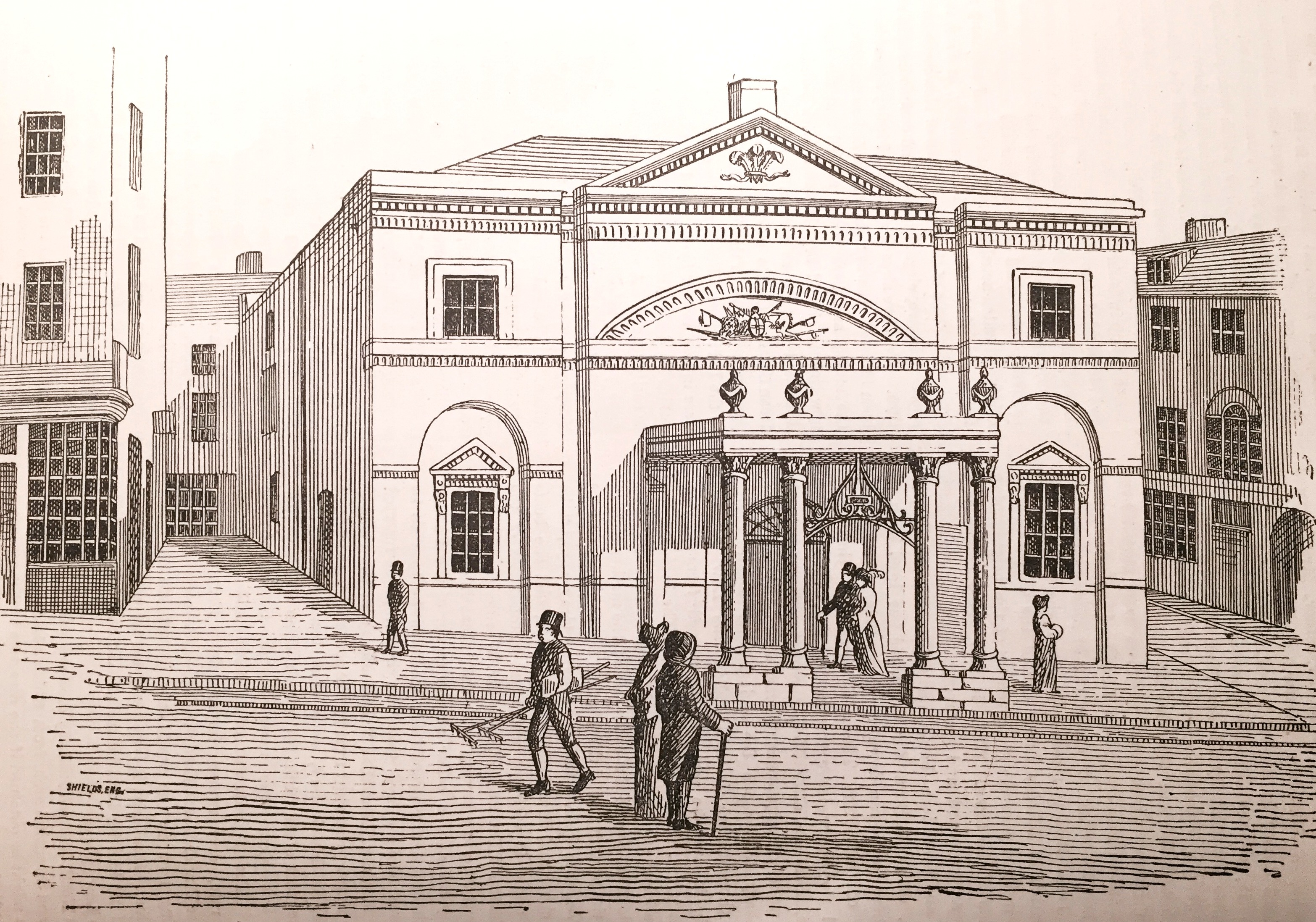
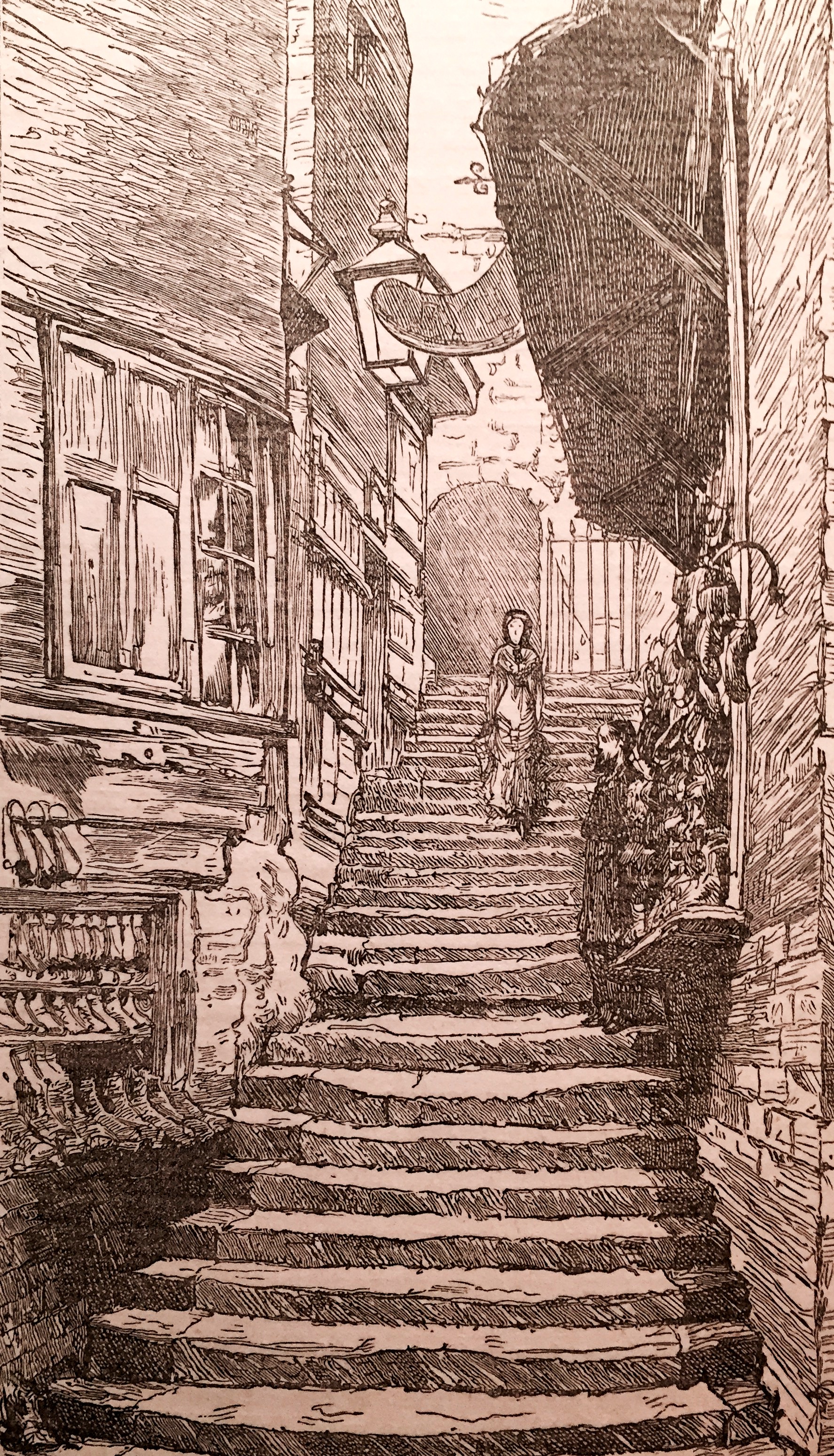
The Walls of Newcastle

The Walls of Newcastle 2

In the Middle Ages the great cities and towns of England, like those of the Continent of Europe, and indeed of most parts of the world, were girded about by fortified walls. Such provisions for defence were indispensable. Rebellions, civil wars, and invasions were of frequent occurrence, and the strength of a kingdom, and the very stability of a throne, depended upon the possibility of rapidly and effectively putting the great military centres and outposts into an efficient state of defence. Especially was this the case with fortresses and fortified towns in proximity to a contested borderland. Every student of Border history is aware of the part played by Carlisle and Berwick and Newcastle in the oft-revived struggle between England and Scotland. But this state of things has for ever passed away. The great castles have either become the peaceful abodes of splendid wealth or have fallen into ruin, whilst the walls of the towns have been piece by piece removed to make way for modern extensions and improvements. Of the many English towns which were formerly fortified, only York, Chester, and Conway retain their walls even in a comparatively perfect state. In most cases, only a few fragments remain, while in some the fortifications have entirely disappeared.

It is not necessary, in writing about the walls of Newcastle, to recapitulate the history of the founding of the town. It is sufficient to say that the fortress to which Newcastle owes its name was erected by Robert, Duke of Normandy, in 1080, for the express purpose of resisting such invasions in future as that of King Malcolm which he had then led an army into the North to avenge. It is, however, to William Rufus that Newcastle owes its foundation, not as a military outpost, but as a great commercial centre. Hardinge, the metrical chronicler, in recording the deeds of Rufus, tells us that

He builded the New Castle upon Tyne
The Scots to gainstand and to defend
And dwell therein. The people to incline
The town to build, and wall as did append,
He gave them ground and gold full great to spend;
To build it well, and wall it all about;
And franchised them to pay a free rent out.

This passage clearly refers to the building of the town, and there is evidence to show that the works to which it relates dated from the year 1095. It must not be supposed, however, that the walls erected in the time of Rufus occupied even the same sites as those of later times. They may have done so to a very limited extent, but it is certain that, as the town extended, portions of the walls were rebuilt, so as to enclose an enlarged area. Of this process we have one extremely interesting instance recorded, to which we shall again refer.

The later lines of mural fortification were due in the main to the Edwardian period. Leland, the antiquary, after quoting Hardinge’s account of the erection of the walls, adds, “This is clean false as concerning the town wall”. But whilst his legend that the capture of the wealthy merchant by the Scots was the occasion of the first walling of the town must be discarded as mere fable, he is undoubtedly right in ascribing the walls, as they existed in his day, to the three first Edwards.

The walls never quite encircled the town. Before the Edwardian fortifications were commenced the river side of the street known as the Close seems to have been so completely occupied as to preclude the erection of a wall there. And besides this, there could not have been the same necessity for a mural defence there as round other parts of the town. The Close could only be attacked from the river, and the existence of the bridge was an effectual barrier to the approach of an enemy in that direction. But, from the west end of the Close, the wall extended in an unbroken line round the town, till it joined the north end of Tyne Bridge. The whole length of the wall was about eighty yards less than two miles, but the circumference of the enclosed part of the town was a little over two miles and a furlong. The wall had six principal gates; but, besides these, there were two or three posterns, and between the corner of Sandhill and the Sand Gate were several small gates which had been made for the purpose of carrying merchandise to and from the vessels lying in the river. Between the gates, and at irregular distances, averaging 116 yards, were towers, and between these again were small turrets, built upon the battlements of the wall. The towers were twenty in number; and, according to Bourne, there were generally two wall-turrets between one tower and the next. On the turrets figures of soldiers, rudely cut in stone, were mounted. Several of these have been preserved, and may be seen in the guard-room of the Old Castle.

Not one of the gates of Newcastle has been allowed to remain, but we possess drawings or engravings of the whole of them, and from these we learn much about their architectural character and their military importance. Several of the towers still exist, though in almost every instance they have been greatly modernised, or entirely rebuilt. But considerable portions of the wall are yet standing, and, although we cannot but regret that so much has been in many cases needlessly destroyed, we must be grateful for what is left. These fragments of the ancient fortifications of the town enable us to realise the character of its military defences in bygone times in a way immeasurably more accurate and valuable than could be possible from written or printed records and pictures. We are thankful for records and pictures, but let us cling tenaciously to existing remains.

The first thing to be noticed is the strength of the walls themselves. Leland assures us that “the strength and magnificence of the walling of this town far passeth all the walls of the cities of England, and most of the towns of Europe.” William Lithgow, the traveller, bears similar testimony. He says: “The walls about the town are both high and strong, built both within and without with saxo quadrato, and mainly fenced with dungeon towers, interlarded also with turrets, and along with them a large and defensive battlement. . . . The walls here of Newcastle are a great deal stronger than those of York, and not unlike to the walls of Avignon, but especially of Jerusalem.”

Wall Turret Near St.Andrews Church

The height of the wall is said to have averaged twelve feet, while its thickness was at least eight feet at the ground level. Outside the wall was a deep and wide ditch or fosse. Its width was at least twenty-two yards. In considering the defence which such a structure afforded it must be remembered that it was built at a time when the use of gunpowder was unknown. The only means by which it could be attacked were, mining its foundations, employing the battering ram against it, and scaling its front. It would occupy more space than we can afford to describe the manner in which these systems of attack were carried out or the military engines which were employed. The military value, however, of such fortifications lay in the fact that a comparatively small garrison within could defy an immeasurably larger force without.

The great purpose of the towers was to enable the garrison to assail the enemy who might be attacking the walls themselves. The towers projected from the face of the wall, and thus afforded means of lateral defence, while the turrets afforded protection to the soldiers who were actually upon the battlements of the wall.
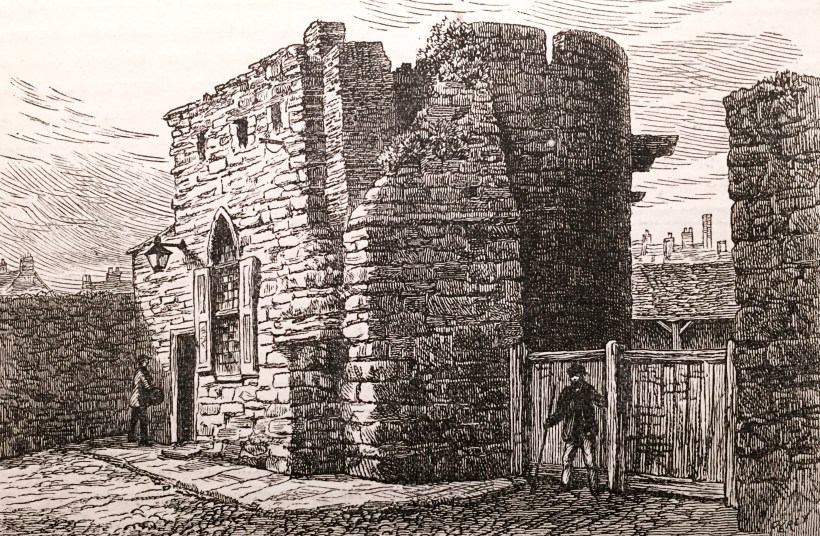
Herber Tower, Newcastle on Tyne

The wall may be said to have commenced on the brink of the river, a few yards south of the Close Gate. Here there was a tower. The site of the Close Gate is marked by an inscription in the wall on the north side of the street. Behind the houses, close to this inscription, some shapeless fragments of the wall remain, but there is no trace of the Break Neck Stairs by which the steep bank was ascended. On the crest of the bank stood the White Friar Tower, which derived its name from its proximity to the house of the White Friars. Immediately beyond this point a portion of the wall, with its battlements, still perfect, yet remains. It is one of the best preserved fragments now in existence. The masonry is distinctly of the Edwardian period. The next tower, which stood on a site now occupied by the new railway works, was the Denton or Neville Tower, the former designation due to the family who gave their name to Denton Chare, and the latter to the proximity of the town residence of the Nevilles. At this point the wall took a sudden turn to the west, and ran forward to the West Gate, passing on the way West Spital, Stank, Gunner, and Pink Towers, the last of which remained, though in a modernised form, till Pink Lane was widened a few years ago. With the exception of the New Gate, the West Gate was the finest of the town entrances. Leland describes it as a “mighty strong thing of four wards and an iron gate.” Tradition ascribes its erection to the great Roger Thornton, and, although there must have been a gate at this point long before his time, as, indeed, is implied in the legendary rhyme:

At the West Gate came Thornton in,
With a hap, and a halfpenny, and a lamb skin,

yet the architecture of the gate which was taken down in 1811 was certainly of his time.

Between West Gate and New Gate several considerable portions of the wall still exist. The most interesting part is that which runs along the back of Stowell Street, at the west end of which is the Berber Tower. The outer front of the tower forms a bastion-like projection from the face of the wall. The long stone corbels which stand out from the tower were intended to carry a timber gallery, from which the garrison could shower their arrows and other missiles down upon their assailants. The towers between West Gate and New Gate were called the Durham, Herber, Morden, Ever (from the family of Eure), and Andrew Towers. Then came New Gate, a truly majestic portal, and the main entrance to the town from the north. It had barbican, drawbridge, and portcullis, and was certainly one of the strongest and most magnificent gateways in England. Its architecture was of various periods, but much of it was at least as early as the end of the thirteenth century. Its name seems to imply the previous existence of a gateway on the same site. There were only two towers between New Gate and Pilgrim Street Gate. These were named Bertram Monboucher and Fickett Towers. Pilgrim Street Gate seems to have been an Edwardian structure, but had been greatly modernised. Then came Carliol Tower (named from the local family of Carliol), removed a few years ago to make way for the Public Library Buildings, and Carliol Croft (or Plummer) Tower, which still exists. This is the first part of the wall now in existence after we leave the precincts of St. Andrew’s Churchyard. Next came Austin Tower, which had its name from its nearness to the abode of the Augustinian Friars. No part of it now exists. Of the next tower, called the Corner Tower, a considerable portion remains, and forms an important landmark, not only of local topography, but of local history. Formerly the town wall ran southward from this point, by Cowgate and Broad Chare, to the brink of the river. The comparative width of these thoroughfares is due to the fact that they were formerly partly occupied by the wall. But in 1299 Pandon was annexed to Newcastle, and it became necessary to include it within the walls. For this purpose the part of the wall which ran along Cowgate and Broad Chare was taken down, and what is spoken of in documents of that period as a new wall was carried round Pandon by way of Wall Knoll. This accounts for the abrupt change in the direction of the wall at Corner Tower, and also for the name of that member of the fortifications. Wall Knoll or Carpenters’ Tower yet exists, but only a small portion of the wall itself (behind the warehouses of Messrs. Monkhouse and Brown and Messrs. Angus and Co. Stockbridge) now remains in this neighbourhood. Between Wall Knoll Tower and the site of the Sand Gate the wall has been almost, though not quite, destroyed. A small part of it may be found by the diligent seeker on the east side of a short cul-de-sac which leads from the Quayside just west of the Milk Market. Sand Gate was entirely taken down in 1798, and the part of the wall between it and Tyne Bridge had made way for the bales and barrels of Quayside commerce thirty-five years before. But, none the less, it may be truly said to still exist, for its stones were used, in part at least, to build the present church of St. Ann.

J. R. BOYLE, F.S.A.

Lord Byron at Seaham

Seaham Hall

All the world knows that the marriage of Lord Byron and Miss Milbanke was a very unhappy one. He was the spoiled child of fame and fortune; she the spoiled child of her own family. His weakness was to be thought strong; hers to be prim and prudish. It was written of them, long: after their union had been broken up for ever: — “He morbidly exaggerated his vices, and she her virtues; his monomania lay in being an impossible sinner, and hers an impossible saint. In the decorous world’s eye, he was the faulty, and she the fault-less monster of romantic fiction. He in his mad moods did his best to blacken his own reputation, while her self-delusions invariably tended to foster the fond persuasion that the strict pharisaical principles in which her mother had brought her up obliged her to suppress her natural feelings, whenever these would have prompted her to comply with the world’s fashions.”

While leading a thoughtless, dissipated life, too common among those of his age and rank, Byron’s inner life was distressingly lonely. He was as conscious as any one could be that the path he was treading was the road to ruin; and, in a passage in his journal, speaking in admiration of some lady whose name he left blank, he wrote — “A wife would be the salvation of me.” Under this conviction, which not only himself, but all his real friends entertained of the prudence of his taking timely refuge in matrimony from those perplexities (to call them by the gentlest name) which form the sequel of all less regular ties, he began to turn his thoughts seriously to marriage, at least, says Moore, as seriously as his thoughts were ever capable of being so turned. But ever and again new entanglements, in which his heart was the willing dupe of his fancy and vanity, came to engross for a time the young poet, and still as the usual penalties of such illicit pursuits followed, he found himself once more sighing for the sober yoke of wedlock as some security against their recurrence. Two or three women of rank at different times formed the subject of his confused matrimonial dreams.

The lot at length fell on Anne Isabella, only child of Sir Ralph Milbanke, of Halnaby, county York, and of the Hon. Judith Noel, daughter of Sir Edward Noel, Viscount Wentworth. The first time Byron saw his future wife was at Lady Melbourne’s in London. He told Captain Medwin long afterwards that in going upstairs on that occasion he stumbled, and remarked to Moore, who accompanied him, that it was a bad omen. On entering the room, he observed a young lady, more simply dressed than the rest of the assembly, sitting alone upon a sofa. He took her for a humble companion, and asked quietly if he was right in his conjecture. “She is a great heiress,” said his friend, in a whisper, that became lower as he proceeded; “you had better marry her and repair the old place, Newstead.” There was something piquant and what we term pretty, about Miss Milbanke. Her features were small and feminine, though not regular. She had the fairest skin imaginable. Her figure was perfect for her height and there was a simplicity, a retired modesty, about her, which was very characteristic. She interested the young poet-peer exceedingly. It is unnecessary to detail the progress of their acquaintance. He became daily more attached to her, and ended in making her a proposal of marriage, which, however, was not accepted, though every assurance of friendship and regard accompanied the refusal, and a wish was even expressed that they should continue to write to each other. A correspondence, somewhat singular between two young persons of different sexes, consequently ensued, but love was not the subject of it.

Meanwhile, a person unnamed, but said to have been Sheridan, who had for some time stood high in Byron’s confidence, observing how cheerless and unsettled was the state both of his mind and prospects – his family estates being heavily mortgaged, and his matutinal reflections, intensified by headaches, very distressing-advised him strenuously to get married. After much discussion, he consented. The next point for consideration was- Who was to be the object of his choice? While his friend mentioned one lady, he himself named Miss Milbanke. To this, however, his adviser strongly objected, remarking that Miss Milbanke, though niece to Lady Melbourne, cousin to Lady Cowper, and heir presumptive to old Lord Wentworth, had at present no fortune; that his embarrassed affaire would not allow him to marry without one; that she was, moreover, a learned lady, which would not at all suit him. In consequence of these representations, he agreed half in jest, half in earnest — that his friend should write a proposal for him to another lady named, which was accordingly done; and one morning shortly afterwards, as they were once more sitting together, an answer from her arrived, containing a refusal “You see,” said Lord Byron, “that after all, Miss Milbanke is to be the person; — I will write to her.” He accordingly wrote on the moment, and, as soon as he had finished, his friend, remonstrating still strongly against his choice, took up the letter, but, on reading it over, observed, “Well, really, this is a very pretty letter; it is a pity it should not go. I never read a prettier one.” “Then it shall go,” said Lord Byron; and, so saying, he sealed and sent off on the instant what proved to be the fiat of his destiny.

This time he was accepted, and there could be no drawing back, whatever misgivings he might have as to the sequel. On the day the answer arrived be was sitting at dinner, when his gardener came in and presented him with his mother’s marriage ring, which she had lost many years before, and which the gardener had just found in digging up the mould under her window. Almost at the same moment the letter from Miss Milbanke was handed in, and Lord Byron exclaimed, “If it contains a consent, I will be married with this very ring!” It did contain a very flattering acceptance, and the omen was hailed as a happy one, though his mother’s experience would not have borne that out.

Contemplating his approaching union, Byron wrote – “I must, of course, reform thoroughly; and, seriously, if I can contribute to her happiness, I shall secure my own. She is so good a person that — that, in short, I wish I was a better.” Again:— “I certainly did not address Miss Milbanke with mercenary views, but it is likely she may prove a considerable parti. All her father can give, or leave her, he will; and from her childless uncle, Lord Wentworth, whose barony, it is supposed, will devolve on Lady Milbanke (his sister), she has expectations. But these will depend upon his own disposition, which seems very partial towards her. She is an only child, and Sir Ralph’s estates, though dipped (?) by electioneering, are considerable. Part of them are settled on her; but whether that will be dowered now I do not know — though from what has been intimated to me, it probably will. The lawyer will settle this among them.”

Byron had the satisfaction of being told that Miss Milbanke had refused six suitors in the mean time which certainly was a salve for his lordship’s not unnatural vanity; for be had now given to the world the first two cantos of “Childe Harold,” “The Giaour,” “The Bride of Abydos,” and “The Corsair,” and had gained for himself the very highest name among the poets of the day. In due course he received Sir Ralph’s invitation to proceed to Seaham, the worthy baronets seat in North Durham, in his capacity as an accepted lover. Somehow or other he had still misgivings. Though Miss Milbanke had “great expectations.” she was possessed at the time of but little money, while the poet stood in need of a great deal. He declared that his head was in a state of confusion; only, having made the venture, he was willing to take the risk; and so his “mind was made up -positively fixed, determined.” “Of course,” continued he, “I am very much in love, and as silly as all single gentlemen must be in that sentimental situation.” Adverting to his approaching marriage, “it should have been two years earlier,” said he, “and if it had, it would have saved a deal of trouble. But. as it is, I wish it were well over, for I hate bustle, and there is no marrying without some; and then, one must not marry in a black coat, and I hate a blue one.”

The affianced couple were now only waiting lawyers, and settlements, and other formalities, all necessary when the parties to be made one have worldly wealth, or the prospect of it, either on the one side or the other. At this time Byron wrote of Miss Milbanke : — “She is a very superior woman, and very little spoiled, which is strange in an heiress — a girl of twenty — a peeress that is to be, in her own right — an only child, and a savante, who has always had her own way. She is a poetess — a mathematician — a metaphysician, and yet, withal, very kind, generous, and gentle, with very little pretension. Any other head would be turned with half her acquisitions and a tenth of her advantages.” There need be little doubt that this high-flown praise was somewhat deserved in the young lady’s case. Byron, on another occasion, long afterwards, said “there never wais a better, or even a brighter, a kinder, or a more amiable being.” Miss Milbanke herself unquestionably dreamed, and was taught perhaps by her mother to expect, that she would wean Byron from his evil courses, and convert him into a good Christian, or at least a reputable member of society, and a staunch adherent of the Established Church, like her father.

A walk is still pointed out in Seaham Dene which the bridegroom expectant used to frequent, probably to court the Muses. It is a very retired spot, and is still known as “Byron’s Walk.” The only thing he wrote, so far as we know, while waiting for the tying of the nuptial knot, was the piece commencing — “When some brisk youths a tenant of a stall ” — referring to Joseph Blackett, an unfortunate child of genius, dubbed by Byron “Cobbler Joe,” whose last days were soothed by the generous attention of the Milbanke family, and whose orphan daughter, whom he styled “the shoemaking Sappho,” Miss Milbanke used to visit in what she sentimentally styled the “Cottage of Friendship.”

The marriage was performed by special license, on the 2nd of January, 1815, in the drawing-room of Seaham Hall. No sooner was the ceremony over than the happy pair set out for Halnaby, Sir Ralph’s country seat in Yorkshire. Lord Byron long afterwards told Captain Medwin he was surprised at the arrangements for the journey, and somewhat out of humour to find a lady’s maid stuck between him and his bride. “But it was rather too early,” added he, “to assume the husband; so I was forced to submit, but it was not with a very good grace. Put yourself,” he went on to say, “in a similar situation, and tell me if I had not some reason to be in the sulks. I have been accused of saying, on getting into the carriage, that I had married Lady Byron out of spite, and because she had refused me twice. Though I was for a moment vexed at her prudery, or whatever you may choose to call it, if I had made so uncavalier, not to say brutal, a speech, I am convinced Lady Byron would instantly have left the carriage to me and the maid (I mean the lady’s). She had spirit enough to have done so, and would properly have resented the affront.” This seems to be the true version of the affair. But we are likewise told that, when the newly wedded pair were on the point of setting off for Halnaby, Lord Byron said to his bride, to the horror of the lady’s confidential attendant, who pronounced it to be a bad omen — “Miss Milbanke, are you ready?” And of evil omen, it truly was, though a mere natural misadvertence.

We are told in Mrs. Beecher Stowe’s wholly unreliable narrative of a hideous confession made by his lordship, as soon as the carriage doors were shut, and of its terrible effect upon the poor lady. Miss Milbanke’s former lady’s maid, Mrs. Minns, who had the close confidence of her mistress during the long period of ten years, who had quitted her service only some months before on the occasion of her own marriage, and who had been asked to return and fulfil once more the duties of lady’s maid, at least during the honeymoon, preceded Lord and Lady Byron to prepare for their reception at Halnaby Hall. She was present when they arrived at that mansion in the afternoon of the day, and saw them alight from the carriage. At that moment, according to Mrs. Minns’s testimony. Lady Byron was as buoyant and cheerful as a bride should be, and kindly and gaily responded to the greetings of welcome which poured upon her from the pretty numerous group of servants and tenants of the Milbanke family who had assembled about the entrance to the mansion. And Lord Byron’s confidential servant, Fletcher, who was the only other person that accompanied the newly married pair from Seaham to Halnaby, but who, of course, sat upon the box, not inside, informed Mrs. Minns that a similar scene had occurred at Darlington, at the hotel where they changed horses.

The happiness of Lady Byron, however, was of brief duration. Even during the short three weeks they spent at Halnaby, the irregularities of her husband occasioned her the greatest distress, and it is said she even contemplated returning to her father. Mrs. Minns was her constant companion and confidante during this painful period, and she did not believe that her ladyship concealed a thought from her. With laudable reticence, the old lady, when interviewed by a correspondent of the Newcastle Chronicle in her eighty-fifth year, absolutely refused to disclose the particulars of Lord Byron’s misconduct at the time. She gave Lady Byron, she said, a solemn promise not to do so; but language, adds the interviewer, would be wanting to express the indignation with which she repudiated the gross explanation which Mrs. Stowe has given of the matter. So serious, however, did Mrs. Minns consider the conduct of Lord Byron, that she recommended her mistress to confide all the circumstances to her father — “a calm, kind, and most excellent parent” — and take his advice as to her future course. At one time Mrs. Minns thought Lady Byron had resolved to follow her counsel, and impart her wrongs to Sir Ralph Milbanke; but, on arriving at Seaham Hall, her ladyship strictly enjoined Mrs. Minns to preserve absolute silence on the subject — a course which she followed herself, so that when, six weeks later, she and Lord Byron left Seaham for London, not a word had escaped her to disturb her parent’s tranquillity as to their daughter’s domestic happiness. Lord Byron, conversing with Captain Medwin, allowed that his honeymoon was not all sunshine.

On the 2nd February, Byron wrote as follows to Moore: — “I have been transferred to my father-in-law’s domicile, with my lady and my lady’s maid, &c, &c., &c, and the treacle moon is over, and I am awake, and find myself married. My spouse and I agree to — and in — admiration. Swift says “no wm man ever married ;’ but, for a fool, I think it the most ambrosial of all future states. I still think one ought to marry upon lease; but am very sure I should renew mine at the expiration, though next term were for ninety and nine years.”

It was after their return to Seaham, that the humdrum sort of life they were expected to lead there tried Lord Byron’s mercurial temper beyond endurance, and rendered him more than ever perversely rebellious against conventional restraint. He wrote to a correspondent : — “Upon this dreary coast, we have nothing but country meetings and shipwrecks; and I have this day dined upon fish, which probably dined upon the crews of several colliers lost in the late gales. My papa, Sir Ralph, has recently made a speech at a Durham tax meeting; and not only at Durham, but here, several times since, after dinner. He is now, I believe, speaking it to himself (I left him in the middle) over various decanters, which can neither interrupt him nor let him fall asleep, as might possibly have been the case with some of his audience.” And he adds in a postscript: — “I must go to tea — damn tea.”

In another letter he says: — ” What an odd situation and friendship is ours! — without one spark of love on either side, and produced by circumstances which in general lead to coldness on one side, and aversion on the other.”

A great quarrel occurred in the sixth week of their marriage. During a jealous mood, superinduced by her husband’s actual or imagined infidelities, Lady Byron fearfully resented a hasty remark of his. “I deeply regret to know,” he said, “that my beloved Mary Chaworth was very unhappy in her marriage. Ah, it might have been different had we married!” Upon hearing this remark. Lady Byron instantly arose, and in great anger uttered the fatal words, “Mary Chaworth rejected you for your deformity, as I did once, and it had been better if I had still rejected a man with a devil’s foot” And with these words she left the apartment. To Lord Byron, sensitive as the quivering aspen leaf upon that very fact of his deformity—his “curse of life,” as he once said to Trelawney — the words were as daggers. From that moment there ceased all marital intercourse between the newly-wedded pair. Both kept their own apartments, and communed only with their own friends, brooding over their respective wrongs; and thenceforward, though the forms of outward decency might be observed before strangers, a fixed determination to part, at least for a time, perhaps for ever, was entertained by each.

But into the particulars of their actual separation, which took place in London, on the 15th of January, 1816, we have no intention to enter here. Their married life had lasted only one year and thirteen days.

The Streets of Newcastle – Northumberland Street and its Offshoots

Northumberland Street is, practically, a continuation of Pilgrim Street; but the difference in the name is easily enough accounted for when we remember that the ancient Gate (figured in vol. ii., page 81) frowned equally on both in former days. We take our start from the point where the old Gate once stood.

And first we are detained for a moment on our left hand by Northumberland Court. This small court has little to stay our progress to-day; and yet it has its item of interest all the same. Some thirty-seven years ago, one William Glover occupied the upper room in a tenement house here. He missed articles from his room, and these disappearances waxed frequent. So he devised a plan by which all unauthorised intrusion on his premises should be stopped for the future. And this was his plan. He obtained a large horse-pistol, loaded it with slugs, and then attached the trigger to the door of his room in such a way that anyone entering would cause the pistol to explode, not, of course, to the intruder’s benefit. But how did he protect himself? Well, he was able to gain admission safely enough by previously pulling a string which passed through the frame of the door. Unfortunately, on the evening of December 6th, 1852, he entered his guarded room without observing this necessary precaution. Result: the pistol went off, and its contents killed him instantaneously.

On the same side of the way is Brunswick Place, at the end of which is the Wesleyan Chapel of that name. This building may be considered the headquarters of the Wesleyan body in Newcastle. It was opened for public service in February, 1821, when the preachers were the Revs. Messrs. Newton, Atherton, and Wood. Its exterior is plain even to barrenness; its interior commodious enough to accommodate two thousand persons. Some notable men have held forth here now and again. Dr. Morley Punshon won his rhetorical spurs in his early years as a stationed minister in Newcastle, and in after years few towns were visited by him with greater pleasure. Other Presidents of the Wesleyan Conference besides Dr. Punshon have occupied the pulpit of Brunswick Place. More than once the Conference itself has met in Newcastle. One of these meetings was held in the summer of 1840, when Robert Newton was president, and Dr. Hannah secretary. Two Ashantee princes were present on that occasion; but the local interest attaching to this particular meeting comes to this, that Mr. H. P. Parker, one of the foremost local artists of his day, presented the body with a large picture representing the rescue of Wesley from the fire of his father’s rectory. The painting was afterwards engraved, and became widely known.

Passing on, let us pause for a moment at the Orphan House Wesleyan School. The stranger may note the date on the front of the building 1857. Right: and wrong. Right, for it was in that year that the schools of to-day were opened for educational purposes. But wrong in this wise: they stand on the site of the old Orphan House founded by John Wesley, the foundation stone of which he laid on the 20th December, 1742. (Monthly Chronicle, vol. ii., pages 504, 570.) The Methodists occupied this building until Brunswick Place Chapel was finished.

On this same side of the street we come, next to Mackford’s Entry, so named after its builder. Across the road is a small, quiet place, called Lisle Street, and then, a little higher up, we come to Saville Row, so named in honour of Sir George Saville, Baronet, who, during the years 1776 and 1777, resided here as colonel of the West York Militia. Ellison Place is a continuation of this street; and here we find the modern Mansion House more precisely, the Judges’ Lodgings at assize time.

Singleton House we arrive at next, formerly the residence of the Rev. Richard Clayton, by virtue of his position as Master of the Mary Magdalen Hospital; subsequently occupied by Sir John Fife; then transformed into an academy; and now the photographic studio of Mr. Lydell Sawyer, and the centre of a series of temporary shops.

Singleton House, Northumberland Street

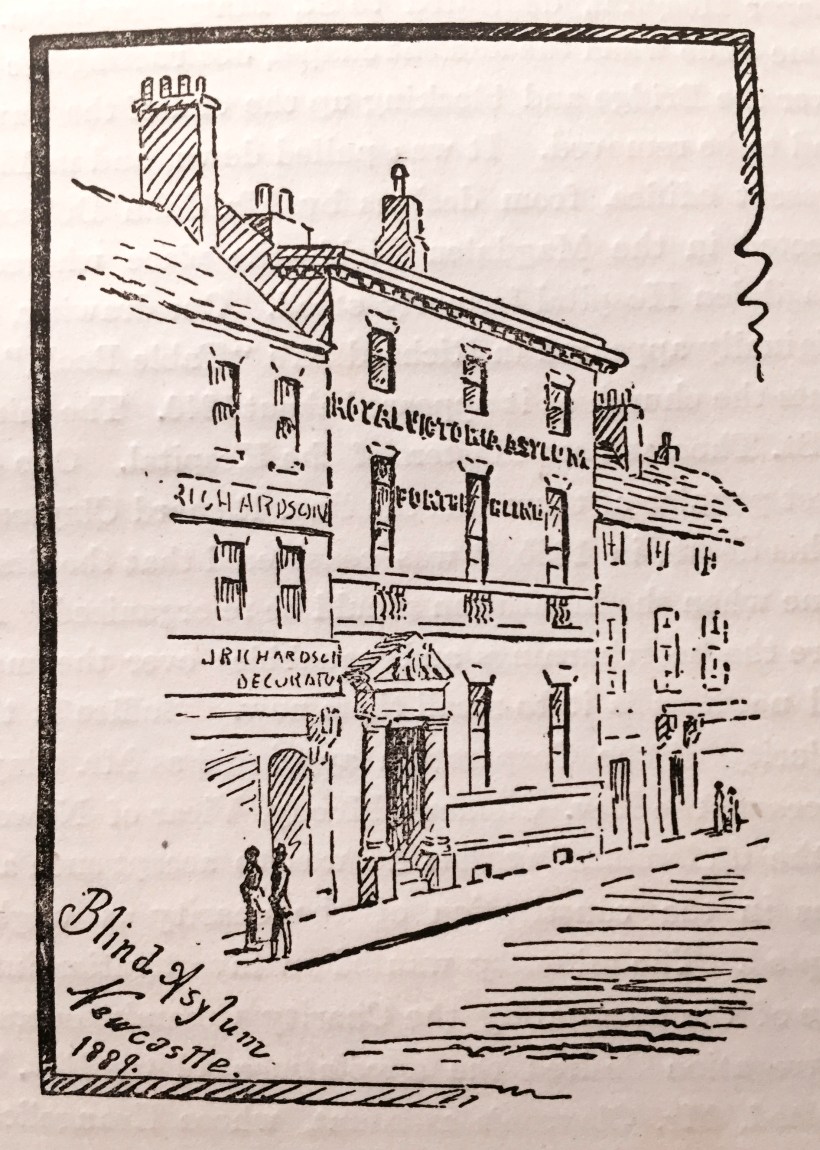
We are now opposite Prudhoe Street. On that side of the street, a step takes us to the doors of the Victoria Blind Asylum. Pause we a moment here, for a more deserving charitable institution there is not in Newcastle; and that, remember, is saying a good deal. Victoria? Why the name? The explanation is simple enough. The Asylum was built in honour of the Queen’s coronation, in lieu of squandering money over illuminations and the like; and surely none can say that our city fathers were wrong in that idea. The determination to establish an institution of this sort was formed in the month of February, 1838; but in the first instance premises were obtained in the Spital, whence the establishment was removed to the existing building in 1841. Behind the asylum there was once a Bowling Green, after the Forth had disappeared.

Blind Asylum, Northumberland Street

Across the road, again, we have Bath Road, so named by reason of its association with the Northumberland Baths. These baths owe their origin to a meeting convened on November 3, 1836, by the Mayor (Mr.C. J. Bigge), whereat Dr. Head lam and others supported the proposal that a lease should be obtained of about twelve acres of ground lying to the north of Saville Row, and that a company to consist of three hundred shareholders, at £20 each, should be established for carrying out the undertaking. The proposal was warmly taken up, and on June 24, 1839, the baths were formally opened. They were built from a design by Mr. Dobson, and the cost of their erection and fitting up was nearly £8,000.

Contiguous to the baths was a once rather favourite cricket ground, now the site of Dame Allan’s Schools, St. James’s Chapel, St. George’s Hall, Cambridge Hall, and the College of Medicine.

St George’s Hall has been erected for the purposes of local volunteers, as has also its neighbour, Cambridge Hall.

Dame Allan’s charity is attached to the parishes of St. Nicholas and St. John. The school was founded by Eleanor Allan, of Newcastle, who, in 1705, assigned for its support a farmhold and tenant-right in Wallsend parish. The farm, held of the Dean and Chapter of Durham, contained about 131 acres; and when first assigned it brought in an annual rental of £61 19s. 5d. In 1708 this good lady died; and in the next year the school was opened in trust for forty boys and twenty girls, the parishioners agreeing to subscribe annually for the clothing of the scholars. Other donations towards increasing the benefits of the charity came in afterwards. In 1723, Gilbert Campel, “innholder,” left it £20, and Samuel Nicholas, organist, 10. Mrs. Chisholm, a clergy-man’s widow, of Wooler, contributed £500 later on; and in 1733, Mrs. Elizabeth Rogers, of Newcastle, left it £50. In 1738, £250 was left by John Hewitt, or Huet, goldsmith, also of Newcastle. A good, sound, useful education is understood to be given to the scholars of Dame Allan’s School. The new building is ornamented with a medallion of the benevolent founder.

Dame Allan's School, Newcastle

A view of the College of Medicine, the foundation stone of which was laid by the Duke of Northumberland on November 5, 1887, appears on page 46, vol. ii.

St. James’s Chapel, a spacious building, has sometimes been called by its supporters the Cathedral of the Congregationalists of the North. We have spoken of this body when dealing with Blackett Street, and need not repeat the story here.

We may now return to Northumberland Street by way of Ridley Place, a quiet street running parallel to Bath Road. Of Ridley Place there is nothing particular to be said, save that it was built by one Mr. Grey, and by that Mr. Maskford whose name we have already found associated with an entry a little way from the present spot.

Next to Ridley Place is Vine Lane, at the end of which stand St. Thomas’s Schools. Some good work has been done here. Amongst old scholars in the boys’ department may be mentioned Mr. J. J. Pace, the borough treasurer of Newcastle; Mr. Ralph Willoughby, the energetic superintendent of the Ragged and Industrial Schools in the New Road; Mr. T. Albion Alderson, organist and composer: the late Mr. William Mitcheson, for many years the head master of St. Andrew’s School; Mr. Andrew Beat, long the Workhouse schoolmaster; and others that might easily be named. These were all pupils of the late Mr. Henry Page, for more than twenty years the master of the boys’ school, and a self-made man. Commencing life as a working joiner, he became a certificated master by dint of hard private study. Even his recreations were intellectual. He took to the solution of mathematical posers as the duck takes to water; in a game of chess he was a formidable opponent; and music was the solace of his lighter moments. He ended his days in Newcastle as the pensioned ex-master of the Victoria Blind Asylum. At St. Thomas’s School he was succeeded by Mr. John Coulson, another self-made man, who from St. Thomas’s went to Durham University, with the object of entering the ministry of the Church of England. In due course he was ordained; he was further successful enough to win the prize of a fellowship of his University, and became afterwards the vicar of Holy Trinity, South Shields.

We are now nearly at the end of Northumberland Street, so far as our right hand is concerned. We are quite at the end of it when we come to St. Mary’s Place.

But before quitting it for good, let us record one of its traditions. Seventy years ago, one Alexander Adams, who lived in Northumberland Street, bequeathed a fortune amassed in commerce to his natural son, then a resident in India. The devisee soon after died in Calcutta, a bachelor, and left all he had to his cousin, Thomas Naters, who was settled in New York, in the United States. In October, 1836, Naters died in Switzerland, and left his fortune, amounting to between £200,000 and £300,000, to a respectable builder in Newcastle, named William Mather. The Swiss authorities were very loth to part with it, and claimed £50,000 as legacy duty. The British Government remonstrated, arguing that Naters was not a naturalised subject of Switzerland. The controversy went on for some time; but eventually the claim was settled by Mather consenting to pay the Swiss £12,000.

One more note we ought to make also, namely, that the houses terminating the north-west side of Northumberland Street were formerly called Pedlar, or Pether Row, as having been built by one who laid the foundation of his fortune by hawking or peddling.

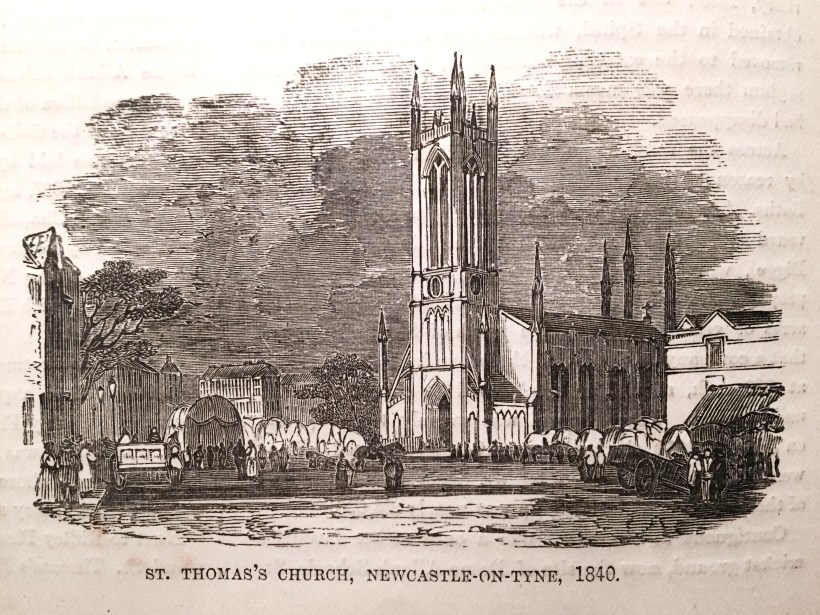
Before us we have now the beautiful church of St. Thomas the Martyr. An old chapel of the same name stood for nearly six hundred years at the Newcastle end of Tyne Bridge. In the ninth year of the reign of James I. (June 12, 1611), this old foundation was, by Royal Charter, annexed to another venerable institution the Leper Hospital, dedicated to St. Mary Magdalen. The time came when the ancient chapel, obstructing the traffic over the Bridge and blocking up the end of the Sandhill, had to be removed. It was pulled down, and in 1829 the present edifice, from designs by Mr. John Dobson, was erected in the Magdalen Field the place whereon the Magdalen Hospital formerly stood. Our drawing, which originally appeared in Richardson’s “Table Book,” represents the church as it appeared about 1840. The ministers of St. Thomas’s are Masters of the Hospital. One of the most popular of them was the Rev. Richard Clayton, and at his death, in 1856, it was considered that the time had come when the institution should be re-organized. Many were the heartburnings and squabbles over the matter, and needless is it to recall them now. Suffice it that a majority of the Corporation appointed as Mr. Clayton’s successor the Rev. Clement Moody, Vicar of Newcastle, on the understanding that he was to accept such alterations in the constitution of the charity as might be adopted. The minority wanted an investigation into the state of the hospital by the Charity Commissioners; the congregation desired the appointment of the Rev. T. D. Halsted, Mr. Clayton’s assistant, whose Evangelicalism had made him popular. A split was the result of the appointment, with the consequence that the Clayton Memorial (now usually called Jesmond) Church was built by the dissatisfied members.

St Thomas's Church, Newcastle-On-Tyne, 1840

The Streets of Newcastle – Pilgrim Street

Sir, said Dr. Johnson, “let us take a walk down Fleet Street” We propose to our readers a walk up Pilgrim Street. We shall find “much matter” as we journey up the gentle hill, “the longest and fairest street in the town,” according to William Gray, whose “Chorographia” was printed in 1649.

Jesmond Chapel

This street, still one of the most interesting in the town, derives its name from the pilgrims who lodged in it when on their way from all parts of the kingdom to worship at Our Lady’s Chapel at Jesmond. The founders of the chapel are unknown, but we know that it was in existence in 1351, for then we find Sir Alexander de Hilton and Matilda, his wife, presenting the chaplainship to Sir William de Heighington, who shortly after resigned it, believing he had no right or title to it. In Edward VI.’s time, the Corporation obtained possession of the chapel, and forthwith sold it to Sir John Brandling. In olden days, pilgrims trooped to it from all parts of the kingdom. Such pilgrimages were popular in the early middle ages. For illustration, we may point to the will of William Ecopp, Rector of Heslarton, Yorkshire, who, amongst other things, bequeathed provision for a pilgrim, or pilgrims, to set out immediately after his burial to various shrines, at each of which 4d. was to be offered. The list of places is too long to be quoted in its entirety; but the extent of ground to be covered may be imagined when we find that Canterbury, London, Lincoln, Lancaster, Scarborough, York, “Blessed Mary of Jesmond,” Carlisle, and Galloway, figure therein. (See Mr. R. Welford’s interesting “Newcastle and Gateshead in the 14th and 15th Centuries,” vol i, p. 364). Bourne gravely tells us that the reason the pilgrims took this road was because there was a house of call ready to respond to their wants. “There was an inn in this street which the pilgrims were wont to call at, which occasioned their constant coming up this street, and so it got its name, as the inn did that of Pilgrim’s Inn.” Brand fancies that there were more pilgrim’s inns than one; for, in 1564, mention is made of the execution of one Partrage for coining false money in “the greate innes in Pilgrim Street.” There was, says an old manuscript quoted by Hodgson, a place of sanctuary near the Pilgrim’s Inn; and, according to Bale’s “Life of Hugh of Newcastle,” a famous Franciscan, pilgrims visited also certain relics of St, Francis, preserved in the Grey Friars’ Convent near the head of the street. At present, though, we are only at its foot) with the church of All Hallows, or All Saints, on our right.

All Hallows Church

With curious eyes must successive pilgrims have gazed on the church, which in the thirteenth century looked down on the stately buildings of the Austin (or Augustine) Friars, the burying-place of the Northumbrian kings, and afterwards “the king’s manor house.” The ancient church first finds mention in 1286. From a painting of it still preserved in the vestry, we can gather an idea of its appearance, which, sooth to say, cannot have been imposing. It was low and very broad, 166 feet by 77, and of Decorated English architecture. The tower was high, and out of proportion to the rest of the church. But as it bore the storms of five centuries, and could not even then be loosened without the aid of gunpowder, its strength was unquestionable. No true Novocastrian can regard with indifference the church of All Hallows, for with it are bound up memories of some of Newcastle’s greatest names. Roger Thornton, Sir Matthew White Ridley, Lord Eldon, Lord Stowell, the Ravensworths, the Collingwoods, Ellison, Brandling, Clavering, W. Blackett, and other persons and families of note are all associated with this ancient (though now restored) parish church. How is this? The present vicar, the Rev. A. S. Wardroper, in his lecture on “All Saints’, the Old and the New,” gives the answer. “In their day, merchants and their families lived where they worked. The wealthy part of the community lived, many of them, in Pilgrim Street. This may be inferred on examining the staircases in Stewart’s Court, or the one over the Eldon Room; the chimney-pieces and oak balustrades in the largest common lodging house; the quaint work on ceilings of rooms over the Bake House Entry; besides the crests over doorways and gateposts in Clayton’s Court, Painter Heugh, and Akenside Hill, in addition to the armorial bearings on the tombstones in the churchyard.” John Wesley generally worshipped in All Hallows when in Newcastle; and in his journal he records that he found more communicants therein than anywhere else in England, save London and Bristol. The sacramental cup handed to him is the same now in use at All Saints’ in the office of Holy Communion. There were seven chantries in All Hallows, adorned with precious stones and other gifts. There were also portraits of benefactors on stained glass. The civil wan swept away all these. In 1780, the old building became shaky; in 1785, its south pillars gave way; in July, 1786, service was celebrated in it for the last time. A new church was resolved upon, and David Stephenson was chosen as architect. The body of the new building was opened in 1789, but the spire was not finished until 1796.

A foolhardy feat signalised the completion of the spire. One John Burdikin, a private in the Cheshire Militia, stood on his head on the round stone at the top of the steeple, and remained in that inverted position for some time, 195 feet above the ground. The man was afterwards a barber in Gateshead. His son, a bricklayer, did the same thing in 1816, when some repairs were in hand. Truly, they did not “set their lives upon a pin’s fee.” The new church of All Saints’ has been condemned by some as unchurchlike; even Mackenzie has a fling at it as “certainly a neat, smart, modem structure, but totally devoid of that solemn religious grandeur which distinguishes the ancient Gothic churches.” Others agree with Thomas Sopwith — no bad authority — in regarding it as “the most splendid architectural ornament in this town, equally conspicuous for the convenience and novelty of its interior arrangements, as for the variety and splendour of its decorations.”

The spire of the church was severely shaken in May, 1884, by a wind-storm which elsewhere left its mark behind it. Divine service was being celebrated in church at the time, which was Sunday morning; and it is a rather curious fact that a very considerable crowd gathered outside to watch the oscillations of the imperilled spire, which seemed likely to topple down at any moment on the devoted heads of the kneeling worshippers beneath it. The service, however, was carried on to its conclusion in seemly and reverent fashion; but the very next day the work of restoration was taken in hand in good earnest. The shattered stones were taken down (some of them are preserved in the church ground now, and are no uninteresting objects); and in time the spire was restored, stronger than ever. By way of commemorating this work, a stone was placed at the summit, bearing this inscription:

“This spire was restored and partly rebuilt, June, 1884. Rev. A. S. Wardroper, vicar; Collingwood F. Jackson, Peter Carr, Thomas Stamp Alder, Thomas Morgan, churchwardens.”

The churchyard has of late years been prettily and becomingly laid out as a flower garden, at the expense of Mr. R. S. Donkin, now a member for Tynemouth. Mr. John Hall has also proved himself a generous friend to the church, presenting it with its dock, and also with a pair of lamps. The latter were formally handed over to the churchwardens by Mr. Joseph Cowen, then member for Newcastle, who delivered an address from the church steps on the occasion, as did also Archdeacon Watkins, who was senior curate at the handsome salary of five shillings a year.

Opposite to the west stairs of the church, Elizabeth Nykson, widow, founded an almshouse about the beginning of the sixteenth century, for the use of the poor of the parish, “on condition of an annual dirge and soul mass being performed in that church.” Four women, who lived in it, were allowed 20s. a year for coals. In Bourne’s time (the beginning of the eighteenth century), the poor inmates had eight chaldrons of coal and 12s. a year; but the house was then “going fast to ruin.”

We now pass Silver Street on our right, leaving it and all the other offshoots of our main road alone for the present, and opposite Painter Heugh are face to face with the fine old house with which Lord Eldon’s name is still associated. John Scott, afterwards Lord Eldon, intended occupying this house, as he at one time expected to be Recorder of Newcastle. Things becoming brighter for him in London, he gave up the idea, and turned over the house to his brother Henry. It must then have been a mansion, indeed; for even in its decadence there are remnants of its ancient beauty.

Pilgrim Street

Note on our left hand that quaint little barber’s shop with its projecting pole. Well, that is, as the notice in the window proclaims, “ye oldeste shaving shop in ye citye.” But it has an interest independent of this fact, for here it was that Tobias Smollett discovered and unearthed the original of his immortal Strap, as related in the Monthly Chronicle, vol. i., page 342.

We are now in the vicinity of some old-fashioned posting houses of the past; the Fox and Lamb, described by Mackenzie as in his day (his history was published in 1827) “a respectable, well-frequented inn”; the old Robin Hood, whither William Purvis, better known in his day as “Blind Willy,” was accustomed to journey for his beloved “bonny beer”; the old Queen’s Head; and the Blue Posts. The two latter have been modernised in their internal arrangements; with them indeed “old times are changed, old manners gone.” But our ancestors had their jovial nights there; cakes and ale were plentiful, and ginger hot i’ the mouth too. Thus, at the Blue Poets, the Newcastle Lodge of Free and Easy Johns held its meetings. It was the third lodge of its kind in the kingdom, being preceded only by those of London and Dover. It was first formed in 1778, and could soon boast of more than a thousand members. The association was formed merely for convivial purposes; but there was a ceremony of initiation, a grip, a password, and so forth. In August, 1784, Charles Brandling, then one of the members for the borough, presented the lodge with a large silver goblet, on which his arms were engraved, with a suitable inscription.

We now pass the new City Road, Mosley Street, and the Arcade — the latter associated with the grim tragedy of 1830, for which Archibald Bolam received transportation for life, being found guilty of the manslaughter of the bank-clerk, Millie, under circumstances which excited profound attention at the time, and suggested the gravest doubts as to the moral character of the murderer; for so he was generally regarded. And next we come to Pilgrim Street with its dean face on; its rags and tatters we have now pretty well turned our backs on. On our left hand is the George Inn — in Mackenzie’s time, “a travellers’ house, and often used for bankrupt meetings.” A little above is the Queen’s Head Inn, at one time the chief posting-house in the town, now the Liberal Club. Riders and oat-riders, in their showy dresses, have often rested carriages of four and sometimes of six horses here; royalty has feasted herein, and men of mark in the scientific world have here assembled to do honour to kindred worth. Thus in August, 1819, Prince Leopold and his suite arrived here, and in the evening visited the Northumberland Glass House. On the next day, which chanced to be the Assize Sunday, he attended divine service at St. Nicholas’ Church, accompanied by Sir William Scott (Lord Stowell), after which he partook of a collation at the Mansion House, and then set off for Alnwick Castle, to dine with the Duke of Northumberland. “The public,” we are told, “showed him much respect, and he was sainted by the guns of the Castle.” In 1815, there was another royalist demonstration of its kind in front of this same inn. In the June of that year, Count Lynch, Mayor of Bordeaux, who was the first to hoist the White Flag in France, arrived here on his way to visit his relative, John Clavering of Callaly. “The populace,” again says Mackenzie just quoted above, “assembled before the Queen’s Head, and congratulated this Bourbonist with repeated huzzas on the defeat of Bonaparte at Waterloo. “Two years later, in October, 1817, a gathering of a different character took place, John George Lambton in the chair, when a superb service of plate was presented to Sir Humphrey Davy, “for his invaluable discovery of the safety lamp,” by “a numerous company of gentlemen connected with the coal trade.” This meeting, let us remark in passing, did not pass without its counteracting gathering; for, in January, 1818, “a respectable party of gentlemen dined at the Assembly Booms, Newcastle, C. J. Brandling, Esq., in the chair, on the occasion of presenting a piece of plate to Mr. George Stephenson, for the service rendered to science and humanity by the invention of his safety-lamp.”

Nearly opposite the Queen’s Head is the Friends’ Meeting House, a neat, plain, substantial building, bearing on its frontage the date 1698, and presenting a clean and comfortable appearance worthy of “the people of God called Quakers,” as they are designated in a Durham Quarter Sessions document issued in 1689. The passer-by, though, must not suppose that the present building is identical with that of 1698. Not so; that was pulled down in 1805, and the present one built. It was considerably enlarged in 1812. Further up the street, on the same side as the Friends’ Meeting House, are the offices of the Board of Guardians, once the town house of the Peareths of Urpeth.

We come next to the New Police Court. At the head of the steps from the principal door is a very fine stained glass window of Justice, blind, and scales in hand. On the left hand, on. entering from Pilgrim Street, is the Chief Constable’s private office; behind is the office for the detective department, containing some curious illustrations of the tools of those with whom the detectives are at chronic war; and then the office proper, where unfortunates in the hands of the law are “run in,” and forthwith duly charged and caged. Away from this room are the cells, where persons apprehended may be temporarily lodged for the night. In the upper part of the building are resting rooms for the policemen, where they may read the newspapers, indulge in innocent games, and practise the latest breaks and cannons in the noble art of billiards. The sculptured figures on the exterior of the building were executed in Edinburgh.

On the same side as the Police Court is the Conservative Club, previously the residence of Mr. George Hare Philipson (who died there), father of Mr. John Philipson, the head of the well-known coachbuilding firm of Atkinson and Philipson, and of Dr. G. H. Philipson, the eminent physician. The house, a comfortable and substantial one, was originally built by Dr. Askew, who practised in his profession for nearly fifty years in Newcastle with the greatest approbation and success.

By the side of the Conservative Club is the entrance to the celebrated works of Messrs. Atkinson and Philipson, a striking evidence in their way of Newcastle skill, energy, and enterprise. The Atkinsons of the firm have long been dead. Mr. John Philipson is now the sole proprietor. The concern was founded in 1794. Mr. Philipson takes a generous and enthusiastic interest in his business; but it would convey a wrong impression of him altogether to suppose that he has no interest in anything else. On the contrary, long before the City and London Guilds and Gresham College took the subject up, technical education was made a great feature in these works. Hence the establishment has aptly been described as a training school for coachbuilders. A volume on “Harness as It has Been, as It Is, and
as It Should Be,” is from Mr. Philipson’s pen. It met with a very favourable reception when first published. In it war is declared, root and branch, against the bearing rein, as an instrument of torture for that noble but often ill-used animal, the horse.

Nearly opposite to the present Conservative Club stood the once celebrated Anderson Place. The building was erected almost on the site of the Franciscan Priory. The Franciscans were divided into two parties — the Conventuals and the Observants. Our Newcastle Franciscans were of the latter persuasion. According to Leland, their house stood by Pandon Gate; “it is a very faire thing.” Mackenzie maintains that this is an obvious mistake, for this reason:— “The site of this monastery must have been somewhere in Major Anderson’s grounds, adjoining the High Friar Chare, which must have conducted to it. The Milburn MS. says it stood near Pilgrim Street Gate. “He goes on to point out that Brand found, built up in the wall of a house adjoining this site, the fragments of a gravestone, with a sword marked on it. Now, this house stood in Pilgrim Street, at the corner of High Friar Lane. This, then, seems to settle the Observant site pretty clearly. Besides that, we have the testimony of an old Pilgrim Street standard. On, or nearly upon, it was a brave mansion built by Robert Anderson, merchant, in 1580. In 1610 it was called the Newe House. Somewhat later it became the headquarters of General Leven during the captivity of Charles I. in Newcastle. There is a popular tradition that the king attempted to escape from this house by the passage of the Lort Burn, a stream which then ran down on the east side of the Sandhill, and that he managed to get as far as the middle of the Side, when he was caught in an attempt to force an iron gate communicating with the sewer. A ship was said to have been in readiness to transport him beyond sea. William Murray projected the scheme, and communicated it to Sir Robert Murray. Somehow the secret became known; and thereafter the king was guarded by soldiers within and without his chamber, who annoyed him much by their continual smoking. He shared his royal father’s antipathies in that respect. The house passed in 1815 to Sir William Blackett, of Matfen, from Sir Francis Anderson. In 1785 it was sold to George Anderson, a wealthy architect, and thence it passed to Major Anderson. A princely house was this Anderson Place, according to Gray; whilst Bourne dilates on its walks and grass plots, its images and trees, its shady avenues and curious and well-painted ceilings.

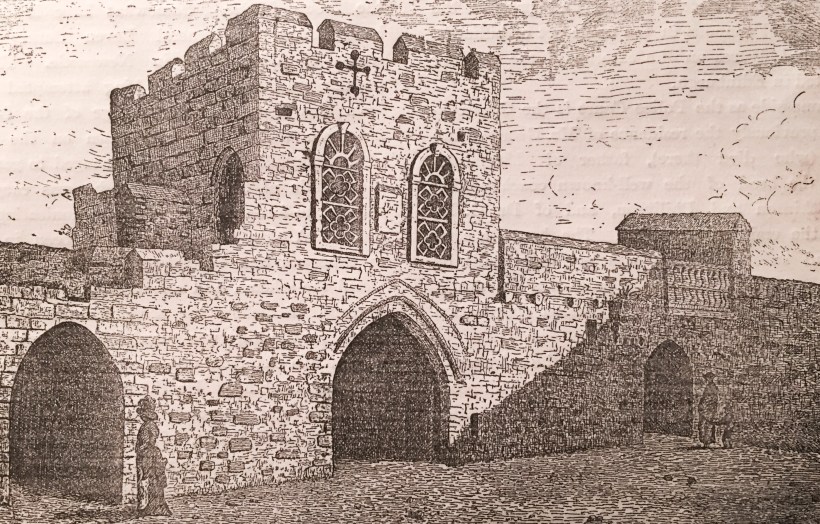
But now we approach the goal of our sauntering; for here before us, at the head of the street, stood the one formidable Pilgrim Gate, “remarkably strong, clumsy, and gloomy.” In the troublous times of old, it was, doubtless, a valuable means of defence when hostile foes threatened the beleaguered town. But when more peaceful days followed, when the mail-clad soldier no longer clanked through the now peaceful street, it by degrees dawned on the inhabitants that this once valued defence had degenerated into naught better than a public nuisance. Such ideas, however, do not take root in a day or a year. It was felt that the arch was so low as to obstruct the passage of waggons, and that it interfered with the free circulation of the air in the town. But the day of its doom was still distant, even when these opinions more and more made way. The Joiners’ Company had their hall above the gate; wherefore it behoved its worshipful members in 1716 to repair and beautify it, and the old relic of former days obtained respite. In 1771 another attempt was made to reconcile its preservation with the demands of the time; convenient foot-passages were opened out on each side. But these expedients did not answer their purpose, and in 1802 the whole gate was levelled to the ground. A cannon-ball was found in the wall on the occasion of the demolition. It was supposed to have been fired during the siege of Newcastle in 1644, when the gate was nobly defended.

Pilgrim Street Gate

Our sketch of Pilgrim Street Gate is taken from the engraving which appeared in the first volume of Brand’s “History of Newcastle.”

The Streets of Newcastle – The Sandhill

View of Sandhill, Newcastle, 1888The Sandhill cannot be omitted in any view of the streets of Newcastle. Its name explains itself. Before the Tyne was embanked by the quay, this place was nothing better than a hill of naked sand, where the inhabitants used to assemble for purposes of recreation.

There is an ancient plan of Newcastle by Speed, whereon only one public place is marked on the Sandhill, namely, the Maison de Dieu. This house, founded by the munificent Roger Thornton in 1412, has already been described in the Monthly Chronicle. The Merchants’ Guild used to hold their courts at “The Maison Dieu Hall” on the last Thursday in every month, their head meeting day on the Thursday after Mid-Lent Sunday, and went in procession on Corpus Christi Day, after high mass was done, to assist in the performance of their mystery-play, “Hogmagog,” the Mayor, Sheriff, and Aldermen, with their officers, having first attended upon the holy sacrament.

The Sandhill had its tragedies also, and notably in 1464. The Battle of Hexham leaves its grim traces in Newcastle records. In this disastrous battle were taken — amongst many others, “knights, esquires, and other men” — the Lords Ros, Molins, Hungerford, Findern, with two others (who would appear, according to the Arundel MSS., to have been Edward Delamere and Nicholas Massam). “Their heads were out off,” says the Year Book, 4 Edward IV., “at Newcastle-upon-Tyne, in a place called Sandhill; and they lie in the Friars Minors and Augustine.”

Adjoining the Maison de Dieu stood the Exchange, also built by Roger Thornton, according to Bourne, and occupying the site on which now stands the Guildhall. It was “a square haul place for the towne,” says old Leland, who visited Newcastle somewhere about the year 1540; but it was pulled down in 1655, and the present Exchange and Guildhall were erected by Robert Trollop, of York. His covenant for expenses amounted to £2,000; but Bourne was informed that the actual cost would be about £10,000. Some local wag wrote a doggerel epitaph on Trollop, which read as follows :—

Here lies Robert Trollop.
Who made yon stones roll up;
When death took his soul up,
His body filled this hole up.

On a line with the Guildhall was the passage from the Sandhill to the river known as the Water Gate; though in the Common Council Books of 1649 it is called the Windowes Gate. Nearly opposite to the Water Gate was the once famous Bella’s Coffee House, which in 1648 was the house of Thomas Bonner, then Mayor. In his year of office, a riotous affray occurred, thus recorded in the Common Council Books: — “Thomas Bonner, Esq., Mayor-elected, coming from the Spittle (October 2) to go to his dwelling house upon the Sand-Hill, the Serjeants carrying torches lighted in their hands, one Edmund Marshall threw a long stick at the said lighted torches, and struck divers of them out, and it being dark, stones, &C., were flung,” and so forth.

Katy’s Coffee House was another famous place of resort with our forefathers. It stood on the east side of the Sandhill, on or near the spot now occupied by the Royal Exchange buildings. The Lork or Lort Burn flowed past it. This burn ran down the Side, and over the Sandhill into the river. The street was thus divided into the Side and the Flesher Row, in the latter of which the butchers conducted their business, as well as in the Butcher Bank. Over the Lork Burn and opposite Katy’s a small bridge was thrown, and here, it is said, the town’s waits, or musicians, used to stand and play whilst Oliver Cromwell was entertained at dinner, either on his progress to or his return from Scotland.

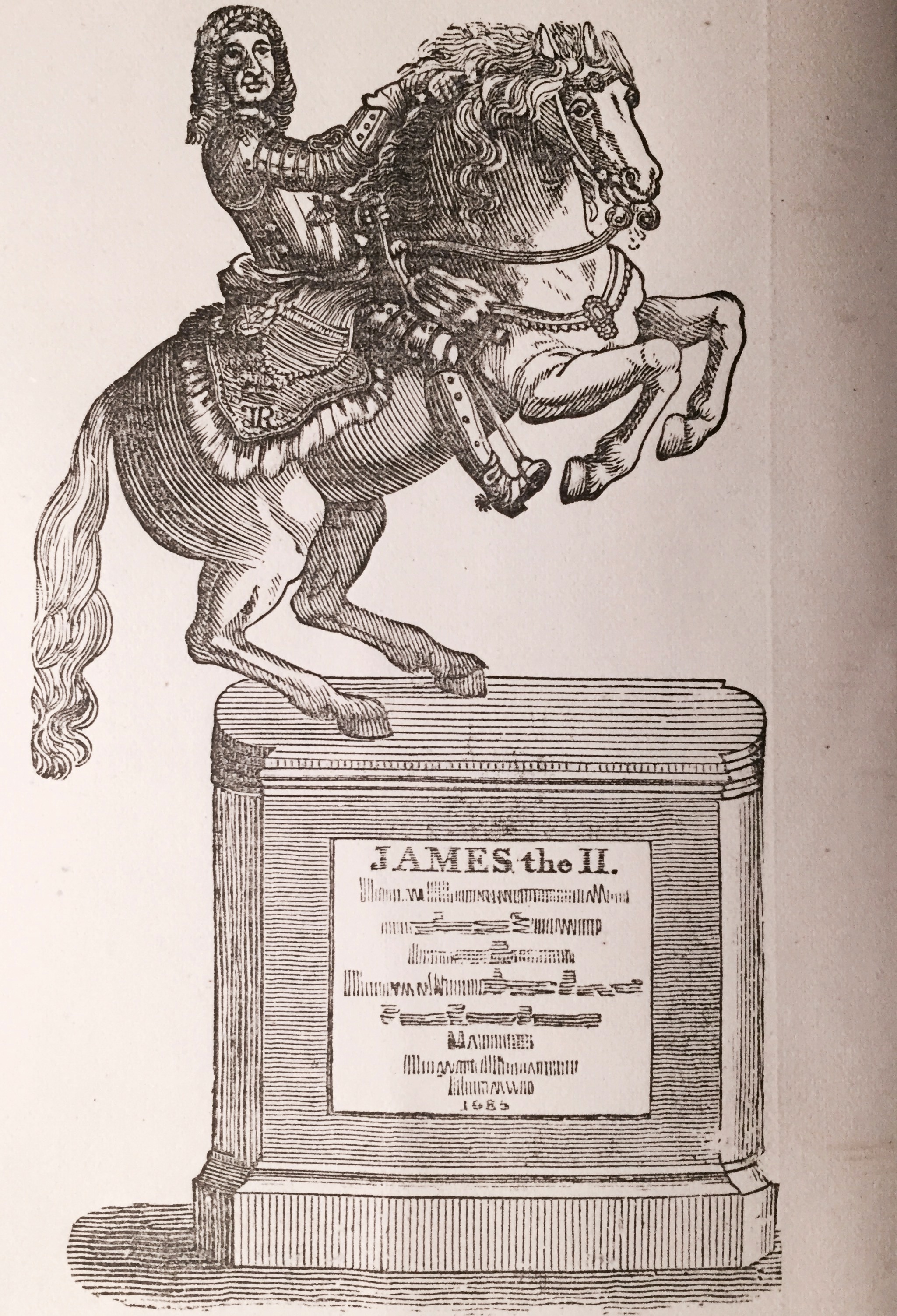
James II StatueA guest of another sort had been welcomed on the Sandhill a little earlier. In 1617, James I., on his way to Scotland, was met here by the Mayor, Aldermen, and Sheriff; and, after an oration from the Town Clerk, “was presented by the Mayor, in the name of the whole Corporation, with a great standing bowl, to the value of an hundred Jacobuses, and an hundred marks in gold; the Mayor carrying the sword before him, accompanied by his brethren on their foot-cloths. On Sunday, May 4th, following, his Majesty, with all his nobles, dined with the Mayor, when it pleased the King to be served by the Mayor and Aldermen. The King left the town on Monday, the 5th of May.” (Brand.) Thus was the first James ministered unto. His son, the first Charles, was caught in an unsavoury sewer, in an attempt to escape from his Scotch custodians. The second Charles we may still gaze upon in effigy as we pass the Exchange, habited as an ancient Roman. Let us conclude the record as it concerns this family, by adding that James II. had also his statue on the Sandhill, “on the south side of the bull-ring, and opposite to the court stairs.” It was cast in copper, and stood on a white marble pedestal; and, according to Bourne, it cost the town £1,700. In May, 1689, when William and Mary had been crowned about a month, away went this fine statue into the river. It was, however, fished up, and rendered of some use, as witnesses this extract from the Council books: — “April 1, 1695. All Saints’ parish humbly request the metal of the statue [of James II.] towards the repair of their bells. Ordered, that All Saints’ have the metal belonging to the horse of the said statue, except a leg thereof, which must go towards the casting a new bell for St. Andrew’s parish.”

Another house on the Sandhill of some note in its day is the Bee Hive. At one time it must have been occupied by well-to-do people, as its marks of ancient grandeur attested. There was, for instance, a large wainscotted room on the first floor, wherein was a very curious carved chimney-piece. This was presented by the owner, Ralph Naters, to the Corporation, and placed by that body in the oak room of the Mansion House. Other houses were remarkable for their excellent carvings also. There was Number 33, for instance, which boasted of a mantelpiece of most elaborate carving, bold in proportion, and in high sculptured relief. In the centre the royal arms were placed; and, arranged in separate compartments, were to be seen the four elements personified, with representations also of Samson slaying the Philistines with the jawbone of an ass, and David cutting off the head of Goliath. The carving was of the time of Charles II. Tradition hath it that this house was at one time the town residence of the Earls of Derwentwater; another tradition gives them a “local habitation in Westgate Road.”

Among these interesting buildings is that known as the Old Custom House, now a public-house, with one entrance from the Quayside and the other from the Sandhill. So far back as 1281, we find that the keeper of the “cockets” at Newcastle charged a duty of 6s. 8d. upon 300 woolled skins, the same sum upon a sack of wool, and 13s. 4d. upon a last of leather. In 1440, Robert Rhodes (a benefactor of St Nicholas’ and All Saints’ in his time) was made comptroller of the customs and subsidies of the King in the port of the Tyne. The new Custom House was built in 1765. It is curious to learn that an Independent congregation once worshipped in the Old Custom House Entry, having separated from “the church of Silver Street,” at the time of the pastorate of the Rev. James Shields (1765-85).

The Sandhill and The Guildhall, Newcastle, 1888The old house to the left of our engraving was that of Surtees the banker, associated in local history with the names of its “Bonnie Bessie,” and her faithful swain, John Scott, afterwards first Earl of Eldon. The story of the elopement hence will have to be told another time.

On more than one occasion coronation festivities have been celebrated on the Sandhill. When the second George was crowned in October, 1727, the bells were rung, the magistrates donned their scarlet gowns, and went from the Guildhall to church, music playing and cannon firing, “accompanied by the Common Council, clergy, and gentry.” Then they dined sumptuously, and returned to the Guildhall, where the healths were a second time drunk of the King, Queen, and Royal Family, “with many other loyal toasts,” the cannon firing at each health. “A conduit ran wine all the time for the populace.” A great “bonefire” was burnt, the ladies had a ball in the evening “at the Mayor’s house,” and the proceedings concluded with “rejoicings, bonefires, illuminations, ringing of bells, and all other demonstrations of joy.”

An alarming bread riot occurred some thirteen years later. Provisions were very dear. The militia were called out; at their head Alderman Ridley announced that the corn factors had set a certain fixed price on their grain; and the tumult was stayed for the time. But for a time only. Some of the factors vanished from the town; the rest kept their shops closed. “The pit-men, keelmen, and poor of the town,” accordingly plundered the granaries, and stopped a vessel about to sail with a load of rye. This was on the 2lst of June, 1740. On the 25th, the militia were disbanded. As a consequence of this strange step, an immense multitude assembled on the Sandhill the very next day, whilst the Mayor and Aldermen were consulting in the Guildhall on the steps to be taken in the emergency. The mob became unruly. They were fired upon; one rioter was killed, and several others wounded. The Guildhall was thereupon invaded; most of those assembled there were wounded; the court and its chambers were ransacked. Many of the public writings and accounts were destroyed, and a very large sum of Corporation money was carried off. Then the rioters traversed the streets, and “threatened, with horrid execrations, to burn and destroy the whole place.” The military were summoned from Alnwick; forty of the rioters were arrested, whilst the others were suffered to disperse; and at the next Assizes six of the ringleaders were each transported for seven years. This riot is said to have cost the Corporation £4,000.

In 1745, war was proclaimed on the Sandhill (amongst other places) against France, “the Mayor and Aldermen attending in their scarlet gowns, accompanied by their proper officers.” In April, 1749, there was a general thanksgiving for the peace which followed, and wine again ran from a fountain on the Sandhill for a considerable time. Three volleys were fired from the Exchange by three regimental companies. Wine again flowed from a Sandhill fountain in November, 1760, “when George the Third was King.” Mayor and magistrates were to the fore “in their scarlet robes, preceded by the town’s band of music and the regalia,” and attended by the colonels and officers of the two regiments of Yorkshire militia then stationed in Newcastle. “Many loyal healths were drunk” ; there were the usual “joyful acclamations”; and the rejoicings concluded with a ball and illuminations. The pillory was brought into use in 1766, when one Jean Grey, convicted of perjury, was paraded there for an hour, pursuant to her sentence. In 1768, a too adventurous sailor was killed here by an infuriated bull which the populace were engaged in baiting.

The coronation of George IV. was celebrated in grand style on the 19th July, 1821. Strangers poured into the town in thousands to take part in the rejoicings. Royal salutes were fired from the Castle; flags and colours were everywhere displayed; and the church bells rang their merriest peals. In honour of the occasion, the Mayor (Mr. George Forster) was invested with the gold chain and medallion still worn by our chief magistrates on state occasions. Everywhere there were mirth and jollity – of their sort. An ale-pant ran in the old Flesh Market (which was next to the Cloth Market); it was demolished whilst the beer was running. A similar fate befel the Spital ale-pant; indeed, the mirth and jollity were not without their attendant disorder in all parts of the town. It is, however, with the proceedings on the Sandhill on this day that we have at present to do.

The Sandhill PantIn the centre had been erected an elegant pant, twelve feet high, which was surmounted by a handsome crown. From this it was intended to supply the populace with wine. The Mayor and magistrates went dutifully to St. Nicholas’ Church, where Vicar Smith preached them a sermon. This done, they returned to the Sandhill, and appeared at the great window of the Town’s Court to drink the king’s health, to the accompaniment of a royal salute from the Castle. This was to be the signal on which the wine was to flow with regal lavishness from the pant. It speedily became a pant of Pandemonium! Fair it was to look upon in the early day, being painted to resemble stone, and displaying full gaily its showy cupola of copper bronze, and its crown and crimson velvet cap of State turned up with ermine. But the Sandhill had its thirsty souls then, as indeed it has now. One of them climbed to the top of the pant, sat down on the cupola, and placed its crown on his own head. This served to amuse the waiting multitude while the magistrates were at their devotions. When the signal was given that the wine should flow, off came the crown from the adventurer’s head, and away into the river it was speedily kicked. The original idea was that the Mayor and Corporation should drink the Royal health at the pant; but this they found it impossible to do by reason of the surging crowd. The wine, however, poured forth its ruby stream at the signal from the Castle; and then ensued an indescribable scene. Hats, caps, vessels of all descriptions were brought into requisition; and might was right that day. Amongst other things, a man got upon the tub set below the spout, and endeavoured to wrench the latter off. The reeling mob would not have this. They tore off his upper clothing; they did not even spare his “unmentionables.” The wine ran for about an hour, and then it “gave out,” as our American cousins would say. Forthwith, the mob began to throw about the pots and the soaked hats and caps. Finally, they tore down the pant bodily.

The Sandhill has, to this day, a peculiar character of its own. Its open-air public meetings each Sunday morning may be regarded as so many self-acting ventilators for the diffusion of the grievances and the crotchets of those who are not much in the habit of troubling church or chapel with their attendance. Much sound sense and much nonsense, too, have been talked at these meetings. Eccentric preachers, such as David Davies, the best known of them all, can there discourse at length on things in general. The teetotallers are ever in earnest here, though it is long since they lost the services of Tommy Carr, a Tyneside philosopher whose racy utterances it was impossible for anybody to resist, so redolent of the native Doric were they. Thus the historic ground trodden by kings and king-makers in the past has become the open-air conference room of the toiling masses of today!

The Streets of Newcastle – Mosley Street & Dean Street

Old Theatre Royal, Mosley Street, NewcastleMosley Street is comparatively modern, having been begun in 1783. It was named after an alderman of that day, and was regarded as a decided improvement. And so it was; but it is to be regretted that, when it was made, some of the monuments and tombstones sold by auction at the restoration of St. Nicholas’ Church the same year, should have been employed in its construction. This contempt for sacred monuments was too common at that time. Alderman Hornby, an antiquary of the period, who lived in Pilgrim Street, preserved in his garden portions of the monuments thus disposed of. Amongst others, Mrs. Carr’s effigy, from George Carr’s monument, was so preserved; it is now in the old Castle. Such disregard for the memory of the dead and the feelings of the living would scarcely be tolerated today; at least, not without an earnest protest. But the work was in itself a street improvement all the same. At the time the Cloth Market ran in a continuous line to the church yard, whilst the Groat Market went as far as its northwest corner; but narrow passages permitted the pedestrian to pass from the one end of the exterior of the church to the other.

Beginning at the Pilgrim Street end of Mosley Street, we note that the building at the southern corner is Messrs. Woods’s Bank, the old establishment of Sir Matthew White Ridley and Co. Mrs. Jameson, when a child, resided with her father, Mr. Brownell Murphy, a miniature painter, above the shop of Richard Ratter in Mosley Street. It was in the premises occupied by Messrs. Mawson and Swan that Mr. Joseph Wilson Swan conducted the experiments in electric lighting that led to the invention of the Swan Lamp. These same premises were gutted by a great fire which occurred on January 17, 1880.

When we arrive at the centre of Mosley Street, we find Dean Street meeting it from the south. The formation of Mosley Street caused the Corporation to take in hand also the improvement of the neighbouring portion of the town. What is now Dean Street was then an awkward and unsavoury dean, or dene, with high and precipitous banks on either side. The Lork, Lort, or Loot Burn — for the name has been spelt in all these ways — ran down it to the Side, where it had been covered over. The authorities saw that they could no longer leave this locality alone. Some three years, therefore, after Mosley Street was constructed, the work of improvement was begun. It was found necessary to remove the old Nether Dean Bridge(the thoroughfare is still called the. Low Bridge), which, it may be remembered, crossed from Pilgrim Street to St. Nicholas’ Churchyard. The bridge was a very ancient structure. The old Roman Wall probably ran along it, passed the north side of the mother church, near the present site of the Turf Hotel, and then onward up Westgate Hill. Bourne, copying Gray, says, “the river ebbed and flowed above this bridge, and the boats came under it with the wares and commodities of the merchants.” Dr. Bruce quotes Mr. Wardle, an architect of Newcastle, as having told him “that in examining, some years ago, a cellar at the corner of the Painter Heugh and Dean Street, he noticed what he took to be the remains of a quay,” that “an iron ring was inserted in the masonry,” and that “the masonry in the vicinity of the ring was marked as if by the action of boat-hooks.” Baillie, in his history, says that boats came as far as the foot of the hill up which Dean Street runs. And this seems the most feasible theory of the three. The statements of Bourne and Gray, at any rate, are rather improbable. Dr. Wolcot — “Peter Pindar” — satirised George III. once for not knowing how in the world the apples got into the dumpling. Similarly, it is not easy too see why the river should not find its level before getting so far up the hill as the Low Bridge.

The North-Eastern Railway crosses Dean Street over a lofty and beautiful arch, from which a fine view of Grey Street might be obtained if the directors of the company could only be induced to lower the parapet.

The circumstance which most of all gives Mosley Street its historical interest is its association with dramatic art. True, the drama was popular in Newcastle long before Mosley Street was thought of. Not to mention the old miracle plays, which were probably performed in the open air on the Sandhill, there were bands of strolling players in Newcastle from the times of the Plantagenets. In modem times dramatic entertainments were given in the Moot Hall, Castle Garth, and in a booth set up in Usher’s Raff Yard, near at hand. Then, in 1748, a third establishment was fitted up in the Turk’s Head Inn, not the present hostelry in Grey Street, but the original house of that name in the Bigg Market, subsequently converted into a chemist’s shop. Amongst others, Munden acted here. But this did not long meet the wants of the day; and accordingly, in 1785, it was resolved by some of the literary men of Newcastle to build another theatre, elegant in plan and commodious in structure. We have already said that Mosley Street had just been formed. It was rightly regarded as an ornament to the town; and here it was settled that the site of the new theatre should be. It was a brick building, with a decorated portico, as seen in the picture, facing down Dean Street. On its west side was Drury Lane, an old passage leading from the Flesh Market, or Cloth Market, to the Lort Burn. Some of the entrances to the theatre were in this narrow by-way, and as it is still standing: and retains its designation, the position of the building may be easily traced. A royal license for the performance of stage plays was obtained in 1787, and on the 2lst of January following the theatre was opened with Arthur Murphy’s comedy, “The Way to Keep Him” and “The Sultan.” The enterprise began well, nor did public favour fail to support it through many succeeding years.

Among the earliest performers in the new theatre was George Frederick Cooke, one of the very ablest actors of his day, though assuredly, also, as erratic as able. Cooke’s Sir Pertinax Macsycophant, Sir Archy Macsarcasm, Iago, Falstaff, and Richard were admitted by his own contemporaries on the boards to be beyond challenge by the best of them. In the Mosley Street theatre, he opened, as the players say, in Othello. “Here,” he says, “I met with most flattering applause, which I continued to receive while I remained attached to the theatre. My own night the first season was ‘Richard the Third,’ in which Miss Duncan, now of Drury Lane Theatre, acted the Duke of York.” Mrs. Siddons and he appeared together in Newcastle in 1789; and in the same year, on the same boards, he first saw and played with Mrs. Jordan, an actress who stood as unrivalled in comedy, particularly in girls of every description, as Mrs. Siddons did in the sublime, the terrible, and the pathetic of tragedy.

Stephen KembleStephen Kemble, who used to play Falstaff without stuffing, became sole manager of this Mosley Street Theatre in 1792, and continued so for fourteen years. He was a remarkable member of a remarkable family; brother of John Kemble – “Black John” and “King John,” Cooke would sometimes call him when in one of hit sarcastic moods, though they were good friends for all that; of Charles Kemble, the finest light comedian of his time; and of Mrs. Siddons, so unapproachable in graver parts that she sat to Sir Joshua Reynolds as the representative of the Tragic Muse. Stephen himself excelled in the old men alike of tragedy and comedy; yet he had a curious fancy for playing Hamlet, even when he weighed eighteen stones. A caricature likeness of him in this part, with the quotation beneath, “Oh, that this too, too solid flesh would melt,” rather checked his ardour in the indulgence of this hobby at last. He wrote several plays, odes, and lyrical pieces; and Brinsley Sheridan pronounced him to be the very best declaimer he had ever heard, on or off the stage. He died in retirement at his seat, the Grove, Durham, where his remains were interred in the Chapel of the Nine Altars, at the east end of the Cathedral, and on the north side of the shrine of St. Cuthbert

The inimitable comedian, Liston, the original Paul Pry, was a member of one of Stephen Kemble’s stock companies in Newcastle. Commencing life as a pedagogue of humble pretensions, a teacher’s assistant in a day school, Liston possessed such rich comic powers as carried him to the very front rank in his profession. “How is it possible,” asks John William Cole in his Life of Charles Kean, “to fancy boys looking seriously for a moment on that magazine of fun which his countenance must ever have exhibited? By some strange infatuation he imagined himself destined to excel in the heroes of tragedy, and was not a little mortified when on benefit nights he played Borneo and Octavius in sober seriousness that the audience insisted on receiving them as burlesque. George IV. encored him from the royal box in Maw-worm’s Sermon (in “The Hypocrite”) which ever afterwards stamped that unbecoming mummery with a singular reputation and a similar call.” Liston died in 1846, aged sixty-nine, in the possession of a handsome fortune.

William Macready succeeded Stephen Kemble in the management, and remained in it for twelve years. His famous son, William Charles, commenced his career as an actor in Mosley Street.

A melancholy incident in connection with the old theatre must be mentioned. On the 19th of February, 1825, “Tom and Jerry” was produced, under Mr. De Camp’s management. Hardly had that play commenced, when a cry of “Fire !” was raised, a flash was seen, and a great quantity of smoke soon after penetrated through the floor of the gallery. Panic ensued; the inevitable ugly rush came; the gallery stairs were blocked up; the check-taker, in attempting to open the barriers, was thrown down the stairs; and when at length the results came to be ascertained, it was found that seven persons had been killed.

In the face of a record such as we have given above, who shall deny that “Newcastle can boast of having been a famous nursery for dramatic genius”? Here, in this one theatre, at various times in its history, Newcastle had Mrs. Siddons, Mrs. Jordan, Miss Duncan, Cooke, the Kembles, Liston, and Macready. Some came as stars; others, who came as strangers and as members of the stock company, the kindly yet discriminating criticism of Newcastle audiences sent away to become stars. A sorry day will it be for the real interests of the drama in Newcastle if that criticism should ever cease to be discriminating as well as generous! It remains only to add that the projects of Richard Grainger caused the Mosley Street Theatre — or Drury Lane, as it was at other times called — to be pulled down; and with its destruction there closed no inglorious chapter in the artistic history of Newcastle.

The Streets of Newcastle – Castle Garth Stairs

Castle Garth StairsStanding upon the Swing Bridge over the Tyne at Newcastle; and looking up at the steep hill on which stand the Castle and the Moot Hall, it is hard to imagine the state of the declivity before its face was covered by the blocks of houses which now crowd it. Still harder is it, looking up the Castle Garth Stairs, hemmed in as they are on either side by high buildings, to recall the time when it was a mere footpath running up the wooded side of the hill to the ancient British fort perched on its summit. Yet it is not unreasonable to suppose that such was the case, and that the footpath occupied this very site. However this may have been, there is no reason to doubt that there was here a road way up the hill at least as early as A.D. 120, when Hadrian built his bridge across the Tyne, for it would be the nearest means of access from the bridge to the Roman castle, which was built where the Moot Hall now stands. It is probable, too, that stairs were then formed, and that they have ever since followed the same line.

At what period houses were first built on either side of the stairs it would be hard, if not impossible, to determine; but it is unlikely, as long as the eminence above was occupied by fortifications fit for service, that any buildings would be allowed here to form a sort of covered way for an attacking enemy. What was the nature of the buildings on the hill top in Saxon times, when Newcastle was the abode of religion and went by the name of Monkchester, we know not; but, in the time of the Conqueror, his eldest son Robert erected a castle here, afterwards rebuilt by William Rufus, and again replaced, in the reign and under the direction of Henry II., by the magnificent pile of which the Keep and some other portions still remain.

The Postern which stands near the head of the stairs, as shown in our illustration, and which Dr. Bruce says is the only Norman Postern extant in England if its circular arch is original, is a proof of the importance attached to this climbing road way. The arch does not go straight through the gate tower, but, for greater security against an attacking force, changes its direction about half way, and goes off at an obtuse angle from its original course. So we may safely conclude that for some time after the building of the Castle no houses were built upon the stairs. But we know bow the Castle Wardens in time began to neglect their duties, and suffered the place to fall into disrepair; for, when Edward III. came to the throne, “the castle of Newcastle-on-Tyne was so decayed that there was not in all the castle a single house or room where one could be received, nor one gate which could be closed.” Of all this neglect advantage would doubtless be taken by enterprising citizens; and so dwellings and shops would be erected on the stairs. King Edward set to work with vigour, and repaired the castle; but, as the town walls were now completed, there was less need of the inner fortress, and the clearing of its approaches might not be thought so necessary as before.

The Streets of Newcastle – Neville Street & Scotswood Road

The Central Railway Station, Newcastle-on-Tyne, 1889We propose now to set forward towards Scotswood Road from the well known corner where Grainger Street ends by joining Neville Street. For otherwise we should slight our famous Central Railway Station sadly; and that would never do.

It was in the year 1847 that the need of a new and central railway station, commensurate with the growing requirements of the town and neighbourhood, was felt to be imperative. Accordingly, on the 13th of September in that year, building operations were commenced, which continued for nearly three years. At last, August 29th, 1850, Queen Victoria came to Newcastle to open the new station. Her Majesty was received in all form by the corporate authorities, and by a detachment of the 33rd Regiment, then stationed at the barracks. There were also present Earl Grey, as Lord-Lieutenant of Northumberland; Sir Walter Trevelyan as High Sheriff; and many other dignitaries of the district. The Royal party consisted of the Queen, the Prince Consort, the Princess Royal, the Prince of Wales, Prince Alfred, and the Princess Alice. An elegant luncheon was prepared for the visitors; corporate addresses were presented; and there was much firing of cannon and so forth. It need not be added that the streets were thronged. The visit, however, was a very brief one, lasting twenty minutes only, after which Royalty proceeded northward.

As to the station itself, it is of the Romano-Italian style of architecture, with ornamental work of the Doric order. Its principal front is about six hundred feet long, and the station occupies altogether an area of about three acres. It was built by the York, Newcastle, and Berwick, and the Newcastle and Carlisle Companies, jointly, at an original cost of about £90,000. Of course, alterations and repairs, &c., must have since added considerably to that sum. The architect was Mr. John Dobson, whose skill and genius were never better shown than in the beautiful curved roof of the building,

In 1850, on the 30th of June, and, therefore, prior to the formal opening, the station was en file, on the occasion of a banquet given within its precincts to Robert Stephenson. In addition to the conventional adornments of banners, devices, and the like, it was appropriately bedecked with handsome views of the Menai Tubular Bridge, the Berwick Viaduct, and the High Level Bridge, in honour of the celebrated engineer whose name will ever be associated with these great works. The Hon. H. T. Liddell, M.P., was in the chair on this occasion, in graceful recognition of the helpful hand held out to George Stephenson in his early struggles upward; the vice-chairs were occupied by the Mayors of Newcastle and Gateshead (Messrs. Crawhall and Hawks); and about four hundred persons sat down to dinner.

Across the road from the station stood the Railway Arcade public- house (so called from a covered archway of glass which gave communication into Westgate Koad). In 1855 it was kept by one Beardsmore. On the 22nd of December, in that year, about four in the morning, P.C. Ellison, being on duty close at hand, heard cries of “Murder! murder!” in a female voice. They proceeded from the back premises of this public-house. Ellison hastened thither and knocked at the door, which was forthwith opened to him by the landlord. On entering the premises, the policeman found Mrs. Beardsmore lying in the passage, bleeding; and he ascertained that she had sustained some severe wounds on the head. After seeing to the removal of the woman for surgical treatment, he apprehended her husband on the charge of having thrown her out of an upstairs window. This charge, on the death of his wife a few days later, was altered to one of manslaughter, on which Beardsmore was, in due time, put upon his trial before Mr. Baron Martin. It was conclusively proved that both husband and wife were dissipated characters; it was also shown that on this fatal night they had had a serious quarrel; and, accordingly, Beardsmore got off with a sentence of six months’ hard labour. This is the only tragedy associated with the name of Neville Street a name which was given to it in remembrance of the Earls of Westmoreland, who had their town house on the site of the Literary and Philosophical Institution. The thoroughfare was opened so recently as the year 1835, being then formed to advance the interests of the new Cattle Market, of which we must now say something. We pass on the way to the Cattle Market St. Mary’s Roman Catholic Cathedral, which is adorned with a lovely spire, designed, by Messrs. Dunn and Hanson, though the main building was designed by the celebrated Pugin.

There are veterans amongst us who can remember the time when Newcastle butchers had to travel to Morpeth on its market day to make their bargains. This arrangement no doubt suited the graziers and farmers of the district of which Morpeth is the centre well enough, but it was found an irksome one by their Newcastle customers. There was the coach fare to pay. There was the man or boy sometimes both to think about. These had to make the journey on foot the night before, and usually broke their fourteen miles’ walk at some convenient spot on the roadside, where they slept in the open air. Moreover, the road was not a particularly safe one. For these reasons a beginning was made, in a small way, with a cattle market at Newcastle about the year 1830 or 1831. For a long time the ground between the Infirmary and Marlborough Crescent proved sufficient for all the purposes of the market. Then new pens were erected for large cattle to the westward of the Infirmary.

The Infirmary was in the first instance the result of a kindly thought on the part of some members of a convivial society which was about to break up in 1751, who desired to leave behind them a charitable memento’ of their merry meetings for the benefit of posterity. Amongst them was Joseph Airey, George Headlam, Ralph Headlam, Richard Burdus, and Richard Lambert, a young surgeon. The latter is supposed to have been the author of a letter inserted in the Newcastle papers in advocacy of the project, signed B. K. In remembrance of this letter, one of the wards of the Infirmary is still called B. K. A house in Gallowgate was secured, to begin with, as a temporary hospital. Soon another house was needed, and secured. Subscriptions for a permanent building flowed in freely, amongst them being a shilling found in the poor’s box, wrapped up in a paper containing these lines:

To serve the needy, sick, and lame,
This splendid shilling freely came,
From one who knows the want of wealth,
And, what is more, the want of health.
Beneath this roof may thousands find
The greatest blessing of mankind;
And hence may millions learn to know
That to do good’s our end below;
That vice and folly must decay
Ere we can reach eternal day.

The famous Joseph Butler, Bishop of Durham, laid the foundation stone of the present structure in September, 1751, and it was ready for patients thirteen months later. An addition was made to it in 1801-2. The hundredth anniversary was celebrated in 1851, when a further enlargement was made. Since that time still other additions have been carried out.

Some eminent physicians have been connected with the Infirmary at various times, as, for instance, John Clark, “the greatest benefactor of the afflicted poor that ever appeared in Newcastle.”; Adam Askew, ancestor of the Askews of Pallinsburn; John Rotherham, author of “A Philosophical Essay on Water”; and Edward Kentish, a clever man with some odd opinions, as when he argued that the French Revolution was “a moral and political epidemic,” to be cured by “a cooling regimen and free ventilation.” The institution has had some remarkable patients too, but we have only space for one, to wit, “Radical Jack,” who died here in 1848, at the age of 54. His real name was John Dennis, and he gained his living by hawking cheap periodicals, though he was said to have received an excellent University education. He was certainly a man of ready wit and great command of language, but ah, that fatal but! “for years he was hardly ever sober.”

We have not forgotten that in going from Neville Street to the Cattle Market we have passed the site where once stood the celebrated Forth House. But the ancient Forth, completely transformed in its character and surroundings within living memory, has been described in a previous volume (coming soon! to Northeastlore).

Scotswood Road, which begins beyond the Cattle Market, was only commenced in the summer of 1834. It has been growing ever since, and is now a long thoroughfare of shops and public-houses. The streets which run off from Scotswood Road are, in their names, suggestive of the rural character of this neighbourhood up to a recent time. Amongst them we have, for instance, Pine, Laurel, Sycamore, and Maple Streets. As we progress onwards, we come to the famous Elswick Ordnance Works of the great firm of Sir William Armstrong, Mitchell, and Co., which are amongst the industrial glories of their time, and give employment to thousands of artizans in their various departments.

Elswick Works, Newcastle-on-Tyne, 1889In August, 1846, a thunderstorm did considerable damage in Scotswood. A row of houses called Greenhow’s Terrace, fell to the ground, and fifteen persons were also struck down. Some of these were dreadfully scorched, but they all eventually recovered.

In the next year, in the month of April, a young man made his appearance at the house known as the Ord Arms, Scotswood, then kept by one John Cox. He took lodgings here, stating that he had come to Newcastle to be trained by Harry Clasper for a skiff race to be rowed shortly at Manchester. The young man’s name was John Bourne, and he was respectably connected. To a Scotswood publican of that day, the thought of having for lodger an oarsman training under the redoubtable Harry was a pretty considerable bait. Cox swallowed it; and at night lodged the new comer in his own bedroom. Behold! in the morning the lodger had vanished, and with him £200 had gone also, as a chest of drawers broken open too surely testified. The thief, captured at Normanton railway station with all the money upon him, was transported for ten years.

Scotswood Road has its tragedy, young as it is. On October 22nd, 1854, the bodies of two young women, decently dressed, were found drowned in the Tyne. They turned out to be those of Ellen and Isabella Robinson, fifteen and thirteen years old respectively, daughters of Ezekiel Robinson, who lived in Duke Street. How came they in the river? Well, there had been a slight family quarrel, which induced Ellen to rush from the house at midnight. Isabella followed her. Ellen, who was of a very passionate temper, jumped into the water. Isabella followed, hoping to save her, and both were drowned.

Prints?

Hi, I got myself a print of the Sunderland Bridges illustration and it looks fantastic framed. Just wondering if anyone would be interested in buying a print of any of the illustrations I’ve been posting. If there’s enough interest I’ll get a limited run of high quality prints done. I sell my own prints and would double mount them with backing board so you can frame them to your taste. I’ve gone for a 10 X 8 image size which looks really good. Depending on the cost to produce and demand they would be priced at around £25 to £30 per print. Please let me know on the Facebook page if you’d be interested. Thank you.