Vol 3 – No. 29 – July 1889 – John the Pieman, a Sunderland Character

JOSEPH CAWTHORNE, familiarly known as John the Pieman, was a well-known figure in the streets of Sunderland thirty or forty years ago. John’s “pies all hot” were made of good materials, and he used to cry them in a fashion peculiarly his own. When any young customers came, they were required to put pennies down on the tin-lid, and ask: “Heads or tails?” If “John” guessed right, he whipped up the pennies and gave them no pies; but if he guessed wrong, they got their pennies back, and pies each into the bargain. “Toss or buy, gentlemen,” he said on such occasions; “I am the only man in Sunderland who fought at Waterloo.” And this boast was commonly taken to be well founded, as it was sustained by the medals he displayed on his breast when in holiday costume. These seemed to bear out that “John” was one of the few surviving heroes of the Peninsular War, and of the great battle on the plains of Waterloo. According to his own account, Joseph Cawthorne was born on the anniversary of the Decollation of St. John the Baptist, the 29th of August, 1790, at Newark-on-Trent. When he was fourteen years of age, he was bound apprentice to a canvas weaver; but he was hardly out of his apprenticeship when he joined the Montgomeryshire Militia, and shortly afterwards volunteered into the first battalion of the Rifle Brigade. After a six weeks’ furlough, he proceeded to Lisbon to join his regiment, marching through Portugal to Spain. He fought at Vittoria, the Pyrenees, and Toulouse, and in nearly every one of the hotly contested engagements in the Peninsula ; and he had the rare good fortune to be only once wounded, and that but slightly. But at Waterloo he was wounded a second time, and that rather more severely. After returning to England, he continued in the service of his country for three or four years more, and then took his discharge. This was about the year 1819. Unfortunately, he got no pension, for what reason we cannot say; neither do we know what chance brought him to Sunderland, where he eventually took up his abode, and managed to make a decent living in the way above indicated. When he had reached his sixty-eighth year and began to feel the infirmities of old age, efforts were made to get him a small pension, and the consequence was that he had sixpence a day allowed him, which was increased in 1863 to ninepence, and in 1866 to a shilling a day. The old pieman died in 1869, in his seventy-ninth year.
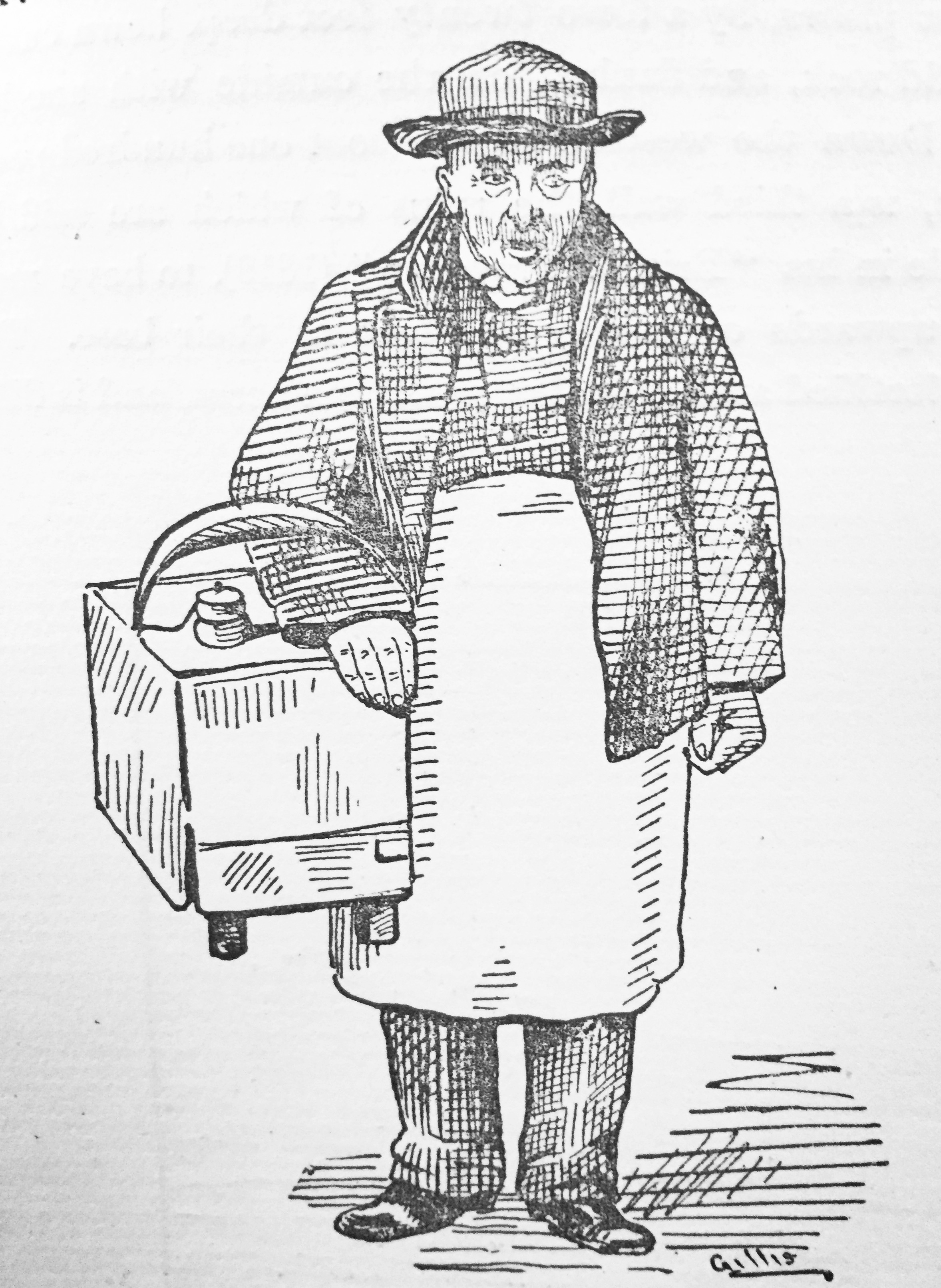
John the Pieman

Vol 1 – No. 7 – September 1887 – Making Money

In a public house just outside Newcastle, a few weeks ago, a conversation took place between some men present as to a certain individual in the neighbourhood who had made a good sum of money, “nebody knaad hoo”.  Geordie Muffin was asked if he knew the party in question, and if he could account for so much money being “myed oot o’nowt” “Yis”, answered Geordie, “aa knaad him varry weel”.  He was a queer man an’could myek money oot o’nowt.  Aa knaw for a fact, myets, that he used to gan to Newcassel an’ buy spades for haaf-a-croon, an’ sell ’em for eighteenpence, and then myek a profit”.  There was a pause, when suddenly Geordie added: “Yis, ‘caas the beggor nivvor paid for ’em!”

Vol 3 – No. 23 – January 1889 – The Lion Bridge, Alnwick

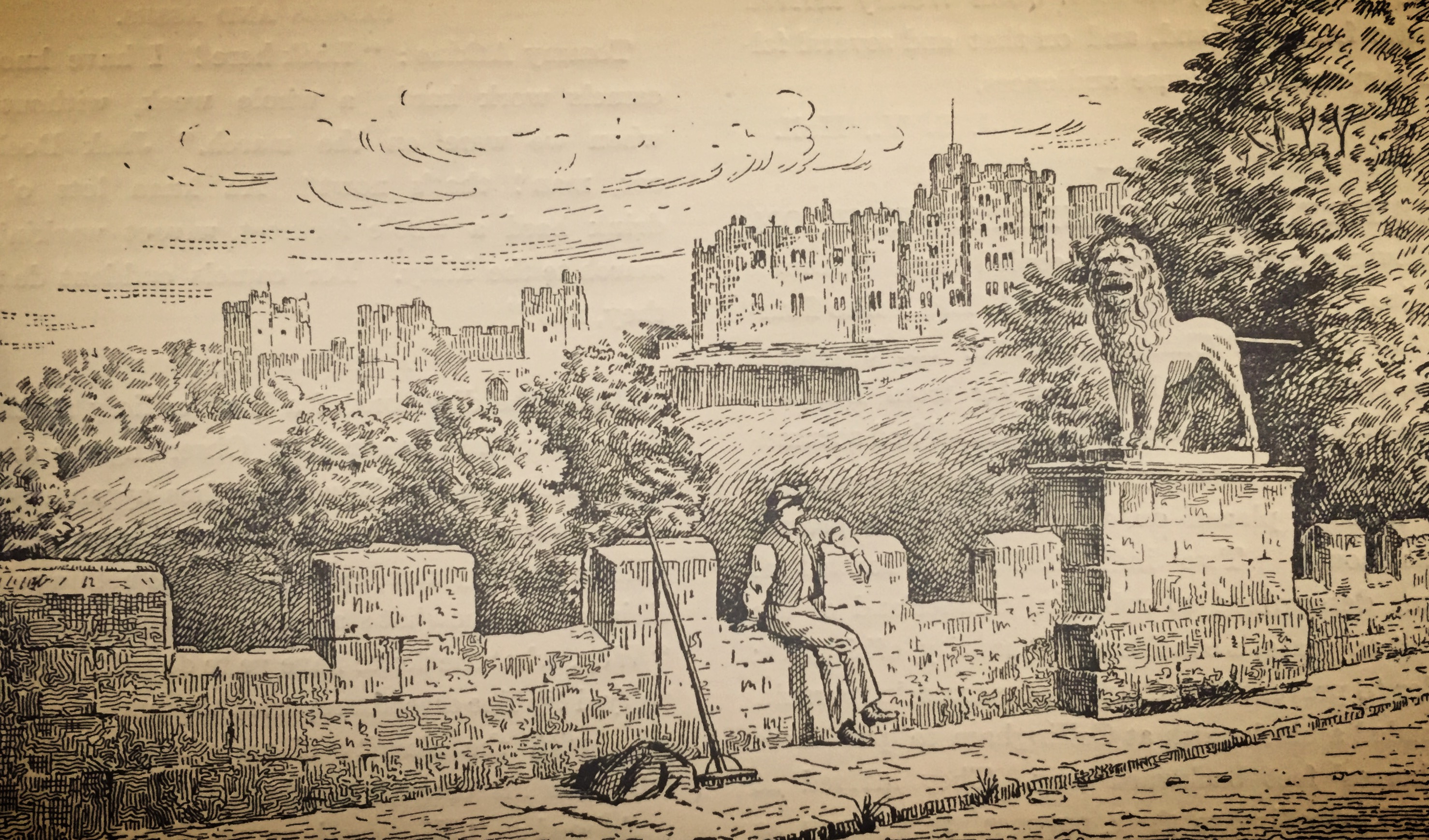
Many subjects engage the attention of the antiquary and the painter in the neighbourhood of Alnwick. The Castle, of course, stands first in importance, and it is this venerable structure which is delineated in our sketch, the standpoint being the Lion Bridge, itself a most picturesque object. From the battlements of the bridge a fairly comprehensive view of the castle may be obtained. Those who wish to include the bridge and castle in one grand scene will have to walk a short distance along the river bank. It is here that the artist may frequently be seen with busy pencil. The bridge figures prominently in Turner’s great picture of Alnwick by moonlight. An incident in connection with it is described by Oliver Wendell Holmes in his “Autocrat of the Breakfast Table,” as an illustration of the strange fact that trivial things are often remembered when more important ones are forgotten. ” I remember,” he says, “the Percy Lion on the bridge over the little river at Alnwick the leaden lion with its tail stretched out straight like a pump handle and why? Because of the story of the village boy who would fain bestride the leaden tail, standing out over the water which breaking, he dropped into the stream far below, and was taken out an idiot for the rest of his life.” Alnwick Lion Bridge

Alnwick Castle, Northumberland circa 1829 Joseph Mallord William Turner 1775-1851 Art Gallery of South Australia, Adelaide; South Australian Government Grant 1958 http://www.tate.org.uk/art/work/TW0864

Vol 3 – No. 25 – March 1889 – A Fatal Balloon Ascent from Newcastle

In the evening of Monday, August 15, 1859, an immense number of people were assembled in the old Cricket Ground, Bath Road, Newcastle, to witness a balloon ascent, the aeronaut being a man named William Henry Hall, better known as “Captain Hall,” who had a great reputation as a gymnast. The entertainment, or “grand gala” as it was called, was a speculation of Mr. Smith, the first lessee of the Victoria Music Hall, Grey Street, and as regards attendance the affair was certainly a success. Special trains were run to Newcastle, not only from many places in the locality, but from even as far as Berwick. As the evening was very fine, everything promised to pass off pleasantly. It took three hours to inflate the balloon ; but at ten minutes to seven the ascent was made amidst the crash of music and the loud cheers of the spectators.

When at the height of about a thousand feet, Hall got out of the car, and began a series of most extraordinary gyrations on a trapeze, holding on first by his hands and then by his feet, while he performed his sickening exploits. Women screamed, and even strong men averted their faces in terror, so that it was quite a relief when the acrobat again took his seat in the car. Shortly after this, attention was called to the apparent eccentricities of the balloon, which at times descended quite low, and again shot up suddenly to a great height, until it appeared no larger than an ordinary hat. Finally, it passed out of sight, and the people in the grounds became interested in the music of the bands and other entertainments provided for them.

Soon after ten o’clock, the cab which had been engaged to follow the balloon and its occupant arrived at the Cricket Ground. The driver had a sad story to tell. He reported that the poor “captain” had fallen from the car, and was then lying in a critical condition at the residence of Mr. Hugh Lee Pattinson, Scots House, near the Felling. Mr. Smith, accompanied by a surgeon, immediately drove to the scene of the accident. Some men who were working in a field when the balloon descended, stated that it came down slowly and steadily, and that Mr. Hall was just in the act of stepping out when it rose again with great velocity.  Hall’s feet became entagled in the ropes, and for some seconds he hung suspended head downwards, and then fell a distance of fully 120 feet. He was taken up unconscious, placed upon a couple of corn “stooks,” and carried into Mr. Pattinson’s house. That gentleman did all he could for the sufferer; and on the arrival of Mr. Smith with medical assistance, it was found that no bones were broken, nor were there wounds of any kind to be seen. Mr. Pattinson provided a spring cart, which was made as comfortable as possible with cushions, &c., and the injured man was conveyed to Newcastle. On his admission into the Infirmary, he was attended chiefly by Dr. Gibb, who from the first did not take a very cheerful view of the case, and it soon appeared that the doctor was right in his diagnosis. Poor Hall lingered until Thursday, 18th August, when he succumbed to the effects of his terrible fall. The funeral took place on the following Sunday, at Elswick Cemetery, an immense crowd being present at the ceremony.

Two or three incidents in this fatal balloon ascent are worth recording. When Hall fell from the car, the ground was deeply indented in two places; and yet his watch was quite uninjured, and continued to “go” until it had run down. A favourite little dog, of great intelligence, was in the car with his master, and was at his heels ready to jump when the balloon escaped from the grapplings. Much pity was felt for the poor dumb animal which was never seen afterwards. Nor was the balloon itself ever re-captured.

Vol 1 – No. 1 – March 1887 – The Houghton Feast

Houghton Feast was originated in the time of Queen Mary by Bernard Gilpin, Rector of Houghton-le-Spring.  When the rector provided the feast, he generally killed a bullock, and with that and other articles of food he feasted the poor.  Gilpin was ordered to be beheaded according to the decree of Queen Mary, and was on his way to London for that purpose when the horse on which he was traveling fell down, and, through the fall, Gilpin had his leg broken.  He was taken care of by an inn-keeper.  During his illness, Queen Mary died, and Queen Elizabeth, who succeeded her, ordered all clergymen who happened to be prisoners at the time to be set free.  After his demise, the feast at Houghton continued to be observed by the people.  It gradually got to assume greater importance, and strolling players visited the place on the anniversary of the day on which Gilpin had entertained the poor.  The feast falls between 5th and 10th of October.

William Robson, Fence Houses

First Blog

So here it is.  My aim for this blog is to share old stories and images from the Northeast of England.  For the most part this will be from the five volume Monthly Chronicle of North Country Lore & Legend which was published at the end of the 19th century.  It’s chock full of interesting articles, anecdotes, songs, poems and descriptions of local places which I hope you will find interesting.  I can’t beat the introduction given in the first volume, so here it is:

To the Reader

The scope and intention of the Monthly Chronicle can be briefly explained.  A few sentences will do it.  To collect and preserve the great wealth of history and tradition, legend and story, poetry and song, dialect and folklore, which abounds in the ancient kingdom of Northumbria-this is the scope and intention of the monthly chronicle.  As no district in the British Isles is richer than our own in singular character or romantic incident, so no district, it is thought, will have a stronger desire than our own to see those characters and incidents presented in some accessible and preservable form.

I am passionate about the Northeast.  It’s my home and it’s where I am bringing up my kids.  The area has such a rich heritage that we can all be proud of.  Considering how tough times are today we should all spare a moment to remember where we’ve come from. I hope you enjoy.

JPM