Illustrations of Railway Development

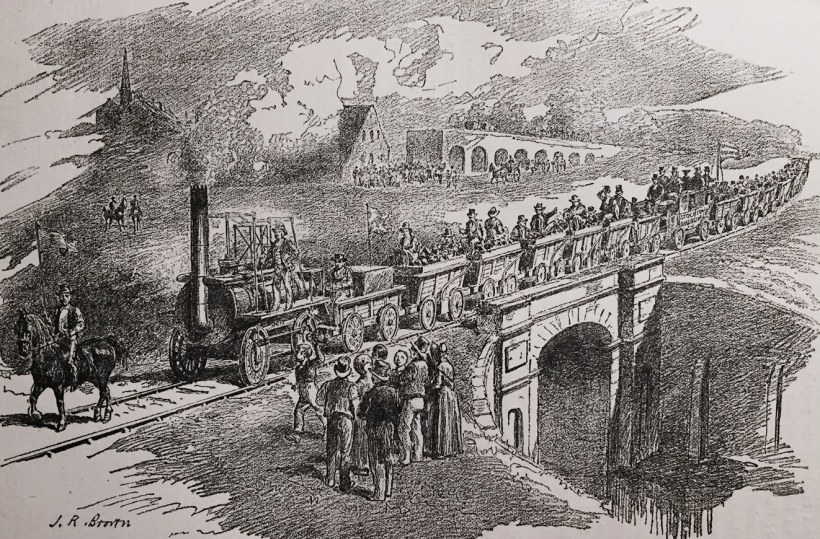
Opening of Stockton and Darlington Railway - September 27th 1825

Although George Stephenson is rightly regarded as the “Father of Railways” for it was he who first made the locomotive a practical success for traffic the idea of a steam engine for traction had been previously worked out by several mechanical geniuses. Thus, Messrs. Trevethick and Vivian obtained a patent in 1802 for a high pressure locomotive engine, which, when the inventor had made certain improvements in it, was found capable of drawing a carriage on a circular railway at the rate of twelve miles an hour.

In 1813, Mr. William Hedley, of Wylam Colliery, made the first travelling locomotive engine, or substitute for animal power in the traction of coal waggons, ever see in the North. The coal was worked on the south side of the Tyne, conveyed under the river to the bottom of the shaft, and drawn up there; and from thence it was sent by the locomotives on a tramway to Lemington, a distance of above five miles. Each engine drew ten waggons, carrying eight chaldrons of coals, or 211 tons, and sometimes a dozen or more waggons were dragged by one engine. Strangers used to be struck with surprise and astonishment on seeing a locomotive engine moving majestically along the road at the rate of four or five miles an hour, drawing along from ten to fourteen loaded waggons; and their surprise was increased on witnessing the extraordinary facility with which the engine was managed. This invention was deemed a noble triumph of science, and so it really was, considering the time; but “Puffing Billy, “as Hedley’s locomotive was christened by the people near, is now only a curiosity, though it kept the road for a considerable time. The escapes of the jets of steam at high pressure, indeed, caused so much annoyance to the owners of horses in the neighbourhood, that the engine had to be stopped whenever a cart or carriage approached, and the working of the traffic was thus seriously interrupted, until Billy’s manners were improved by an ingenious arrangement for allowing the eteam to escape gradually.

George Stephenson, who had been for some time experimenting on the subject, constructed in 1815 the engine of which a figure ia here given, and which was a great improvement in many respects, and particularly in the simplicity of its mechanism, to Hedley’s engine. It weighed about eight tons, and could make a speed of nearly sixteen miles an hour in those days quite a marvel but with this disadvantage, that the chimney often became red-hot when running at that rate. But George was one of those extraordinary men to whom failure in any task, not physically impossible, is an unrecognised thing; and though his first locomotive was not very efficient, he was never satisfied till he had improved it so far as to come up somewhat near his own ideal. Mr. Goldworthy Gurney’s grand improvement of the steam blast was utilised by him to carry his experiments to a triumphal issue.

In 1820, Stephenson was appointed engineer for the construction of the Stockton and Darlington Railway; and when that line was opened on the 27th September, 1825, his locomotive engine was called into requisition, and drew a train of thirty-eight carriages, fully loaded with coals, goods, and passengers, exclusive of the tender with coals and water, a distance of eight and three-quarter miles in sixty-five minutes, the speed in some parts being frequently twelve miles an hour, and, in one place for a short distance, near Darlington, fifteen miles per hour. On this occasion the fields on each side of the railway may be said to have been literally covered with ladies and gentlemen on horseback, and pedestrians of all kinds. A man rode in front carrying a flag, as may be seen in our engraving.

The rapid growth of the trade of South Lancashire, together with the unpopular management of the Bridgewater Canal, gave rise in 1821 to the project of a railway between Liverpool and Manchester. Stephenson, who had meanwhile fully established his reputation as a practical man, was chosen engineer by the directors, with a salary of £1,000 a year. He proposed to work the line with locomotive engines going at the rate of twelve miles an hour an idea which was held up by some incredulous critics as sufficient to stamp the project as a bubble. “Twelve miles an hour!” exclaimed a writer in the Quarterly Review: “as well trust oneself to be fired off from a Congreve rocket!”

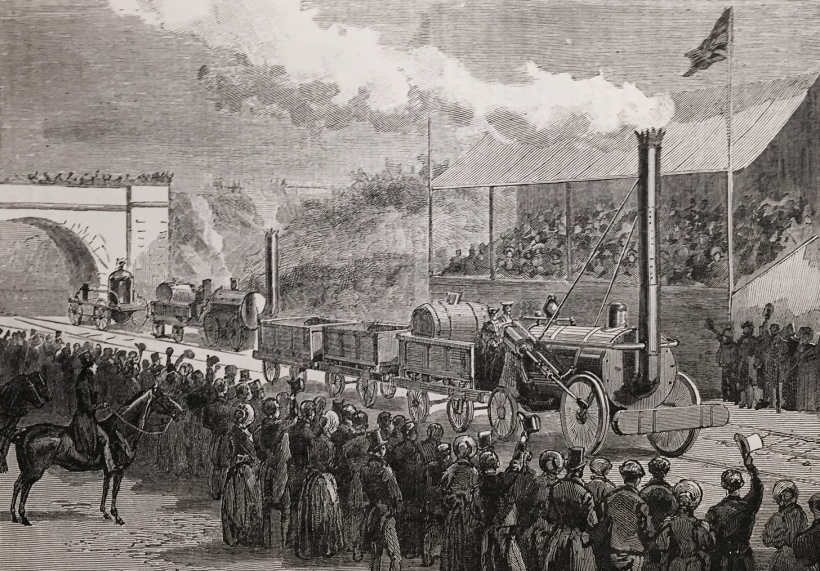
The Rainhill Competition 1829 - The Rocket First

It had been originally contemplated to work the trains by horses; but locomotives having been long used in conveying coal in the Newcastle district, it was believed that they might be used to draw passengers with advantage. The company consequently offered a reward of £500 to the maker of the best locomotive, particularising certain conditions necessary to be fulfilled. The trial took place on the 6th October, 1829, at Rainhill, near Liverpool, on a level piece of the railway one mile and three quarters in length. The distance to be run was seventy miles, backwards and forwards, thus giving forty stoppages. The following engines appeared: The “Novelty,” made by Messrs. Braithwaite and Ericsson, of London, but this was withdrawn, in consequence of some derangement in her pipes shortly after starting; the “Rocket,” made by Messrs. Robert Stephenson and Co., of Newcastle, weighing 4 tons 9 cwt., which did the seventy miles in six and a-half hours an average speed of somewhat over five and a-half minutes per mile and so gained the prize; the “Perseverance,” made by Mr. Burstal, of Leith; and the “Sans Pareil’made by Mr. Timothy Hackworth, of Darlington. The two latter came in second and third. The “Rocket” afterwards astonished everybody by drawing a carriage containing from twenty to thirty passengers up the Whiston inclined plane, rising 1 in 96, at rates of from fifteen to eighteen miles per hour. Yet, marvellous as was the “Rocket” in its day, it would now be looked upon by railway engineers as a pretty toy. For it was soon discovered that the bite and steadiness of the locomotive on the rails were of so much importance as to counteract the disadvantage of the vis inertia of increased weight; and therefore locomotives began to be made always heavier and heavier, till some of them are now, we believe, up-wards of twenty tons weight.

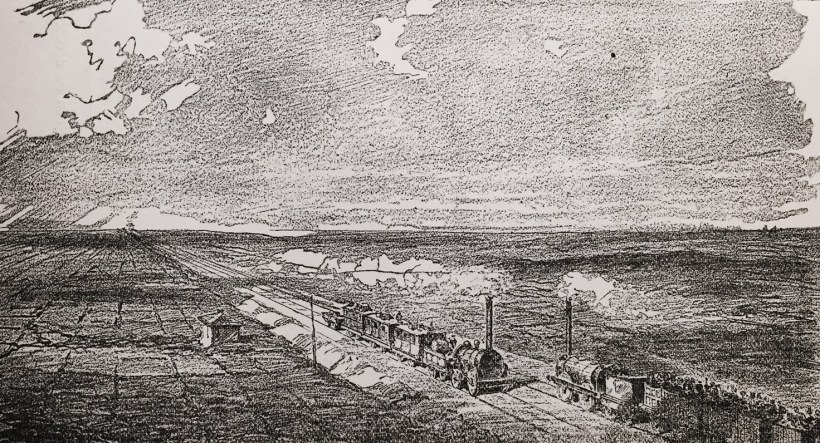
Chat Moss - Showing Stevensons Line

One of the most difficult parts of the Liverpool and Manchester line to make was that over Chat Moss, a huge bog, between Bury Lane and Patricroft, comprising an area of twelve square miles, so soft as to yield to the foot of man or beast, and in many parts so fluid that an iron rod laid upon the surface would sink out of sight by its own weight. It varied from ten to thirty-five feet in depth, and the bottom was composed of sand and clay. On the eastern border, for about a mile and a-half, the greatest difficulty in the construction of the road occurred. Here an embankment of about twenty feet above the natural level was formed, the weight of which, resting on a soft base, pressed down the original surface; many thousand cubic yards gradually and silently disappeared before the desired level was attained; but, by degrees, the whole mass beneath and on either side of this embankment became consolidated by the superincumbent and lateral pressure, and the work was finally completed at less expense than any other part of the line. Hurdles of brushwood and heath were placed under the wooden sleepers, which supported the rails over the greater part of this moss; so that the road might be said to float on the surface. And on the 1st of May, 1830, the “Rocket” steam-engine, with a carriage full of company, passed over the roadway, along the whole extent of Chat Moss, thus affording the first triumphant proof of the possibility of forming this much-contested line.

WILLIAM BROCKIE.

Family

A bit random, but I wanted to share something. One of the main reasons I have such a passion for history is my dad. Everyone’s family is normal in the sense you grow up not thinking that your situation is any different but my family is brilliantly different. I am 33, born in 1982. My dad died when I was 8. He was born inChester le Street in 1910. He worked down the pit (Lumley 6 Pit then Dawdon) for most of his early life before moving to London and working in construction. Through my dad I’ve always had the sense that history is actually not that distant. He lived through some momentus changes. Most people my age have great grand parents or at a push grand parents who lived over the same time span. I’ve got my dad. My grandad was a Victorian in the purest sense. I love that about my family and wanted to share a photo of my dad (on the right when he was 21), his dad (my grandad, centre) and my uncle (left). I love this photo as it seems so distant in time yet so near too. I hope you don’t mind a slight digression.


Cragside

Cragside 2

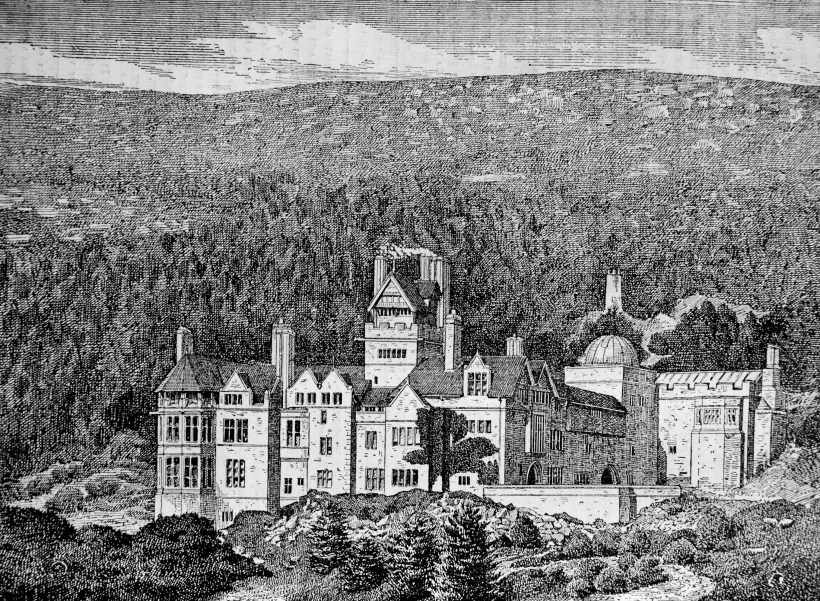
Cragside, the beautiful seat of Lord Armstrong, with its gardens and grounds and terraced walks, stands upon what was, some five-and twenty years ago, a barren hill-side overlooking the deep gorge of the Debdon Burn, a little stream which joins the Coquet about a mile to the east of Rothbury. The house is, both in situation and appearance, certainly the most picturesque and interesting of modern Border mansions. The only other which rises naturally to the mind as suggesting comparison with it is Abbotsford, which rose under the eye of the great master in the domain of fiction, as Cragside has risen under the eye of as great a master in the domain of fact.

The building was begun in 1863. It was designed by Norman Shaw, R.A., and is partly Gothic and partly sixteenth century in style. Our views will give some idea of its many gabled picturesqueness, and of the charming effect of its quaint stacks of chimneys, and its red-tiled, high-pitched roofs, when seen against the dark green foliage, the sombre hill-side, or defined against the sky. The dome-topped tower shown in both pictures has, since they were drawn, been heightened considerably. It bears the name of “Gilnockie Tower,” presumably in honour of Johnnie Armstrong of Gilnockie, that mosstrooper so famous in Border song, who may have been one of the fore-elders of the noble owner of Cragside.

Beautiful as is the building, it is rendered more so by its surroundings. Every natural advantage has been greatly utilized or improved; even natural disadvantages have been conquered and turned to good account. On the steep sides of the hill walks and drives have been formed which lead by easy ascents up to the house and the hill top which rises behind it. From this hill top, where stands the huge solitary boulder called the Sea Stone, we look down upon Cragside, and upon the town of Rothbury lying in the Coquet Valley, with Simonside rising high above. Close by us are the two new lakes formed by the engineering skill of the genius of the place, probably upon the sites where ancient lakes once gathered, while away to the east we see the North Sea gleaming in the distance. Descending again, we may admire the formal beauty of the trim Italian Garden, or the wonders of the Orchard Houses. In these latter, dwarf fruit-trees are grown in large pots which turn on pivots, so that each side in turn enjoys the ripening influence of the sun, or the whole can, by hydraulic power, be wheeled out into the open air with the gangways on which they stand. Then there are the noble Conservatory, the Fern Grotto, and the spacious grounds where nourish in bewildering profusion the rarest and most beautiful trees and shrubs. Or, again, we may descend still lower, into the deep ravine of the Debdon Burn, and follow the windings of the stream the wooded cliffs towering over us on either side and forming a veritable fairy glen of most romantic beauty.

The interior of the house is worthy of its surroundings. Here is gathered together a collection of works of art such as only cultivated taste combined with great wealth could make possible, and this collection of gems is seen in a setting befitting it. There are noble apartments with panelled roofs, with decorations and furnishings the most superb staircases and corridors and cosy nooks are there and throughout all breathes a quiet sense of home-like comfort which enhances the beauty of the greatest treasures, and which even such magnificence would be poor without. A splendid chimney-piece of richly carved and costly marble fills nearly the whole of one side of the drawing-room. On one side of it there is a cosy chimney corner. Over the ingle nook of the dining-room fireplace we see carved in the stone the sentiment which fills the whole place the kindly North-Country proverb, “East or west, hame’s best.”

Cragside

The pictures of Cragside are a sight in themselves. Not only in the picture gallery, but in the library, drawing-room, dining-room, and the staircases they are to be found. We have not space to give even a list of them all, but among them are the following: Millais’s “Jepthah’s Daughter,” and his celebrated landscape “Chill October,” Wilkie’s well-known “Rabbit on the the Wall,” Sir F. Leighton’s “Venetian Lady,” Linnell’s “Thunderstorm,” George Leslie’s “Cowslip Gatherers,” O’Neill’s “Death of Raphael,” David Cox’s “Lancaster Sands,” John Phillips’s “Flower Girl,” and pictures by Turner, Clarkson Stanfield, Copley Fielding, Ansdell, Rosa Bonheur, Albert Moore, H. H. Emmerson, R. Jobling, Hook, Muller, A. Scheyer, Peter Graham, and other artists.

This veritable home of art is notable also as exemplifying the triumphs of science in the application of the forces of nature to the service of man. The mountain stream which rushes past supplies the power which fills the house with the radiance of the electric light. The same long-wasted force, by the aid of hydraulic rams, supplies the house and gardens with water, and fills the lakes which lie on the hill top above. Many other ingenious and unique contrivances there are of a similar nature. Altogether, Cragside, like its master, is one of the wonders of the North.

R. J. C.

Monkwearmouth Church

Monkwearmouth Church

The tower and the west wall of St. Peter’s Church, Monkwearmouth, are now the only portions remaining of tha monastic establishment founded at this place in the year 674 by Benedict Biscop, and immediately endowed with great liberality by King Ecgfrid. Before the sister house at Jarrow was founded, seven years later, Monkwearmouth was the home of Bede, who has left a valuable record of the early history of the twin monasteries in his “Lives of the Abbots of Wearmouth and Jarrow.”

The early churches founded in the North were chiefly built of timber, “after the manner of the Scots”; but Biscop built his churches of stone, “after the manner of the Romans.” And it is interesting to find that the same great founder of churches also brought makers of glass from France, who not only, as Bede tells us, glazed the windows of Benedict’s churches, but taught their art, which till that time had been unknown in Britain, to the natives.

The sight of a structure which has withstood the storms and changes of more than twelve centuries is always impressive; but especially is this the case when, as at Monkwearmouth, that structure is linked with an event of absorbing interest in the early history of our country. Biscop and Bede were great men. The former was a great builder, a man of large and liberal views, and a generous patron of literature and the arts. The latter was the great scholar of his age. Jarrow and Wearmouth were the principal seats of learning, not in the North alone, not in Britain alone, but in the whole of Western Europe. The perishing sculptures which adorn the sides of the entrance of this ancient tower may seem rude to us, but no one can fail to see in the baluster shafts which are built into the same doorway, and which also occur in the little windows high up in the west wall of the nave, evidence of genuine and refined art. And it must not be forgotten that the famous Codex Amiatinus, the most valuable MS. now in existence of the ancient Latin version of the Bible, with its beautiful caligraphy and its gorgeous illuminations, was certainly written either at Jarrow or at Monkwearmouth.

We have only space to add that the lower portion of the tower is of much earlier date than the upper part. This lower part was originally not a tower, but a porch, the porticus ingressus as it is called by Bede. The gable line of its original roof may be seen rising to a point between the second and third string courses.

J. K. BOYLE, F.S.A.

Jack Crawford, the Hero of Camperdown

Jack Craford

The heroism of Sunderland sailors has more than once received ample illustration. Hardy sons of the North, enjoying the excellent physical development peculiar to the inhabitants of this severe locality, trained to battle with the elements in peaceful times, they were ever valuable for intrepidity, skill, and daring, when “wild war’s deadly blast” called men from industrial occupations. Their valour has not passed without recognition in well informed and influential quarters. A committee of the House of Commons, in the year 1820, paid the sailors employed in the coal trade the following high compliment by resolution : “That the number of men obtained in the course of the war, from Newcastle and Sunderland, does not indeed bear a great proportion to the whole of the men employed and raised in the same time for the navy; but their value is not altogether to be estimated by their number. The difficulties of the navigation in the coal trade are admitted to give the seamen derived from it, in point of skill and experience, patience of fatigue and hardship, an incontestable superiority over those drawn from other maritime trades of the kingdom. During the late war, our naval officers gave a decided preference to sailors bred up in the coal trade.”

JACK’S BIRTH AND BIRTHPLACE.

Jack Crawford, the hero of Camperdown, was born in what is now called the Pottery Bank, Sunderland, in the spring of 1775. His father was a keelman on the Wear. The boy was fond of the sea, and served a regular apprenticeship in the Peggy, of South Shields. A difference in his family occurring about 1796, Jack left Sunderland, and entered on board a man-of-war. In the following year he became famous by the daring deed which he performed on board Admiral Duncan’s flag-ship, the Venerable.

THE BATTLE OF CAMPERDOWN.
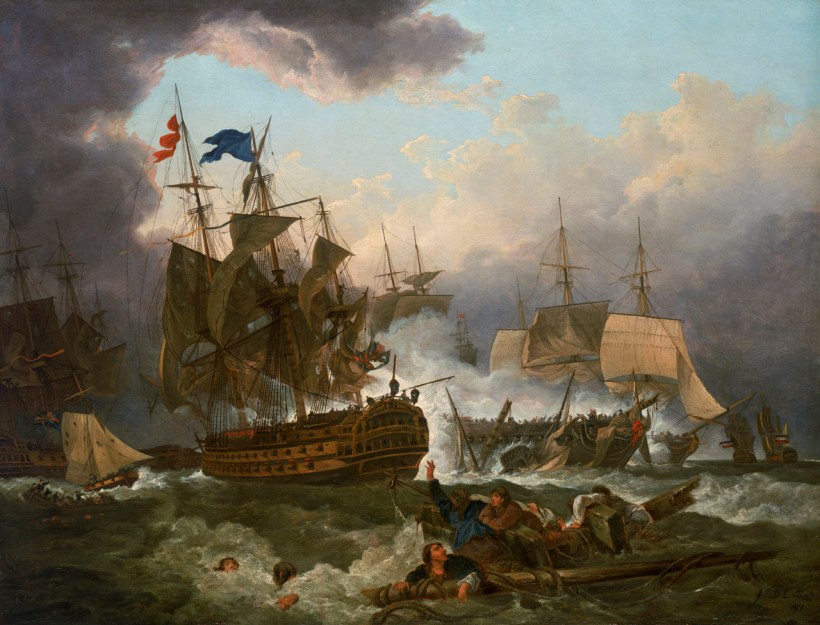
The Battle of Camperdown

The battle of Camperdown, one of the famous naval victories won by British sailors when “wooden walls”, were in their glory, was fought between the English and Dutch fleets on the 11th October, 1797. The fleets were commanded, on the English side by Admiral Duncan, and on the Dutch side by the famous De Winter. Duncan had been blockading the Dutch coast for months, and he found it necessary to proceed to Yarmouth to refit, leaving only a small squadron of observation under the command of Captain Trollope. Scarcely had the Admiral reached the Roads when a vessel at the back of the sands gave the spirit-stirring signal that the enemy was at sea. Not a moment was lost in getting under sail, and early on the morning of the 11th he was in sight of Captain Trollope’s squadron, with a signal flying for an enemy to leeward. He instantly bore up, made signal for a general chase, and soon came in sight of the enemy, meanwhile forming in line on the larboard tack, between Camperdown and Egmont, the land being about nine miles to leeward. Each fleet consisted of sixteen sail of the line, exclusive of frigates, brigs, and other craft. As they approached each other, the British Admiral gave orders to his fleet to break the enemy’s line and engage to leeward, each ship to choose its opponent. The signal was promptly obeyed, and, getting between the enemy and the land, the action commenced about half-past twelve, and, by one, was general along the whole line. The Monarch was the first to break through. The Venerable, Admiral Duncan’s ship, failed in an attempt to pass astern of De Winter’s flag-ship, the Vryheid. As the Venerable came up, the States-General, another vessel of the enemy, filled the gap through which Duncan had intended to pass. The Venerable, although the original intention failed in execution, was not to be denied, and, immediately pouring a destructive broadside into the States-General, compelled that vessel to abandon the line. Admiral Duncan then engaged the Vryheid, and a terrible conflict ensued between the two commanders-in-chief. But it was not a single-handed fight. The Dutch vessels, Leyden, Mars, and Brutus, in conjunction with the Vryheid, poured broadside after broadside into the Venerable till Duncan deemed it expedient to give ground a little, although he did not retreat. Meanwhile, the Triumph came to the Venerable’s assistance, when the two vessels gave a final blow to the gallantly-defended Vryheid, a terrific broadside bringing the masts by the board, and reducing the ship to an unmanageable hulk. De Winter struggled a little while longer on what was left of his gallant craft; but further opposition was fruitless, and, it is said, he pulled his flag down with his own hands, remarking, when he presented it to Admiral Duncan, that he was himself the only man left unwounded on the quarter-deck of the Vryheid. Throughout the rest of the line the contest was not less fiercely sustained. But with the surrender of the Dutch flag-ship hostilities ceased: nine vessels were captured by the English; and De Winter was brought on board the Venerable a prisoner of war. Shortly after the States-General had received the fire of the Venerable, she escaped from the action, and, along with two others, was carried into the Texel. The carnage on board the two admirals’ ships was fearful. Not fewer than 250 men were killed and wounded in each. The total loss of the British was 191 killed and 560 wounded, while the loss of the enemy was computed to have been twice as great. At the conclusion of the battle the English fleet was within five miles off the shore, where many thousand of the Dutch witnessed the defeat and destruction of their fleet. Admiral Duncan was created a peer of Great Britain by the title of Viscount Duncan of Camperdown and Baron Duncan of Lundie, to which estate he had succeeded by the death of his brother. A pension of £2,000 a year was granted his lordship for himself and the two next heirs of the peerage. The thanks of both Houses of Parliament were unanimously voted to the fleet, and Lord Duncan was presented with the freedom of the city of London and a sword valued at 200 guineas. Gold medals were struck in commemoration of the victory, and presented to the admirals and captains of the fleet. People wore “Camperdown” ties, hats, and ribands, and the story of the battle was on the lips of all.

JACK’S DARING DEED.
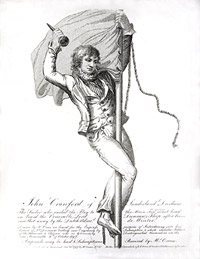
Jack Crawford Illustration

When the Venerable was hard pressed in the unequal combat, with four vessels concentrating their energies for her destruction, an incident occurred which was dwelt upon with just pride by chroniclers of the engagement, which called forth the most enthusiastic popular applause, and which in itself was a proud illustration of the bravery of the British tar. The fiercest cannonade rattled through the shrouds and rigging of the vessel. It came from all sides, slashing and tearing, bearing death and destruction on its wings of fire, and sadly crippling the gallant seventy-four which carried Admiral Duncan’s flag. Several times had the colours been shot away, and as often had their place been promptly supplied. At last, part of the mast which bore them came crashing down on deck with the “red rag” still clinging to the broken spar. The Admiral was near when the accident occurred. Coolly stooping down, he tore the flag from its fastenings, and, looking round, sought for some one who would once more replace the ensign. It could no longer be run up in the usual way, since the necessary part of the mast had succumbed to the enemy’s fire. He called for some one to mount the rigging and nail the colours to the broken mast. It was a dangerous duty, and he who dared it look his life in his hand. A pause ensued before a volunteer appeared, but the pause was short, and there stood before the Admiral one whom he had learned to trust, and whose townsmen he had come to respect for their resolute bravery and skill. “Here, John,” he said, handing the colours to the sailor, “nail them up, and save further orders about them.” Armed with a marling-pike as hammer, “John” climbed the rigging, ropes and rattlings dangling uselessly, and bullets cutting those that remained of service to shreds before him. Up, up he went, bearing as it seemed a charmed life, for the shot went harmlessly past him as the battle raged fiercely down below. Clinging to the broken timber, he literally nailed the colours to the mast, nimbly slid down the topmast backstay, and jumped on deck amid the cheers of his comrades and the approbation of his commander. The sailor was Jack Crawford, of Sunderland. Sir John Hamilton, who was in command of the Active, which acted as tender to the Venerable, saw Crawford go aloft, and then understood the reason of Duncan’s partiality for North-Country seamen. Jack had not escaped scatheless. He was shot through the cheek, the missile inflicting a wound which proved rather troublesome to heal. But he had done his duty, and vindicated the honour of England.

ANOTHER VERSION.

There is a different account of the daring act from the one we have just given. We have assumed that Admiral Duncan gave the order to nail the flag to the mast; but some local accounts agree in saying that Jack Crawford performed the act of heroism on his own account. In the sketch of Jack’s life written by the late Captain Robinson it is stated that Duncan gave the order, but the circumstance is thus referred to in Richardson’s Local History and in the Percy Anecdotes: “In the memorable engagement which Admiral Lord Duncan had with the Dutch fleet on the 11th of October, 17U7, the flag of the Venerable, Lord Duncan’s ship, was shot away by the Dutch Admiral De Winter. John Crawford, a sailor belonging to Sunderland, then on board the Venerable, upon observing this, immediately ran up the shrouds (amidst the fire of the enemy) with a marling-spike in his hand, and, with the greatest coolness and intrepidity, nailed the Venerable’s flag to the topgallant mast-head.” Whichever account be the correct, one, enough of glory remains to stamp the act as one of the boldest which a man could dare to do.

” RULE BRITANNIA.”

If the news of the victory at Camperdown was received with great enthusiasm throughout the country, the sensation created by the intelligence in Sunderland seems to have been more intense than could have been generally prevalent. At that time the post arrived in the town at eleven o’clock in the forenoon. The news arrived on Sunday, when the good folks of Sunderland were at worship. A loyal citizen, elated with tlie joyful intelligence, in passing St. John’s Church, opened the north door and shouted at the top of his voice, “Admiral Duncan’s defeated the Dutch fleet at Camperdown!” The congregation were at prayers at the time, when Mr. Haswell, the organist, immediately struck up the national air of “Rule Britannia.” and the congregation responded to heir organist’s enthusiasm by trising while tho spirit-stirring air was performed. Prayer was then quietly resumed.

JACK’S REWARDS AND HONOURS.

These demonstrations of joy were made in utter ignorance of the gallant exploit of the Sunderland sailor, and further satisfaction was in store for the inhabitants when they learned what Jack Crawford had done. Ordinary expressions of delight failed to satisfy the public appreciation of the sailor’s bravery, and in March of 1798, the year after the battle, an elegant silver medal was presented to Crawford, at the expense of the town. On the one side was engraved a view of two ships in action, with a scroll on the top bearing the emblem “Duncan and Glory.” The reverse bore coat-of-arms, quadrant, and on the shield appeared the motto “Orbis est Die,” while below was engraved, “The town of Sunderland to John Crawford, for gallant services, the 11th of October, 1797.” Crawford received many other marks of honour. So far down as July, 1802, we find it recorded that at a dinner given by the friends of Mr. Rowland Burdon, M.P. for the county of Durham, at the Gray’s Inn Coffee House, London, Sir Frederick Merton Eden, Bart., in the chair, among the toasts given was the following, which received an enthusiastic response: “Jack Crawford, the Sunderland sailor who nailed the British colours to the mast-head in the action off Camperdown.” When the great National Demonstration was observed in London, soon after the battle, to commemorate the victory of Camperdown, Jack Crawford was not forgotten. It was arranged that there should be an open carriage in the procession with a sailor bearing the Union Jack, and this sailor was to have been the gallant Crawford; but he could not be found when wanted, having, as Robinson puts it, gone “on the spree with his Poll.” As the carriage passed through tho streets it was one of the most interesting features of the procession. The crowd showered into it money of all kinds, and the sailor reaped a rich harvest. This was but a too true illustration of the carelessness of his own interests which Jack, with sailor-like thought-lessness, practised during his life. He had no ambition. He did his duty like a man and a British sailor, and he was not solicitous to reap material advantage. It is said that when in London a member of the Royal Family asked what he could do for him Jack requested, in reply, that a keel should be bought for him, and that he should be allowed to go and ply it in his native North.

JACK’S MEDAL AND COLOURS.

crawfordmedal2

When Jack left the navy he received a pension of £30 a year. He returned to Sunderland, and there followed the avocation of a keelman. Generous and sociable, his company was courted, and he often yielded to temptations which surround men of his quality who have done something to win the admiration of their fellows. His habits often left him in hard straits for money, and eventually he pledged his medal, which lay for 29 years at a Mrs. Dunn’s before it was redeemed. Speaking of the medal, Jack’s son, a keelman on the Tyne, said to his father’s biographer: “I ought to have had that now; after my father died, I had it for a few months, but my mother said she had more right to it than me, and that I should have it at her death, which happened about six years after my father. I never saw it ny more. I was told that Mr. Robert Burdon Cay, the attorney, gave my mother £5 for it; from Mr. Cay it became the property of the late Mr. John Moore; from Mr. Moore it passed into the hands of another gentleman of the name of Moore, a relative, I believe, of Mr. Moore, and by whom, I have been told, it was given to the Earl of Camperdown, in whose possession it now is. I should like to have kept it in the family, but I am too poor a man ever to think of being able to purchase it from its wealthy possessor.” The medal really passed into the hands of the Duncan family, by whom it is retained, together with the colours that Crawford nailed to the stump of the mast head, and the colours which the Dutch admiral presented to the English commander. Jack was present at the burial of Nelson, and walked in the procession with his medal on his breast, before hard times had obliged him to part with this mark of his townsmen’s honour and esteem. It is stated that when Vauxhall was in its glory one of the exhibitions consisted of a representation of the battle of Camperdown. Crawford was offered £100 per week to exhibit nightly in the act of nailing the colours to the mast, but he replied, “No, I will never disgrace the real act of a sailor by acting like a play fool!” and the enterprise of the managers could not tempt him aside.

JACK’S FAMILY AND FATE.

Jack was married at St. Paul’s Church, London, in 1808. His wife’s maiden name was Longstaff, daughter of a shipbuilder of that name in Sunderland. He had a family of several sons, and at least one daughter, who married in Sunderland. The eldest son became a keelman on the Tyne, and other two, who were sailors, left Sunderland many years ago. It is supposed they went to Australia. Jack Crawford died at Sunderland in 1831. In that year the cholera broke out on the coast, and the hero of Camperdown was the second victim. He lived in a locality of the town and amid surroundings calculated to invite the pestilence, and he succumbed to the fell disease. As the first visitation of cholera to this country took place in that year, and as Sunderland was one of the towns first attacked, Crawford was among the first Englishmen who died at home of the pestilence. It is supposed that his remains lie near the grave of the late Rev. Robert Gray, rector of Sunderland. No stone marks the spot. Poor Jack had to struggle with poverty in the decline of life. He was a great bird fancier, and spent much of his time in catching the feathered warblers. Some years ago a movement was commenced in Sunderland to erect a monument to his memory. Subscriptions were promised or received, but the proposal fell through. A lithograph representation of Jack nailing the colours to the broken mast of the Venerable was published in Newcastle soon after the event.
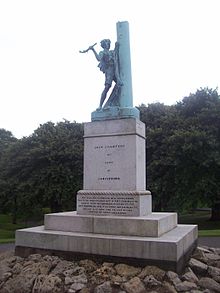
Jack_Crawford_statue

Drummond, the Sunderland Highwayman

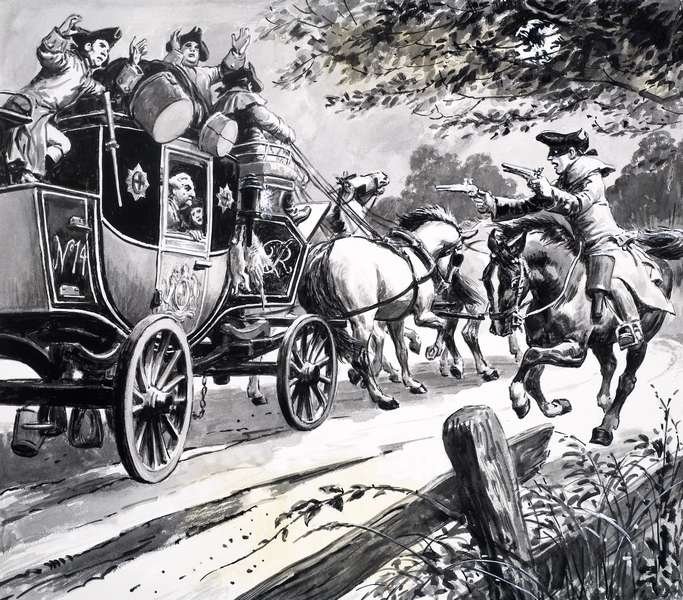
highwaymenIt is not generally known that the first of the name and the family of Drummond who settled under peculiar circumstances on the banks of the Wear, was not the unfortunate James, Duke of Perth, who was said to have taken refuge, after his escape from Culloden, in the then very sequestered and almost quite lawless hamlet of South Biddick, near Pensher, where, marrying the daughter of a poor working man, he became the progenitor of a race of pitmen, one of whom, his grandson, Thomas, laid claim unsuccessfully to the earldom of Perth.
Long before the Forty-Five or even the Fifteen, a man said to be a cadet of the noble house of Perth, Robert Drummond, wandered away from his home and country, and came to the North of England to live, moved, it would appear, by some mad freak or spurt of temper, or perhaps urged by some family quarrel. He associated himself with one or more of the hard-headed, ready-witted Scotch chapmen, packmen, or travelling merchants, who began to flood England, more than they had ever done before, after the passing of the Act of Union. Drummond went into the hardware line, dealing in razors, knives, scissors, thimbles, combs, ear-rings, &c. After perambulating the six Northern Counties for some time, he settled down in the town of Sunderland, then a very small place, but increasing fast in population, and already doing a considerable trade.

Here he lived with a fair reputation for several years. But by-and-by he fell into bad habits. After a while his shop began to exhibit unmistakable signs of neglect and disorder, and it was whispered among the neighbours that, instead of going to bed betimes and getting up at a decent hour in the morning, as all honest people then did, it was his wont to steal off clandestinely soon after dark, twice or thrice a week, along the Shields, Newcastle, Durham, or Stockton road, on no good errand anyone could guess, but not at all unlikely, as some even dared to say, to ease belated travellers of their loose cash. Others, who were either somewhat more cautious or more charitably disposed, chose to put a less ugly face on the matter. Drummond, they said, was not the only man in Sunderland, England, or the world, who had a natural taste for lonely walks at night. He was a queer sort of fellow, they must allow; but, after all, it was no crime to be queer, or what would they make, say, of Anthony Ettrick? He had come from nobody knew where; but so had a good many other folks in the town, and where had all the grandfathers of even the oldest standards come from? Some said Drummond was a Scotch nobleman’s son; well, what the worse or the better was he for that? If he had been the son of a gipsy, mosstrooper, or buccaneer, and yet sold good razors, who had any business to find fault with him?

At length, however, Drummond’s conduct became so outrageous that the darkest suspicions seemed justified. It turned out that he kept a mistress at Ryhope, and that he was one of a set of wild fellows, whose habit it was to convene in a low public-house on the Moor-edge, a little to the north-east of the Spa Well, kept by a person generally known as Lady Lowther, who bore a very light character (this “howff,” we ought to say, has long since disappeared, the sea having washed away the site and everything on it about a century and a half ago). Several robberies had taken place in the neighbourhood of the town, and the perpetrators remained undiscovered. But various circumstances tended to connect some of the frequenters of Lady Lowther’s house with one or two recent cases. Very strong suspicion being directed towards Drummond, he was narrowly watched; and although he was not caught in the very act of robbing a gentleman’s house in the neighbourhood, which was broken into one night, yet everything concurred to fix the guilt upon him as an accomplice, if not the principal. He was accordingly apprehended on suspicion, and committed by the county magistrates for trial at the next Durham Assizes. There the case was clearly made out; Drummond was convicted of burglary, and sentence of death was passed upon him by the judge. But some of his friends used their influence to get the sentence commuted, on what specific ground we do not know, and the result was that, instead of being hanged by the neck until he was dead, as was the usual course with such offenders, he was transported for life to the plantations in North America.

But Drummond soon found a way to return to England, and took up his quarters in the city of London. Here he devoted himself to robbery as a trade, and grew before long one of the most daring and mischievous highwaymen that ever infested the road. The multitude of his robberies made his person well known, and yet he managed to escape capture a good while. This was the more wonderful, considering the roughness and cruelty of his temper, for one quaint old authority tells us, “He never used anybody well, firing upon any who attempted to ride away from him, and beating and abusing those who submitted to him.” He travelled for some time in company with another fellow of the same distinguished surname as himself, one James Drummond, and they together perpetrated a number of desperate outrages on the Great North Road. At length being persued and in danger, Robert gave their armed pursuers the slip, deserted his companion, and left him to his fate, which was to be tried, found guilty, and hanged in due course.

Drummond afterwards fell in with a desperate character, named Ferdinando Shrimpton, said to have been a person genteely brought up and well educated, but of a wild and savage nature congenial to his own. This man’s history, as told in the record we transcribe, was a very singular one. His father, we are told, lived at Bristol, and “behaved, in outward appearance, so well that he was never suspected to have anything wrong about him”; yet he was one of the greatest highwaymen in England. One evening some constables came hastily into an inn where he was, to apprehend another man, when “his guilty heart making him afraid that they were come in search of nobody but himself, he thereupon drew a pistol and shot one of them dead; for which murder, being convicted, he readily confessed his former offences, and, after his execution for the aforesaid crime, was hung in chains.”

This unhappy man’s son had been bred to no trade. Subsequent to his father’s death, he enlisted into the Foot Guards, and served for some time as a private soldier. The pay being insufficient to supply his wants, however, he eked it out by taking the same steps as his father before him had taken. “Never was any fellow of a bolder and of a more audacious spirit than he; and after he had once associated himself with Drummond, the precious pair inveigled Shrimpton’s cousin William, who had come up to London to seek a place, and was then hanging about town, into bearing them company in one or two nocturnal adventures, in the course of which they managed so to shuffle the cards that he should appear to be as guilty as themselves.”

One night the trio sallied out over Hounslow Heath in quest of prey, when, seeing a solitary horseman approaching, William Shrimpton, though but indifferently mounted, and the clumsiest villain of the three, was deputed to rifle him of his valuables, while the other two kept in the background close by. The man was forced to give up his watch, his purse, and his horse. He was then allowed to proceed, and at the first house he reached he naturally gave the alarm. A hue and cry was raised, and William Shrimpton was captured. his two comrades, however, had meanwhile ridden off with the traveller’s horse, the watch, and the money. The man who had been robbed was willing to compound the felony, and agreed not to prosecute if he got his property back. Shrimpton promised he would find a way “to help him to his horse again,” and was as good as his word, “though the gelding was worth fifteen pounds”; but as for the watch, that was not immediately forthcoming, as it had been pawned in the interim with a gentleman of Jonathan Wilde’s vocation, viz., that of receiving stolen goods and restoring them to the owners at half-price a trade which was carried to a great length in the beginning of the reign of George I. The owner of the watch, however, sent 3s. by his wife to Shrimpton’s lodgings, or to some other convenient place appointed for the purpose, and thereupon got back his property. The pawnbroker took 25s. of this sum, and the rest was divided among the robbers. Ferdinando was “very much disobliged that he received but half-a- crown for his trouble,” and a rupture took place between him and his cousin which led to their real characters being detected.

A gentleman of the name of Tyson had been stopped in his carriage on Hounslow Heath some time before, and his coachman, one Simon Prebent, having endeavoured to drive away, was shot through the head. The gentleman was then rifled of all the money and valuables he had upon him, and left helpless in the road. The actual hand in this affair had been Ferdinando’s, but William and Drummond lay in ambush close by. Suspicion fell upon the right parties, and the three ruffians were apprehended. William Shrimpton turned king’s evidence against the other two, and at the ensuing sessions at the Old Bailey Ferdinando was indicted for the murder of Simon Prebent, and Robert Drummond for aiding, abetting, and assisting him. Both the robbers were convicted not, only upon this charge, but also upon several others of a like nature. Moreover, Robert Drummond had been guilty of a capital offence against public justice in returning from transportation an act which was made felony, without benefit of clergy, by sundry statutes passed in the reign of George II.

Under sentence of death, the two bravos behaved themselves with great obstinacy and resolution, and refused to give any detailed account of their crimes. Questions having been pressingly put to them as to their connection or complicity with other highway robberies besides those on account of which they were condemned to die, Drummond would say in a passion, “What, would you have us take upon ourselves all the robberies that have been committed in the country for ever so many years back?”

The barbarous murder committed upon Mr. Tyson’s coachman did not seem to make the least impression upon their spirits. Shrimpton, by whose hands the man was killed, never appeared the least uneasy, not even when the sermon on the murder was peculiarly preached on his account; but, on the contrary, talked and jested with his companions as he was wont to do. “In a word,” says his contemporary biographer, “more hardened, obstinate, and impenitent wretches were never seen; for, as they were wanting in all principles of religion, so they were void even of humanity and good nature; they valued blood no more than they did water, but were ready to shed the first with as little concern as they spilt the latter.” Inured in wickedness and rapine, they yielded their lives at Tyburn, with very little sign of contrition or repentance, on the 17th of February, 1730, Drummond being about fifty, and Shrimpton about thirty years of age.

The Duke of Wellington in the North

Arthur, Duke Of Wellington, “the hero of Waterloo,” paid a visit to his old companion-in-arms, the Marquis of Londonderry, at Wynyard Park, Durham, in the autumn of 1827. Advantage was taken of the occasion, by men of all sides in politics, Whigs, Tories, and Radicals, to show their sense of the great military achievements of the distinguished warrior, irrespective altogether of his policy as a statesman and a Minister of the Crown.

The Duke was met at Yarm Bridge by Lord Londonderry, at the head of a grand procession of the nobility and gentry of the district. Having taken his seat in Lady Londonderry’s carriage, which was drawn by six horses, he was driven in state into Stockton, where, at the entrance into the High Street, a triumphal arch had been erected, formed of laurels and other evergreens, wreathed with flowers and surrounded by seven flags, with appropriate mottoes, all non-political. Previous to entering the town, the horses were taken from the carriage in which the duke rode, and he was drawn by a number of men, wearing blue ribbons inscribed “Wellington for ever,” to the Town Hall, amid the firing of cannon and other marks of rejoicing. Addresses from the corporate bodies of Stockton and Hartlepool were presented to his Grace by the Mayors of those towns, accompanied by the recorders and aldermen; and Colonel Gray also read an address from the inhabitants of Stockton and its neighbourhood. His Grace took leave of the Stocktonians “amidst the most deafening cheers.”

The party assembled at Wynyard to meet the duke included the Earl and Countess Bathurst, Earl Grey, the Bishop of Durham (Dr. Van Mildert), Lord Beresford, Lord Ravensworth, Sir Henry and Lady Emily Hardinge, Sir Thomas Lawrence (the celebrated portrait painter), Sir (Juthbert Sharp, Matthew Bell, M.P., the Rev. Dr. Wellesley (the duke’s brother), the Rev. Dr. Phillpotts (afterwards Bishop of Exeter), and Rowland Burdon, of Castle Eden.

It was on Friday, the 28th of September, that the duke paid a visit to Newcastle. No exertion had been spared to receive him in a manner due to his elevated rank and creditable to the character and public spirit of the town. Notwithstanding the unfavourable state of the weather, the influx of strangers from the different towns and villages in the neighbourhood was immense. At the turnpike gate at the head of Gateshead, a large body of people, together with a guard of honour consisting of Lancers from the barracks, were in waiting to receive his Grace. The horses were taken from the carriage — an open one — which contained the duke, the Marquis and Marchioness of Londonderry, and Field-Marshal Beresford; and it was drawn through Gateshead by men engaged for the purpose, across Tyne Bridge, to the front of a platform raised before the Guildhall, on the Sandhill, Newcastle, amid the booming of the Castle guns and those of the ships in the harbour, and the ringing of the bells in all the churches. The procession was headed by a band of music, playing “See the Conquering Hero Comes,” after which followed the Union Jack, succeeded by standards bearing such inscriptions as “Assaye,” “Vimiera,” “Douro,” “Talavera,” “Busaco,” “Ciudad Rodrigo — Badajos,” “Salamanca,” “Vittoria,” “The Pyrenees,” “Orthes— Toulouse,” ” Waterloo — Europe Delivered,” and “Welcome to the Immortal Wellington,” which were carried by men who had been present at the different battles. Business was entirely suspended. The windows of the houses on each side of the Sandhill were crowded with elegantly-dressed ladies, the roofs of the houses were covered with spectators, and there was not, in short, a single place, however dangerous and difficult of attainment, likely to command a view of the proceedings, that was unoccupied. The Duke of Wellington, on appearing upon the platform, was greeted with applause. The freedom of the town was then presented to his Grace by the Mayor (Archibald Reed), and the addresses of the Corporation and the town by the Recorder and Mr. Christopher Cookson. His Grace replied to both with becoming brevity. As soon as the ceremonies were concluded wine was introduced, and the Mayor, filling a glass, drank to the health of the duke, and called upon the populace to receive him in a manner worthy of the occasion. The populace answered this appeal with cheers, which, however, were principally confined to that part of the crowd that was nearest to the platform; among the multitude at a greater distance there were scarcely any plaudits. The procession then proceeded to the Town Moor, where the South Tyne Hussars, commanded by Lieutenant-Colonel Campbell, and the Northumberland and Newcastle Yeomanry Cavalry, commanded by Lieutenant-Colonel Bell, were assembled for the purpose of being inspected. On arriving at the lines, the duke rode through the troops, but a thick fog and drizzling rain which had set in deprived the spectacle of much of its attraction. His Grace afterwards proceeded to the Mansion House, where he dined with a large party. In the evening there was a grand ball in the Assembly Rooms. The duke left the rooms about one o’clock, and was escorted on his way from the town to Ravensworth Castle, where he slept, by twelve torch-bearers on horseback, six before and six behind the carriage. Next day (Saturday) the duke inspected the coal works of the Marquis of Londonderry. His Grace and suite arrived at Pittington from Ravensworth Castle, at half-past two o’clock, where Mr. Buddie, attended by the marquis’s miners, was in attendance to receive them. At six o’clock the distinguished party sat down at Mr. Buddie’s seat, at Pensher, to a sumptuous dinner. The house and the neighbouring pitmen’s cottages were illuminated, and a dinner was provided in a building on the premises, of which 600 people partook, so that it was a day of general rejoicing in the vicinity.

On Wednesday, the 3rd of October, his Grace paid a visit to the city of Durham, on his return from Alnwick Castle, where he had gone in the beginning of the week, on a visit to the Duke of Northumberland. A guard of the Yeomanry Cavalry, accompanied by the band belonging to that corps, a number of men carrying banners and flags, many of which bore the names of some of the duke’s most splendid victories, the carriage of the Marquis of Londonderry, and several of his lordship’s friends, and hundreds of spectators, repaired to Aykley Heads, to await the arrival of the duke and to accompany him into the town. Leaving his own travelling carriage, he entered that of the noble marquis, from which the horses were instantly taken by the populace, and his Grace was drawn into the town, amidst the warmest greetings, the firing of guns, the ringing of bells, and every demonstration of the most perfect enthusiasm. His Grace was afterwards escorted to the Castle, where most of the leading gentry of the county were invited to meet him, and where an entertainment in a style of the greatest splendour was given by the bishop in honour of the illustrious visitor. In the evening there was a ball at the Assembly Booms. Upwards of 270 ladies and gentlemen were present, being a greater number than was ever known upon any former occasion. The duke retired at an early hour, and returned to Ravensworth Castle.

Thursday was devoted to a visit to Sunderland, where his Grace got a most cordial and flattering reception. He was met by an immense number of persons at the Wheat Sheaf Inn, Monkwearmouth, on his approach from Ravensworth Castle; and by them the horses were taken from his carriage, and he was dragged in triumph across Wearmouth Bridge, through the streets to the Exchange, preceded by a band of music and several flags, the crowd increasing at every step, until there were at least from fifteen to twenty thousand persons present. The windows of the houses were graced by numerous ladies, to whom the Duke bowed with the greatest affability as the procession passed along. Innumerable flags were displayed throughout the town; and from a splendid triumphal arch, which had been erected over the High Street of Bishopwearmouth, at the expense of the ladies of the town, half-a-dozen children dressed in white showered flowers upon his Grace as he passed beneath. On arriving at the Exchange, he quitted his carriage, and accompanied by the Marquis and Marchioness of Londonderry, &c., ascended a platform erected in front, upon which Sir Cuthbert Sharp and several other gentlemen were assembled for the purpose of presenting him with an address from the freemen of the borough and the magistrates, clergy, and inhabitants of Sunderland, Bishopwearmouth, Monkwearmouth, and their vicinities. During the time of the presentation and reply, the cheering from the populace was deafening, and it continued without intermission till his Grace entered the Exchange, where a splendid dinner was provided in the newsroom, to which, at about half-past six o’clock, 204 persons sat down, there not being room for more. The Marquis of Londonderry was in the chair, and on his right were seated Earl Bathurst, the Marquis of Douro, Lord Beresford. Captain Cochrane, Sir H. Hardinge, and Lord Castlereagh. On his left were the Duke of Wellington, Lord Ravensworth, Sir Walter Scott, Dr. Wellesley, and the Hon. H. T. Liddell. Sir Cuthbert Sharp filled the vice-chair. Among the numerous toasts was one which the celebrity of its object induces us to particularise — the health of Sir Walter Scott, to whose genius the Marquis of Londonderry, who proposed it, paid a warm tribute, and who, on his rising to retain thanks, was received with the most tumultuous cheering, so much so, indeed, as to render what he said completely inaudible to the reporters. After the dinner party broke up, there was a ball in the Assembly Rooms, which were crowded to excess. At this ball, Sir Walter Scott says in his Diary, published in the last volume of his Life by Lockhart, “there was a prodigious anxiety discovered for shaking of hands. The duke had his share of it, and I came in for my share; for, though jackal to the lion, I got some part in whatever was going.” The noble party did not retire till after one o’clock, and got home far on in the morning, “sufficiently tired.”

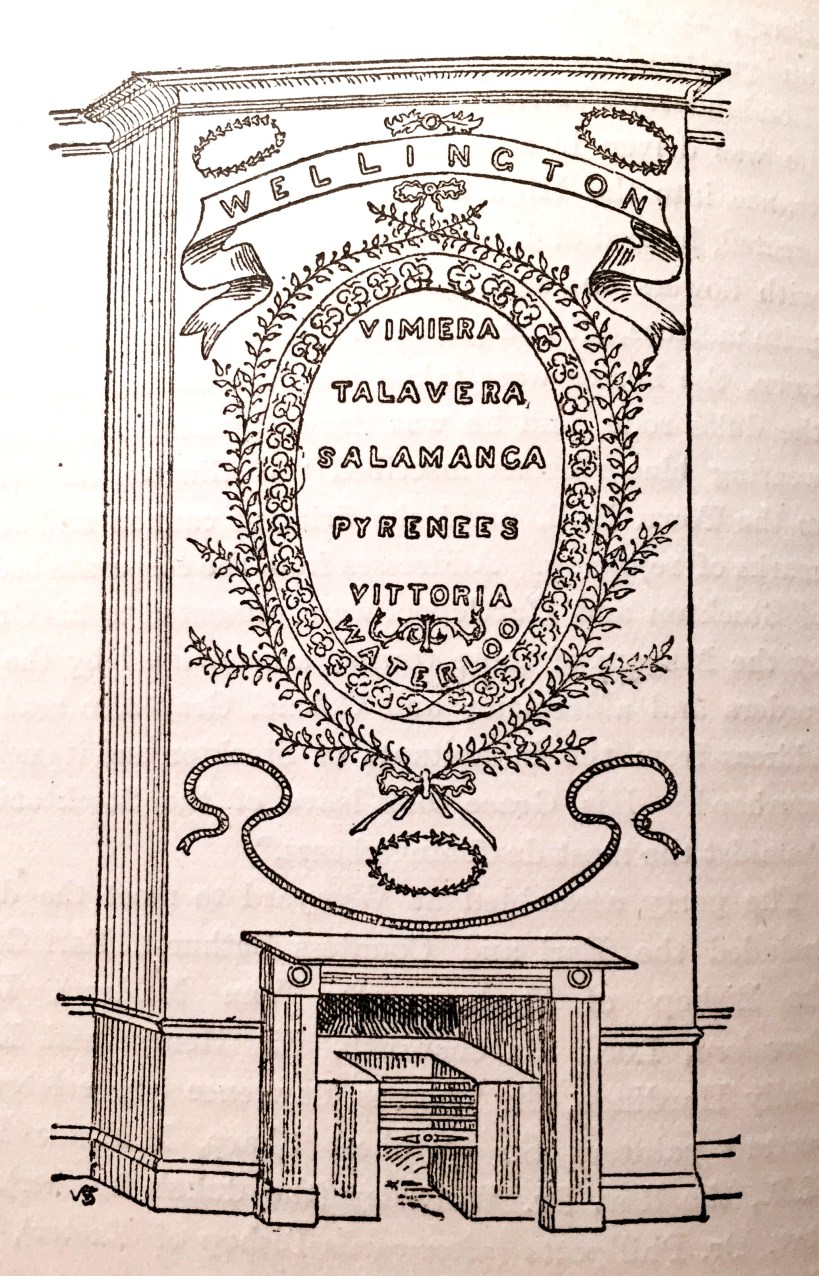
Wellington in the North

The dinner was served in the large news room of the Exchange, over the mantel of which was painted the decoration shown on page 350. This room is about to be entirely altered, the old Exchange being on the point of conversion into a Seamen’s Mission Chapel. The alteration will involve the removal of the chimney breast shown in the above sketch, which was drawn by Mr. William Scott, of Tyne Bock. The inscription on the ribbon immediately above the fireplace reads as follows: “The inhabitants of Sunderland received the Duke of Wellington to dinner in this room, 4th October, 1827, and the above Decoration (painted for the occasion) has been ordered to remain in commemoration thereof.”

Turnip Husbandry

Who said the Victorians were stuffy and prudish with no sense of humour?  This article from Volume IV – No.27, dated March, 1890 made me smile.  I’ve always found the turnip to be the most humorous of vegetables (although I think this was written in all seriousness!)………….I blame Blackadder!

Blackadder Turnip 1


If the tale of agricultural improvement could be told in any two syllables, it would be those which spell turnips. To ask a farmer now-a-days to farm without turnips, would be like asking the Israelites of old to make bricks without straw; and yet there was a time, and not so far back in the history of this country, when turnips were as great a novelty as guano was in our own day. There were no turnips at no very remote period. Turnip husbandry is later than our first turnpike road. Let us learn from Macaulay what our fathers had to do and to do without in the days when there were no turnips:

The rotation of crops was very imperfectly understood. It was known, indeed, that some vegetables lately introduced into our island, particularly the turnip, afforded excellent nutriment in winter to sheep and oxen; but it was not yet the practice to feed cattle in this manner. It was therefore by no means easy to keep them alive during the season when the grass is scanty. They were killed and salted in great numbers at the beginning of the cold weather; and, during several months, even the gentry tasted scarcely any fresh animal food, except game and river fish, which were consequently much more important articles in housekeeping than at present. It appears from the Northumberland Household Book that in the reign of Henry the Seventh fresh meat was never eaten even by the gentlemen attendant on a great Earl, except during the short interval between Midsummer and Michaelmas. But in the course of two centuries an improvement had taken place; and under Charles the Second it was not till the beginning of November that families laid in their stock of salt provisions, then called Martinmas beef.

What would we say if for only three instead of nine months of the year we had to go without fresh meat, nay, what if for only one single month? We cannot conceive the possibility of not being able to procure fresh beef and mutton either for love or money. The thing seems preposterous, and the idea incredible. But if in aught history is to be believed, this was the case in the reign of the Second Charles and for long afterwards. How long afterwards is more than I can say, and I am not disposed to hazard a conjecture. I have no wish to discredit my authority, and I am ready to admit that by the reign of Charles the Second the turnip had been introduced into this country. So had the potato in the reign of Elizabeth or that of James the First. But neither had become generally known. Sir Walter Scott tells us that in Scotland, so late as in 1745, the now all but universally grown potato was then all but totally unknown, and that the only esculent of the cottar was the kail or colewort which grew luxuriantly amidst nettles and national thistles. If the potato was so long in making its way, how long might not have been the turnip? It is one thing for a root or a plant to be known as a botanical curiosity, or even as being grown in gardens, and quite another to have it as the subject of cultivation as common husbandry. The fact is that the turnip as a root to be raised in the fields was unknown in this country until after the accession of the House of Hanover in 1714. The Marquis of Townshend was made Secretary of State at the accession of George I. in 1714, continued in office until the close of 1716, and resumed office again in 1721. Now George I., much to the dissatisfaction and disgust of the English people, was continually visiting and sojourning at the petty place from which he came. As far as might depend upon the king personally, Britain for half the year round was ruled from Hanover. While at Herenhausen, the king had, as a matter of course, to be attended by an English Minister, and the Marquis of Townshend was the one who went oftenest abroad. It was in Hanover where the Marquis of Townshend first saw turnips growing in the fields, and from whence he introduced their cultivation into his own county of Norfolk. According to John Grey, of Dilston, no turnips grew on a Northumberland field until between the years 1760 and 1770, although they had been sown and reared in gardens for several years before.

When turnips were first introduced, there was a prejudice against them on account of their coming from Hanover. But I venture to say that the turnip was cheap to this country at the cost of all the wars which ever we were driven or drawn in to wage for German objects and German interests. What, indeed, has not turnip husbandry done for England? Why, practically, it has doubled our acreage and doubled the duration of our summer. Turnips are the raw material of beef and mutton. Turnips have made us for a very great part of the year independent of grass, and have enabled us to go on feeding the whole year round. How could the present population be found with animal food except by means of turnips? If that man is a benefactor to his species who makes two blades of grass grow where one grew before, what must the Marquis of Townshend have been to have found food for nations and generations? And yet the Marquis of Townshend is hardly so much as noticed in history for the introduction of turnips. What signify Ministerial intrigues and Parliamentary squabbles at this day? Half a line of Pope has made Townshend immortal “All Townshend’s turnips and all Grosvenor’s mines.”

We are apt to regard Christmas beef as something coeval with creation. There could not be any such thing as Christmas beef in the first quarter of the last century. We talk fondly of roast beef being true old English fare. We might rather have termed it rare old English fare, for our fathers only knew it from Midsummer to Martinmas.

But the good of turnip husbandry is not by any means confined to the production of beef and mutton. Turnips make manure, and manure makes corn. Turnips really and truly mean everything. Get but turnips, and all other things are added, or rather implied. The great value of guano and other portable manures is in enabling turnips to be grown. No man can tell how much turnip husbandry has not augmented our annual product of corn. Neither can any man measure how much turnip husbandry has increased, is increasing, and will increase our national wealth. If Grosvenor’s mines had been as rich as those of Peru, they could not have done so much for England and the English people as Townshend’s turnips.

Blackadder Turnip 2

Sunderland – Bishop Pudsey’s Charter

HughPudseysSeal

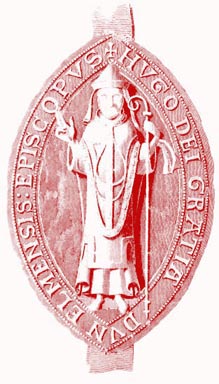
Bit of a diversion from my usual sources today.  This is from “History of Sunderland” by William Cranmer Mitchell, published in 1919.  I decided to share the translation of Bishop Pudsey’s Charter of Privileges for Wearmouth (Wearmue) which was an event of great importance for Sunderland.  The Charter was issued in 1154 in the reign of King Henry II (Thomas Becket and all that!).  Bishop Pudsey (or Puiset to give him his Norman French name) was the nephew of King Stephen, and was a very successful Bishop of Durham, commissioning many of the buildings and bridges which define Durham to this day.  The Bishops of Durham ruled the Palatinate of Durham much like Kings in their own right and followed the example of Royal patronage by granting Charters to important towns within their control.  This is the translation of the Charter.

Hugh, by the grace of God, Bishop of Durham.

To the Prior, Archdeacons, Barons, and all the men in the whole of his diocese, both French and English, Greeting.  Be it known that we, by this present charter, concede and confirm to our burgesses of Wearmue, free customs in their borough, similar to the customs of the burgesses of Newcastle, nameley: –

  1.  That is is lawful for them to judge in a court of law peasants and other rural inhabitants, within their borough if they be indebted to them, without the license of the Bailiff, unless perhaps they may have been placed there by the Bishop or Sheriff, for some matter of the Bishop’s own.
  2. If a burgess accredited anything to a villein (bondman) within the Borough.  However a burgess must no on any reason harass a villein by unlawful speech.
  3. All pleas arising within the Borough except those of the Crown, shall be determined there.
  4. If any burgess be accused within the Borough, he must comply, unless he makes his escape into another Borough, when he shall be retained or placed in security, but if the same Borough do not fail in their duty, and if the plea does not pertain to the Crown, he shall not be called upon to answer within an appointed day, unless it has been formerly fixed by an unwise council in law.
  5. If a ship touch at Weremue, and it is about to depart, any Burgesses may purchase whatever merchandise he wishes from the ship, if anyone be willing to sell to him; and if a dispute arise between the burgess and the merchant, they must settle it within the third influx of the tide.
  6. Merchandise being brought into the Borough by sea, ought to be landed, except salt and herrings, which may be sold either in the ship or in the Borough, at will of the seller.
  7. Should anyone hold land in the borough for one year and a day without accusation, while the claimant has been within the realm, and not under age, if then accused he ought not to give it up.
  8. If a burgess has his son boarded in his own house, the son may enjoy the same liberties as his father.
  9. If a villein come to live in the borough and hold land and tenements for a year and a day without accusation, by desire of his landlord, he may remain to any time in the Borough as a burgess.
  10. It is lawful or a burgess to sell his lands, and go where he pleases, unless his lands be under a bond.
  11. If a burgess be complained against, in a matter where battle ought to be waged, by a villein or free inhabitant, he may defend or clear himself by the civil law, or by the oath of thirty-six men, unless the value in suit be one hundred pounds, or the crime imputed to  him ought to be tried by battle.
  12. A burgess ought not to fight against a villein if he should force him, unless before the accusation he should have forfeited his office as a burgess.
  13. Blodwite (a fine paid as compensation for the shedding of blood), nor Merchet (a payment made by a villein to his lord for liberty to give his daughter in marriage), nor Heriot (a tribute or fine payable to the lord of the fee on the decease of the owner, landowner, or vassal), nor Stengesduit (a fine inflicted for an assault committed with a stick or similar instrument) ought not to exist in the borough.
  14. It is lawful for any burgess to have his own oven and handmill, saving the right of the Lord Bishop.
  15. If anyone fall into forfeiture to the Bailiff touching bread or beer, the Bailiff alone can allow him to escape, but if he fall the third time let justice be administered to him by the common consent of the burgesses.
  16. A burgess may bring in his corn from the country when he pleases, except at a time of prohibition or embargo.
  17. A burgess may give or sell his land to whom he pleases, without the voice or consent of his heir, if he bought it with his own money.
  18. Every burgess is a liberty to buy timber and firewood equally with the burgesses of Durham.
  19. The burgesses may enjoy their common pasturage, as was originally granted to them, and which we have caused to be perambulated.
  20. We shall hold the same customs arising from fish being sold at Weremue as Robert de Brus held from his people at Hartlepool.
  21. We will therefore and more firmly determine that the burgesses have and hold the before mentioned customs and privileges freely, quietly, and honourably from us and our successors.

These being Witnesses: –

Germanus – Prior of Durham

Burchard – Archdeacon of Durham

Symon – Treasurer of Durham

Richard De Coldingham – Vical of St. Oswald’s

Master Stephen Lincoln

Master Bernard

Henery Marescall

Arnold Adam and Simon – Chaplains

Gilbert De Ley

Philip the Sheriff

Jordan Escolland – Lord of Dalton

Alexander De Hylton – Baron of Hylton

Gaufrid, son of Richard – Lord of Horton

Roger De Eppleton; and others.


Spotty’s Hole

Spottys Hole, 1887 (2)

From a little to the north of Hartlepool to a little to the north of Sunderland, the East Coast of Durham is broken or indented by deep ravines locally called “denes,” or, when they are small, “gills.” Castle Eden Dene is famous all over the North of England; but Roker Gill, in the parish of Monkwearmouth, three-quarters of a mile to the north of Sunderland Harbour, has not attained more than a parochial celebrity, and that much only in connection with a now somewhat dubious and almost mythical personage called Spotty.

But, first of all, who was Spotty? Incredulous people are to be found who daringly say with Betsy Prig that “there never was no such person.” Sir Cuthbert Sharp observes in a note to the song called “Spottee” in his “Bishoprick Garland”: “Spottee was a poor lunatic, who lived in a cave between Whitburn and Sunderland,’ which still retains the name of Spottee’s Hole.” Garbutt, in his “History of Sunderland,” says: “The name of Spotty’s Hole, by which this place is now generally distinguished, is derived from a foreigner who, some years ago, having probably left some vessel in the harbour, took up his residence in this dreary abode. Being unable to speak the English language, his daily subsistence was gained among the farm-houses in the neighbourhood, where he endeavoured to make himself understood by means of signs, and was known by the name of Spotty, on account of the variegated spots on his upper garment. “Tradition and probability, according to the late Mr. W. Weallands Robson, are on the side of Garbutt, who, so far, is right, and Sir Cuthbert wrong.

Spotty was, in fact, a vagabond of the Lascar genus. But Garbutt is as far wrong himself as Sir Cuthbert when he goes on to add : “Having lived for some time in this subterraneous habitation, he suddenly disappeared, and was supposed either to have died suddenly, or, by advancing too far into the cavern, to have fallen a prey to foul air.” That Spotty suddenly disappeared is beyond doubt, but whether he died suddenly and prematurely, or whether he died a lingering death at the close of the ordinary span of life, nobody ever pretended to be able to say. One thing is very certain, that he did not die in his hole, where his body might and would have been found, and it is now quite clear that, for the very best of all possible reasons, he could not have advanced so far into the cavern as to have fallen a prey to foul air. The truth was that Spotty kindled a fire at the mouth of his hole to keep himself warm. Wood was then and long afterwards plentiful enough on the beach just above high-water mark, and the glare of Spotty’s fire, being mistaken for the light of the town, lured a small ship to its destruction, upon which Spotty prudently disappeared.

On the principle of omne ignotum pro magnifico, the most absurd and exaggerated ideas were formed of the extent of Spotty’s Hole. Nobody knew exactly how far it did, or rather did not, go, and therefore everybody felt free to make it go as far as he pleased. Some had it that it was a subterranean passage to the ancient monastery of Monkwearmouth; others would have it that it went as far as Hylton Castle; and probably, if the notion had been suggested, we would soon have had it going all the way to Jarrow, or to Finchale, or to Durham Abbey. It actually went nowhere at all! Garbutt gravely says: “This secret way, which most probably has been wrought by the monks, with a view of eluding their enemies in times of invasion or civil commotion, was some time ago partially explored by three of the inhabitants of Monkwearmouth. After they had advanced a little way from the entrance, they found the passage perfectly good, in general allowing them to walk upright, and entirely hewn out of the limestone rock, with which this place is surrounded. Having proceeded a considerable distance in the direction of the site of the monastery, without meeting with any considerable impediment, they thought it prudent to return, on account of the danger of coming in contact with foul air, to which they might have been exposed by a further progress.” Alas for the credit of veracious history! In all human probability, the three faint-hearted or vain-glorious inhabitants of Monkwearmouth thought it most prudent never to go in at all. Their whole story was a fib, or a fiction, or a fancy, as much so as Don Quixote’s account of the Cave of Montesinos.

When the present Sir Hedworth Williamson succeeded to his patrimonial estate, he unfortunately resolved to test the truth of the stories he had heard in the nursery: so the worthy baronet employed some men to explore the cavern. They “howked” a little marl out to facilitate their entrance, and soon brought their labours to an end with the end of the cavern! The romance of the place was destroyed directly. The unfathomable aperture, the secret way wrought by the monks, turned out to be nothing else than an ordinary natural fissure in the rock, not very much more than would have fitted it for the burrow of a badger or the earth of a fox!

Spottys Hole, 1887 (1)

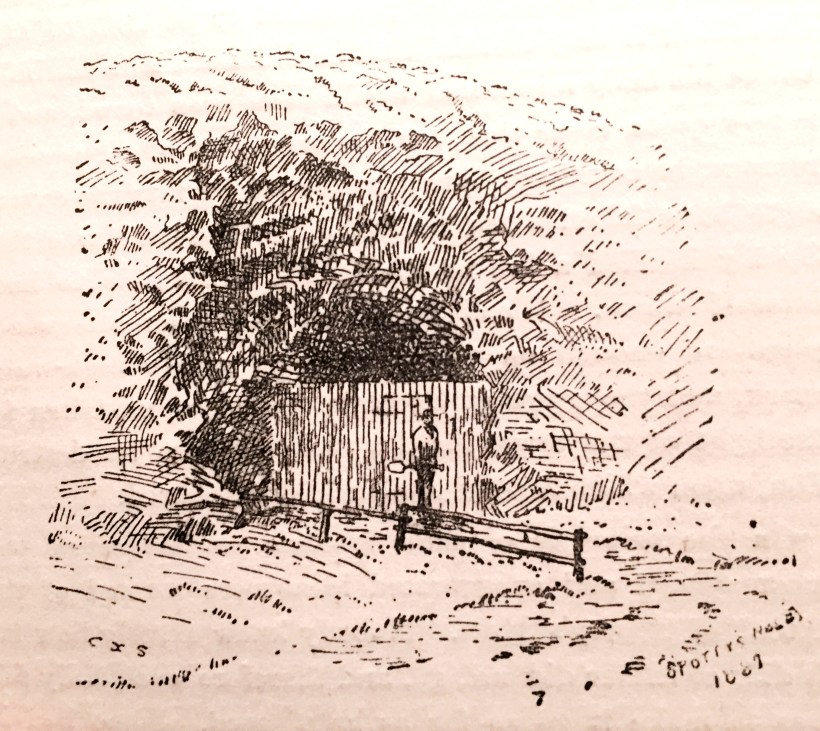
The present appearance of Spotty’s Hole may be gathered from the accompanying sketches of it. Our artist was informed that the cavern is used as a sort of store-house for something or other. But the whole character of the neighbourhood has lately been changed. Roker Gill now forma part of Roker Park, while a substantial new bridge across the ravine has been constructed to afford an easier mode of communication between Whitburn and Sunderland than formerly existed.

We subjoin the song which Sir Cuthbert Sharp printed in the “Bishoprick Garland.” The Jacob Spenceley mentioned in it was an ancestor of the late Captain Burne of Bishopwearmouth, who married one of the Allans of Blackwell Grange. He was a man of considerable property in Sunderland, some of which descended to, and was sold by,
Captain Burne. The name of Spenceley is still preserved in Spenceley’s Lane, otherwise called Bet Cass’s Entry. Laird Forster we take or conjecture to have been either Alderman Forster, the owner of a good deal of land at Whitburn which was inherited by his nephew, Mr. Thomas Barnes, or some predecessor in name and estate of Alderman Forster. “Floater’s flood” is the local name of a great flood which carried away Floater’s Mill, near Houghton. The “carcasses” spoken of were the wood-work of which the North Pier of Sunderland Harbour was built, and which was replaced by stone some forty or fifty years ago. Sir Cuthbert Sharp, Knight, the preserver of the song, was Collector of Customs at Sunderland, and afterwards at Newcastle-upon-Tyne, where he died in 1849.

The following note prefaces the song in the “Bishoprick Garland”: “This curious ditty is printed from a copy found in the papers of the late Thomas Clerke, Esq., of Sunderland (and possibly written by him). He was a gentleman of powerful convivial talents, and the author of several spirited and anacreontic songs which are now attributed to others. He was a cheerful member of society, and his poetical contributions were remarkable for their ready wit and sparkling humour. His ‘Sons of the Wear’ is bold and enlivening, his ‘Musical Club’ is full of good-natured point and playful fancy, and his ‘Ode to Silver Street’ is a pungent and lively portrait.”

And now for the song itself:

Come all ye good people and listen to me,
And a comical tale I will tell unto ye,
Belanging yon Spottee that lived on the Law Quay,
That had nowther house nor harbour he.
The poor auld wives o’ the north side disn’t knaw what
for te de,
For they dare not come to see their husbands when they
come to the Quay;
They’re feared o’ their sel’s, and their infants, tee,
For this roguish fellow they call Spottee.
But now he’s gane away unto the sea-side,
Where mony a ane wishes he may be weshed away wi’ the
tide,
For if Floutter’s flood come, as it us’d for te de,
It will drive his heart out then where will his midred be?
The poor auld wives o’ Whitburn disn’t knaw what for te
de,
For they dar not come alang the sands, wi’ their lang tail
skates in their hands, to Jacob Spenceley’s landing,
as they us’d for te de.
They dare not come alang the sands, wi’ their swills in
their hands.
But they’re forced to take a coble, and come in by the sea.
As Laird Forster was riding alang the sands,
As he or any other gentleman might de,
Spottee cam’ out, his tanter-wallups did flee,
His horse teuk the boggle, and off flew he.
He gathers coals in the day-time, as he’s well knawn for
te de,
And mak’s a fire on i’ the neet, which kests a leet into the
sea,
Which gar’d the poor Sloopy cry, “Helem a-lee,”
And a back o’ the carcasses com poor she.
“Alack and a well-a-day,” said the maister, “what shall
we de?”
“Trust to Providence,” said the mate, ” and we re sure to
get free;”
There was a poor lad that had come a trial vaige to sea,
His heart went like a pair o’ bellows, and he didn’t knaw,
what for te de.
Johnny Usher, the maister, wad ha’ carried him away,
But the ship’s company swore deel be their feet if they
wad with him stay;
“We’ll first forfeit our wages, for ganging to sea,
Before we’ll gan wi’ that roguish fellow they call Spottee.