A journey along the River Tyne around 1830

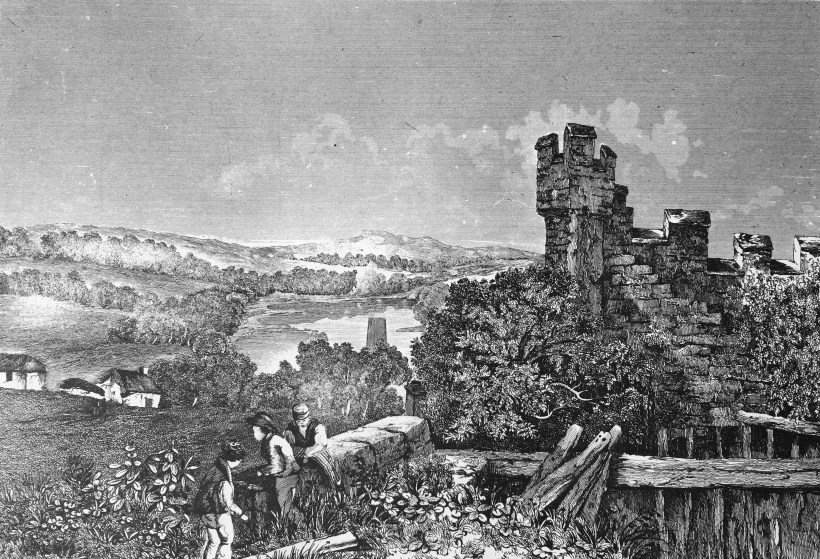
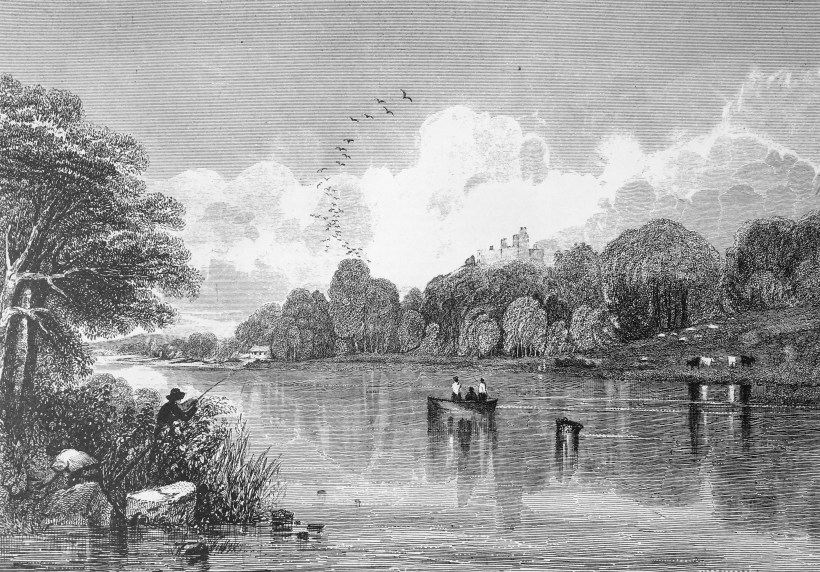
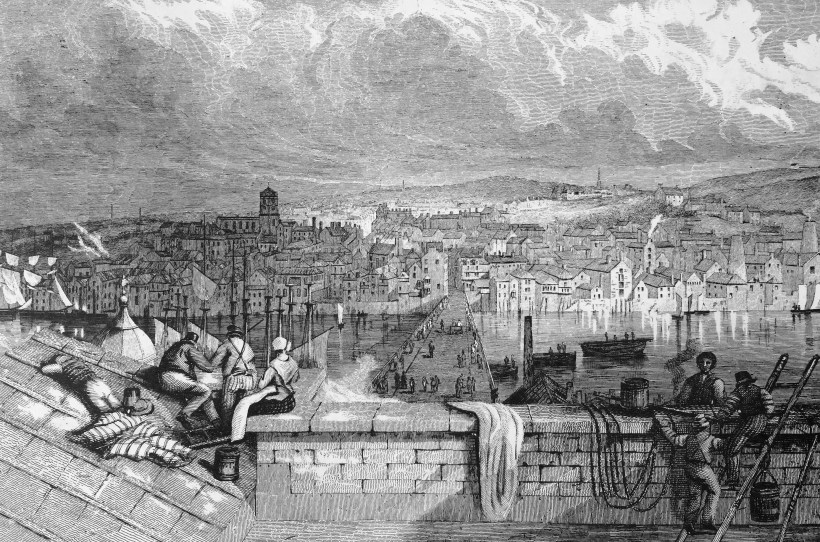
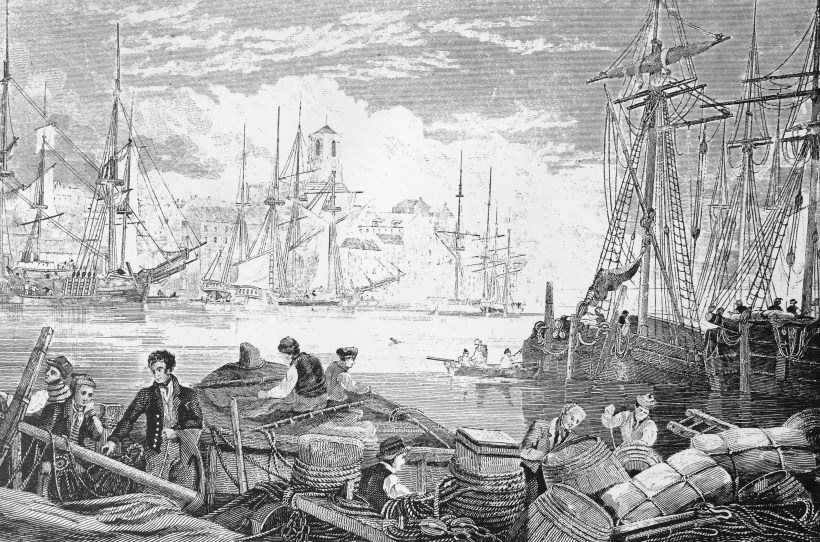
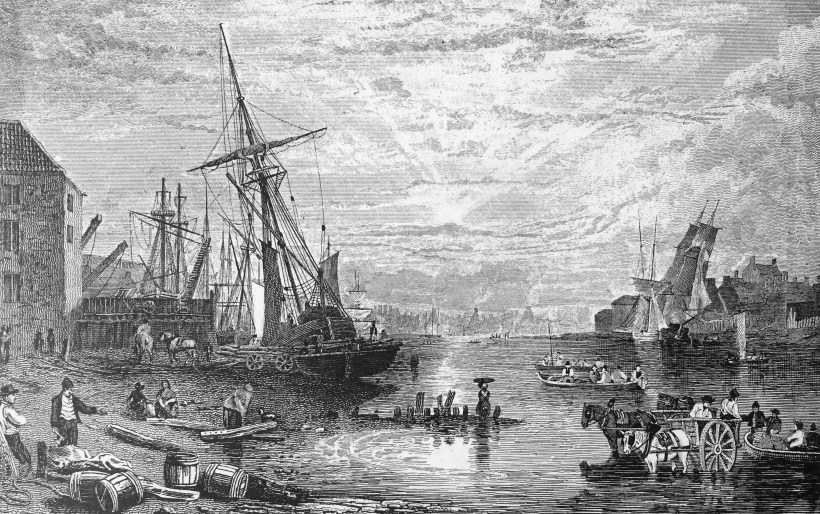
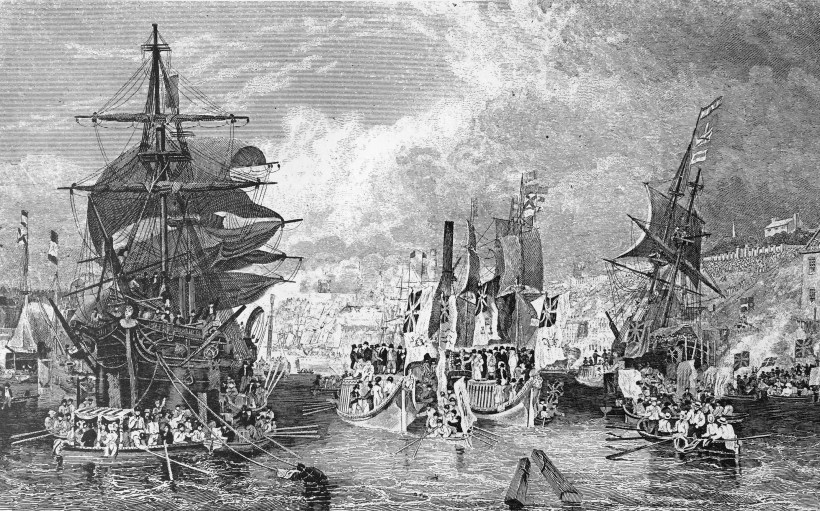
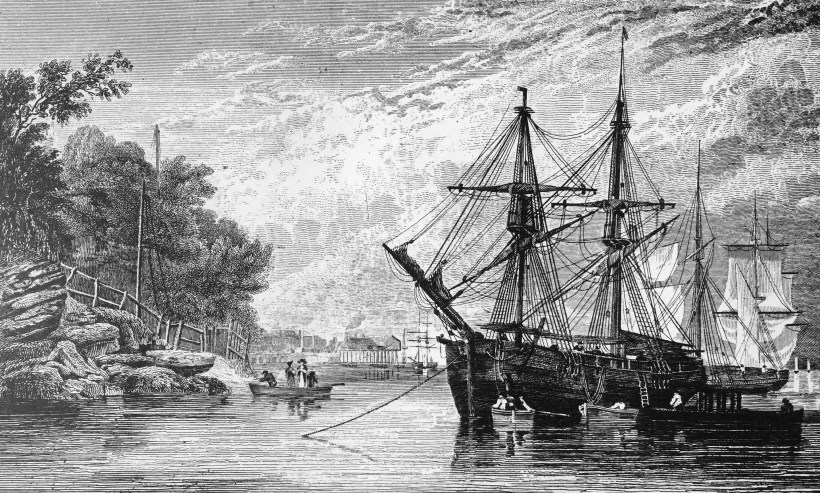
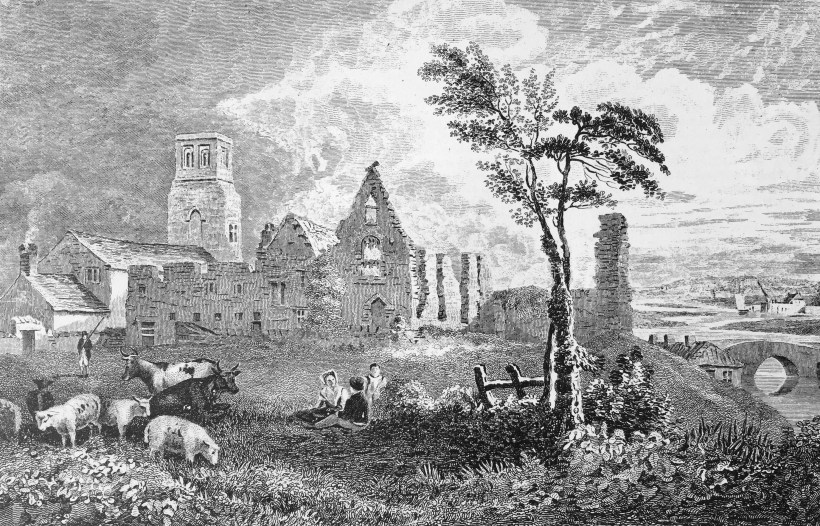
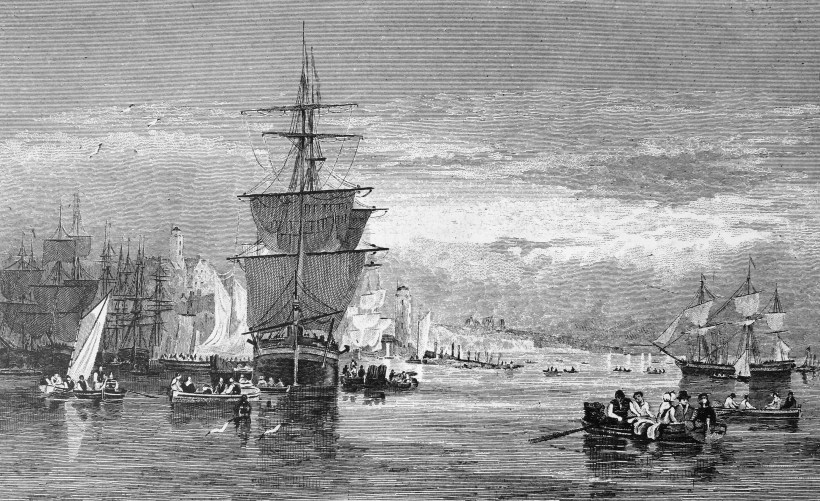
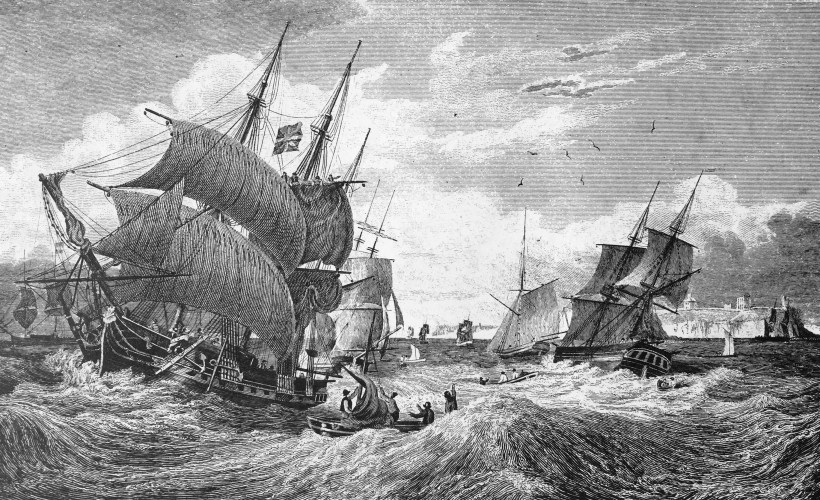
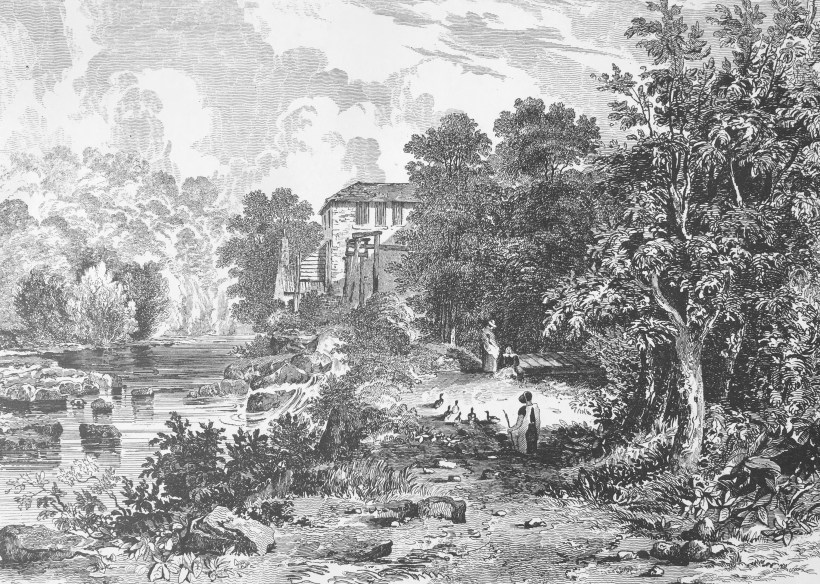
The following images are the reproduced engravings of J.W. Carmichael (1800 – 1868) which depict views of places along the River Tyne from Bardon Mill to Tynemouth.  They were re-published in the 1969 book “Pictures of Tyneside” (which I found in a second hand book shop for a fiver!).  The original copper plates from the first edition in 1830 were found in 1966 from which these prints were taken.  They beautifully depict everyday life at various location along the Tyne.  With the advent of photography this wonderful art form went into decline.

1 Bardon Mill
Bardon Mill
2 Beaufront
Beaufront
3 Dilston
Dilston
4 Aydon Castle
Aydon Castle
5 View from Bywell Castle
View from Bywell Castle
6 Bywell from the River
Bywell from the River
7 Prudhoe
Prudhoe
8 Ryton
Ryton
9 Newcastle upon Tyne
Newcastle upon Tyne
10 Gateshead
Gateshead
11 Gateshead
Gateshead
12 Sandgate Shore
Sandgate Shore
13 North Shore
North Shore
14 North Shore
North Shore
15 Ascension Day
Ascension Day
16 Dent's Hole
Dent’s Hole
17 Dent's Hole
Dent’s Hole
18 View from St. Anthony's
View from St. Anthony’s
19 Felling Boat Landing
Felling Boat Landing
20 Bill Reach
Bill Reach
21 Walker Quay
Walker Quay
22 Carville Shore
Carville Shore
23 Willington Quay and Howdon
Willington Quay and Howdon
24 Jarrow
Jarrow
25 West Entrance to Shields Harbour
West Entrance to Shields Harbour
26 North Shields, Peggy's Hole
North Shields, Peggy’s Hole
27 North Shields
North Shields
28 North Shields
North Shields
29 North Shields
North Shields
30 North Shields
North Shields
31 Tynemouth Priory
Tynemouth Priory
32 Tynemouth Cliffs
Tynemouth Cliffs
33 Tynemouth Bar
Tynemouth Bar


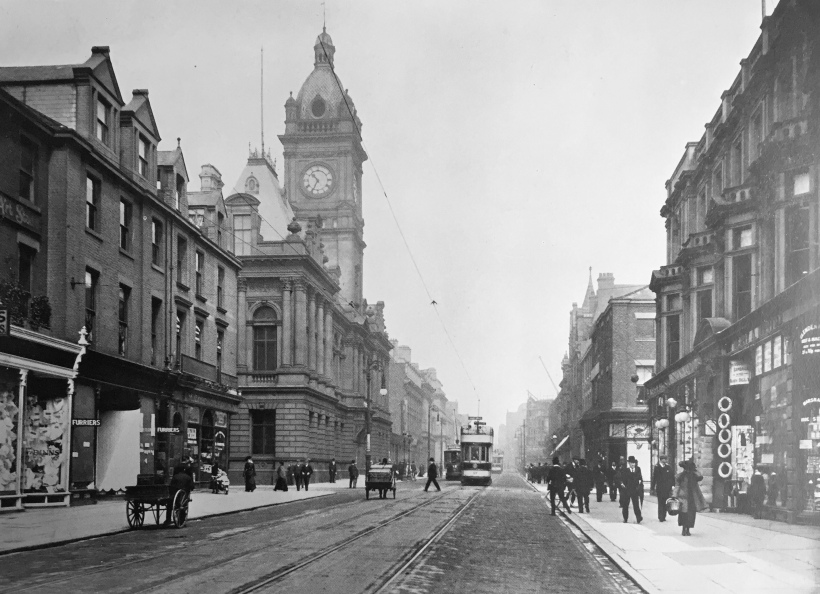
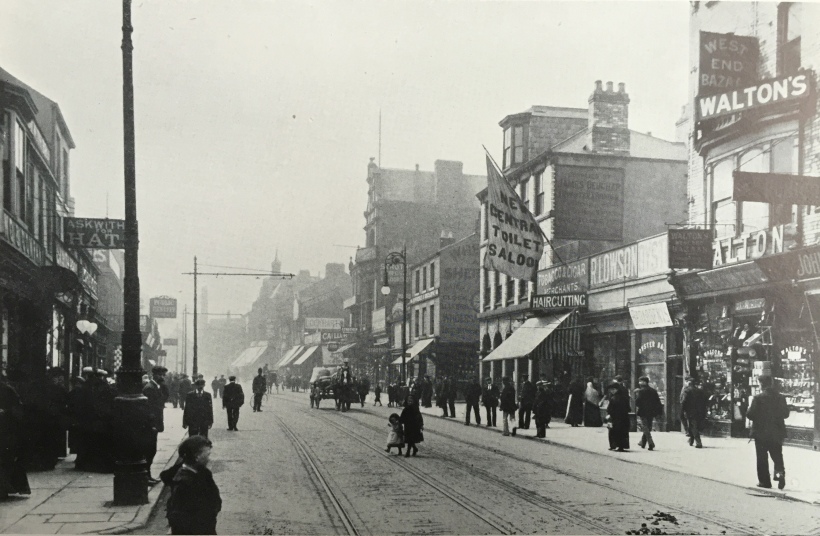
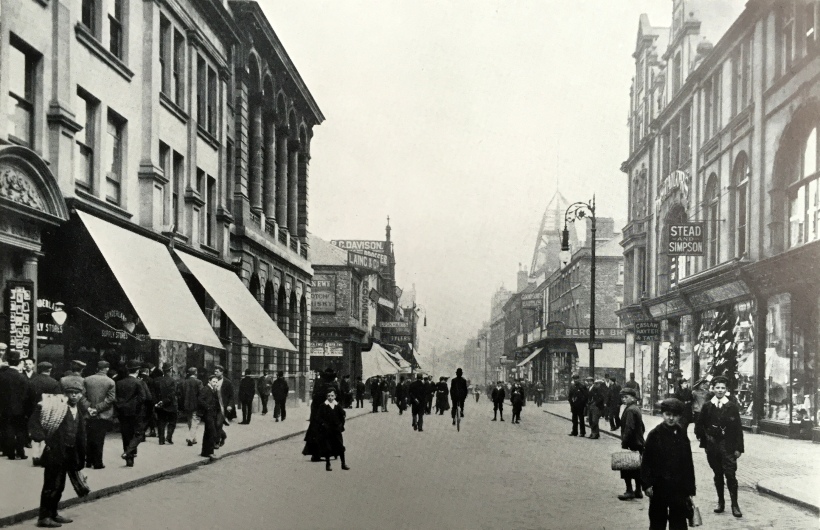
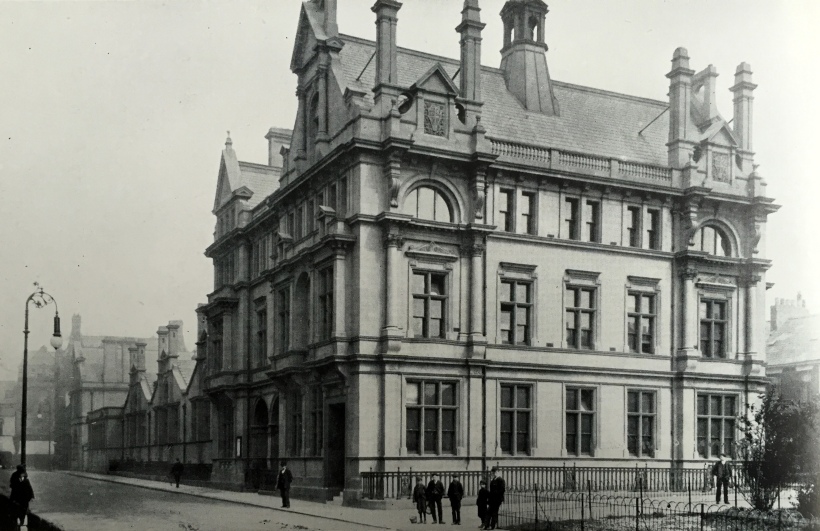
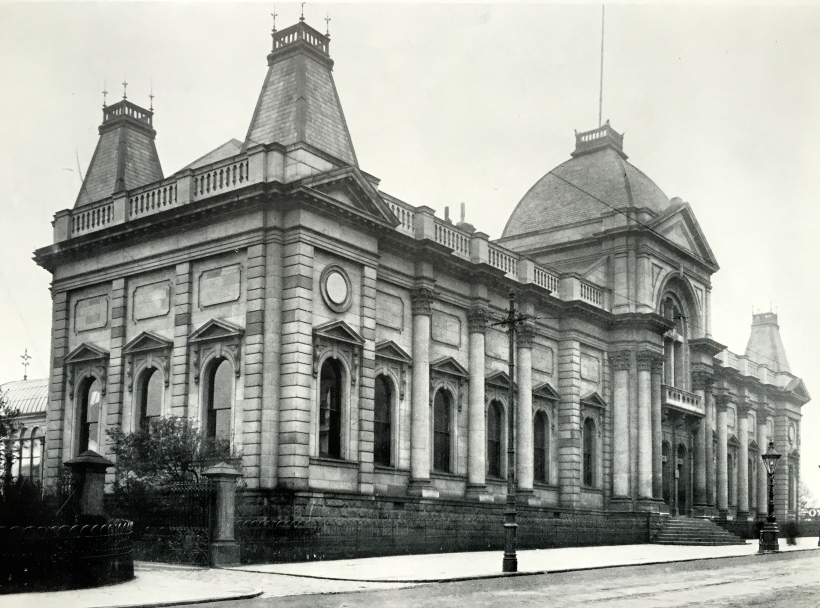
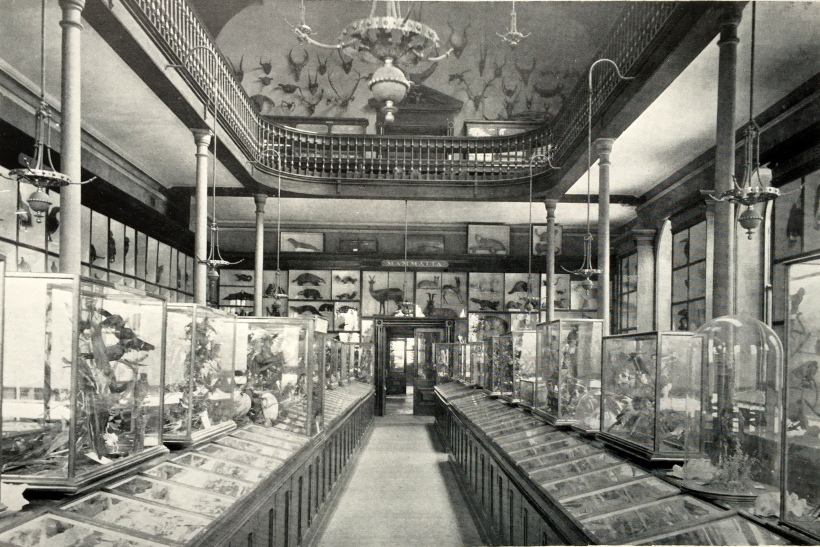
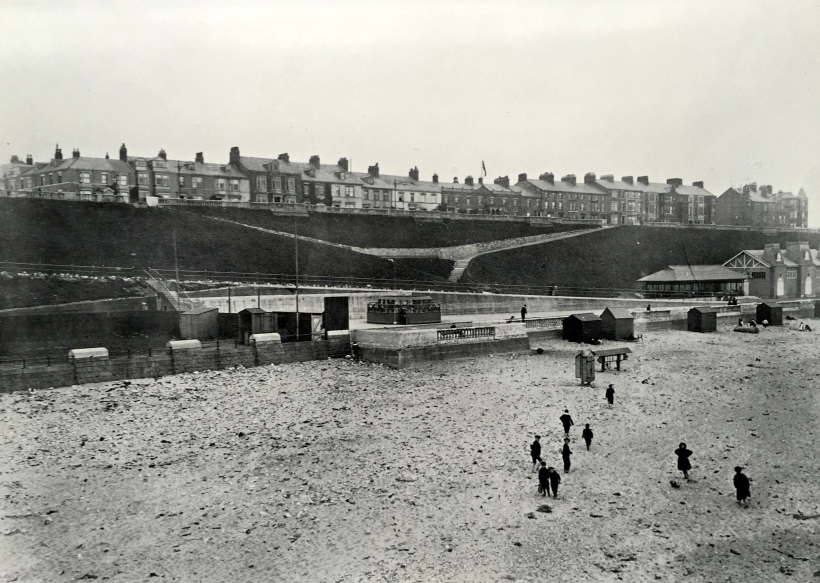
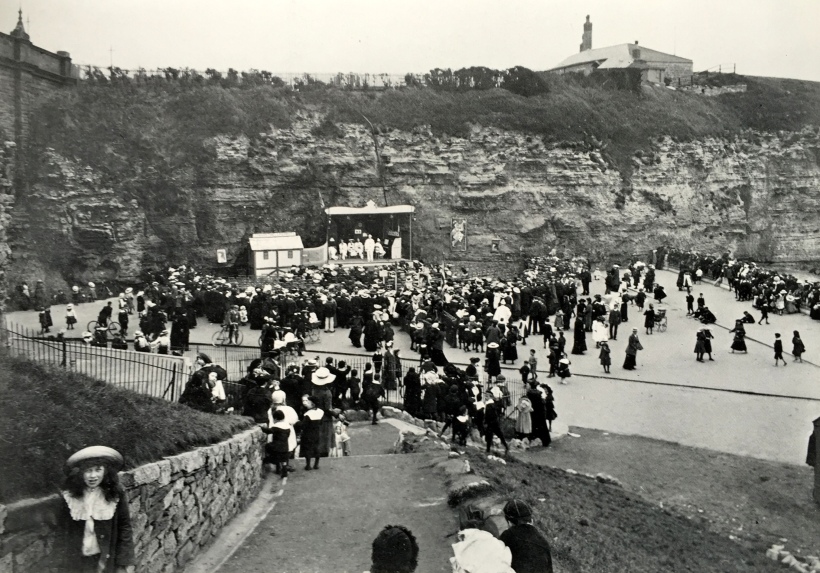
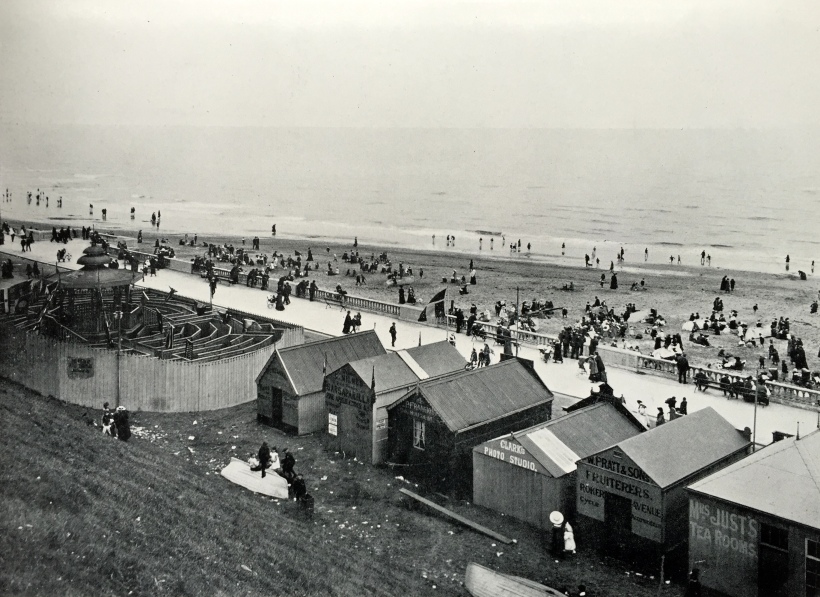
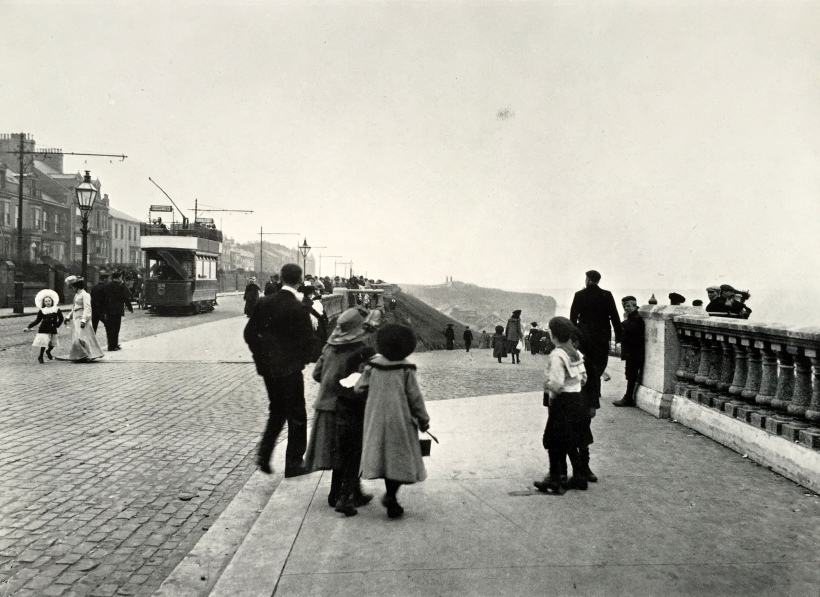
Some Old Photographs of Sunderland (c.1908)

Fawcett Street
Fawcett Street
High Street 1
High Street
HIgh Street 2
High Street
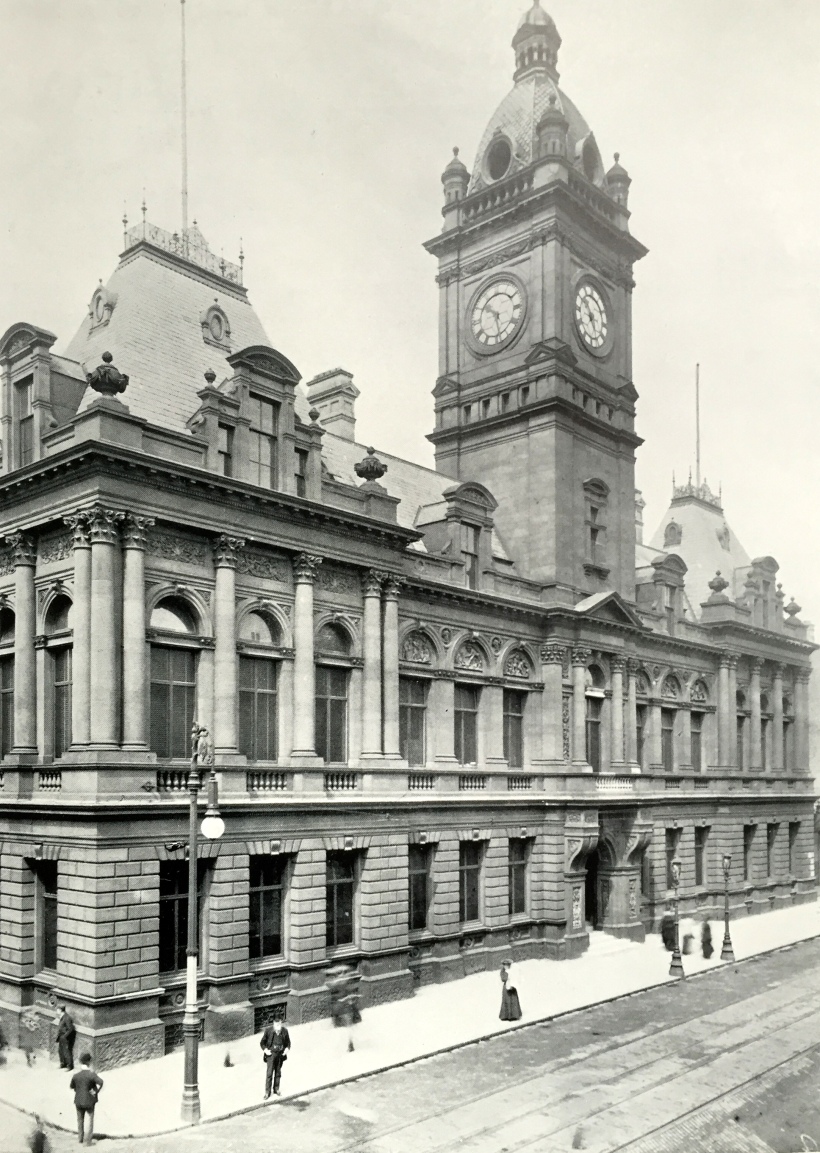
The Town Hall
Sunderland Town Hall
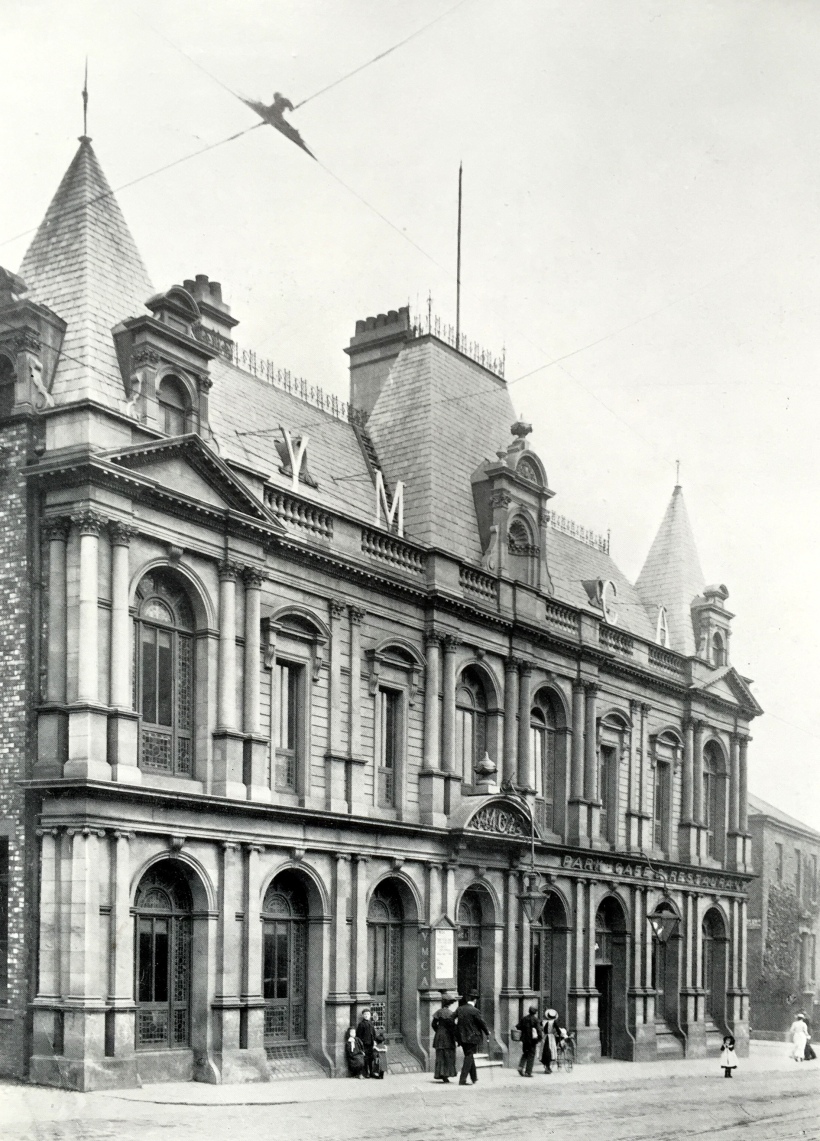
YMCA Sunderland
Y.M.C.A. Sunderland
The Post Office
The Post Office
The Museum
The Museum
The Natural Histoy Museum
The Natural History Museum
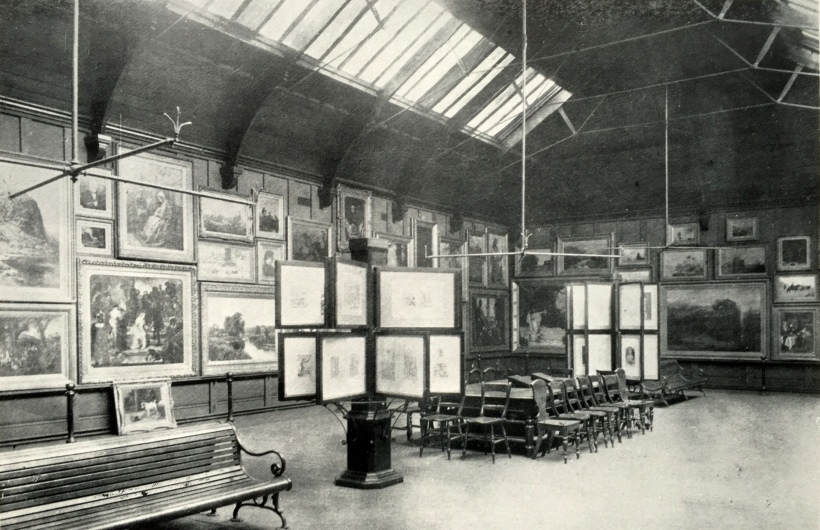
The Art Gallery in the Museum
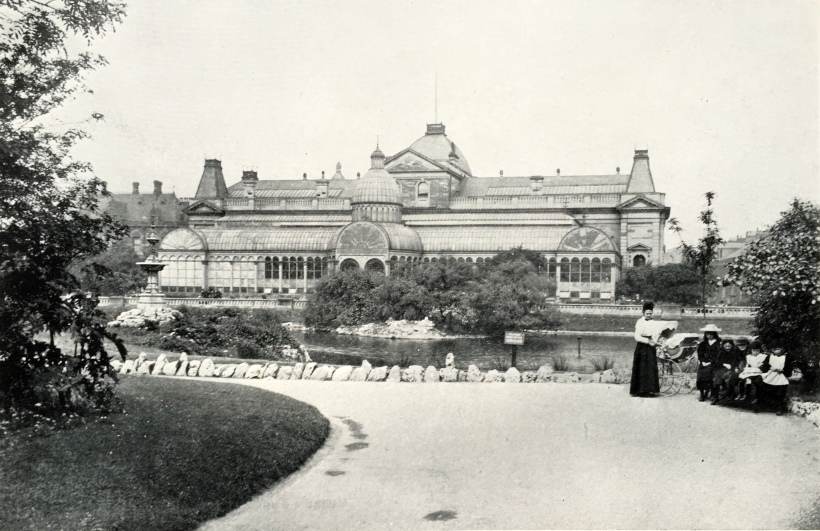
The Winter Gardens
The Winter Gardens
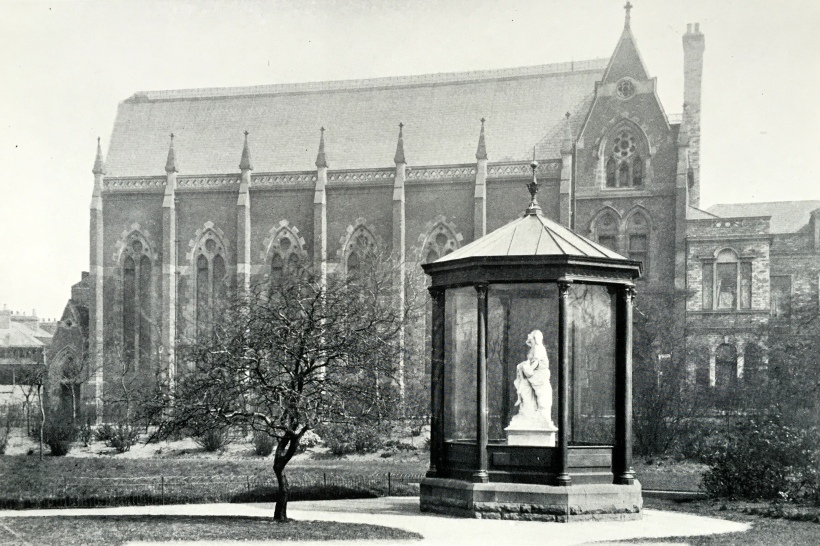
Victoria Hall and Memorial
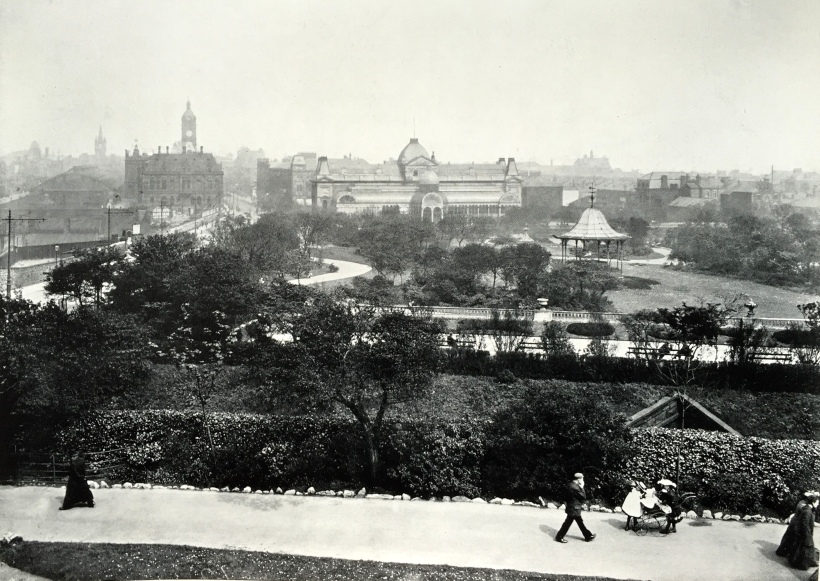
General View of Sunderland from Mowbray Park
General View from Mowbray Park
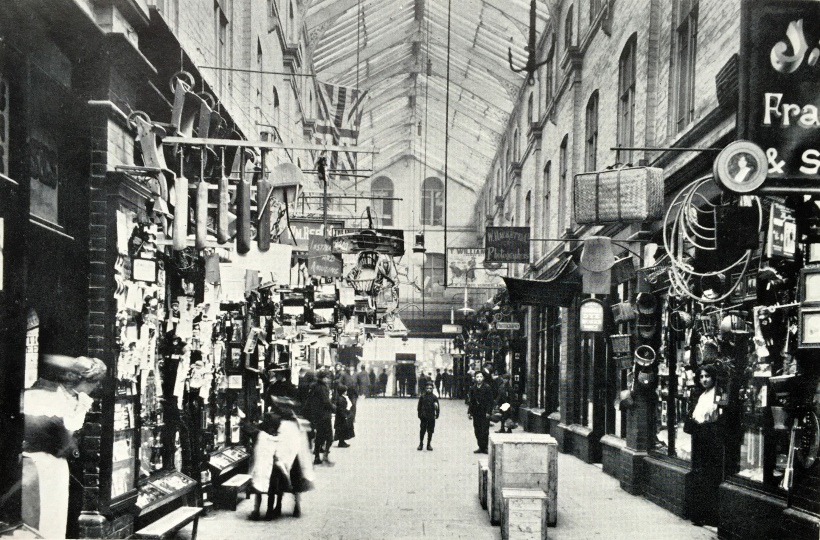
The Arcade
The Arcade
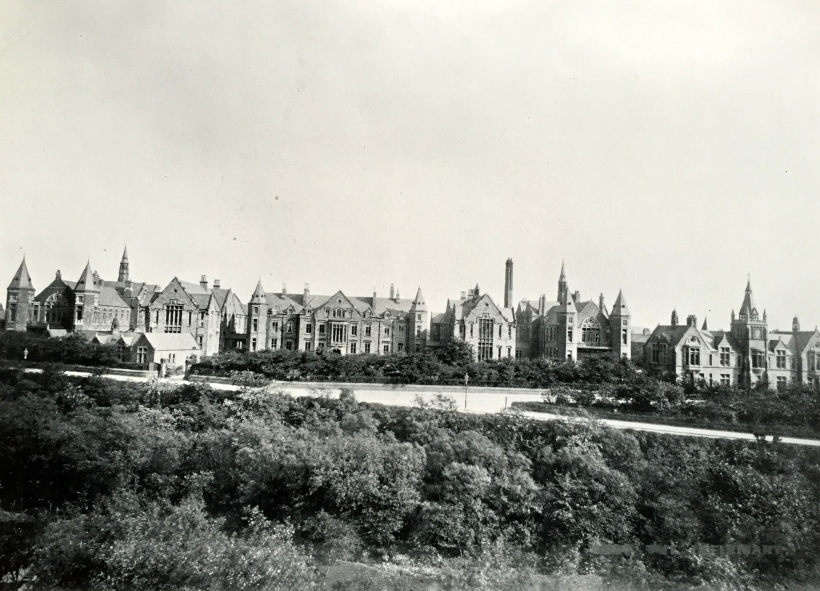
The Infirmary
The Infirmary
Sunderland Parish Church
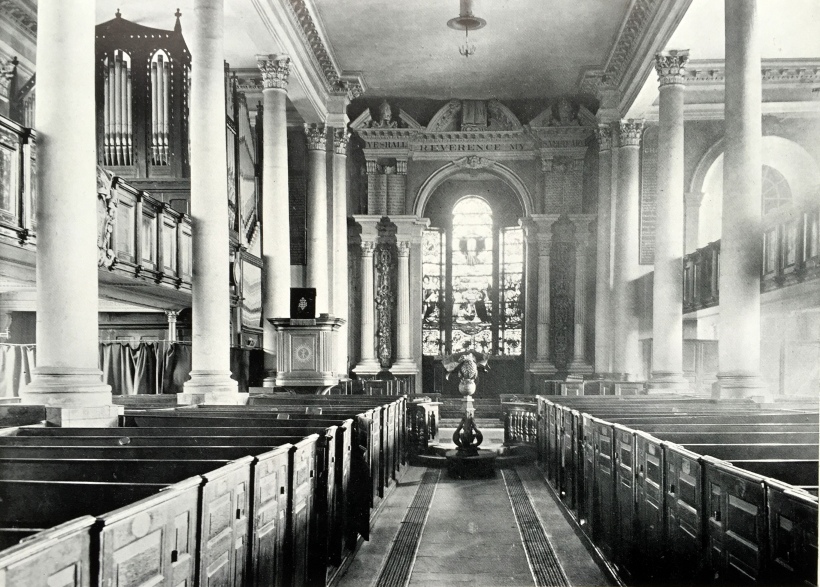
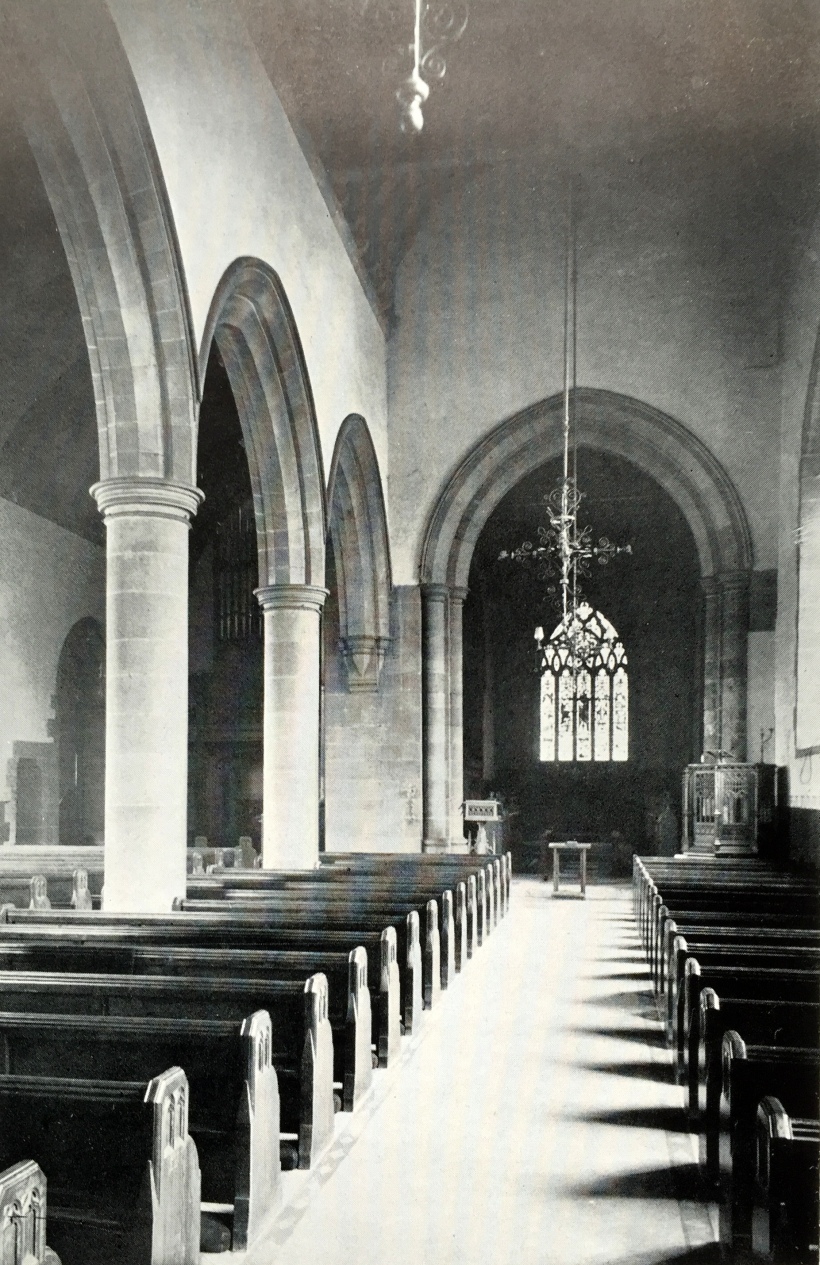
Sunderland Parish Church Interior
Sunderland Parish Church (Interior)
Penshaw Monument
Penshaw Monument
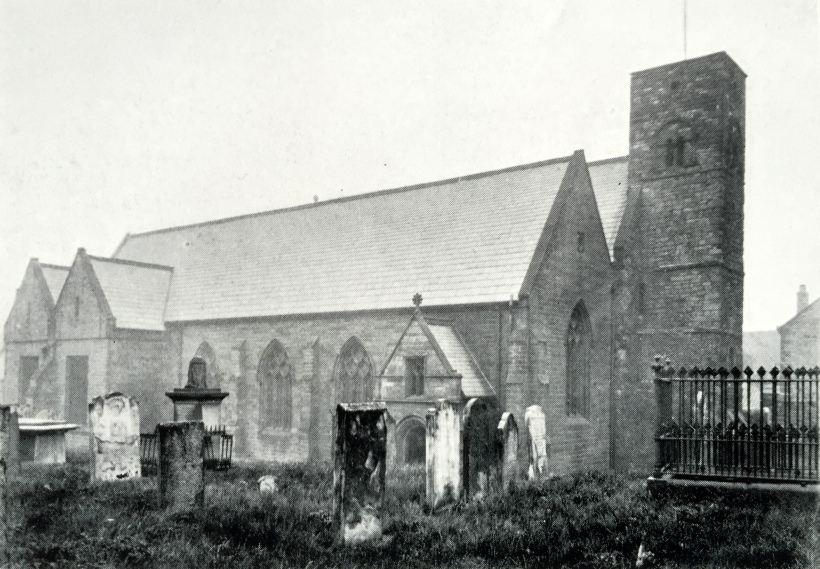
The Parish Church Monkwearmouth
The Parish Church, Monkwearmouth (St. Peters)
The Parish Church Monkwearmouth Interior
The Parish Church, Monkwearmouth (Interior)
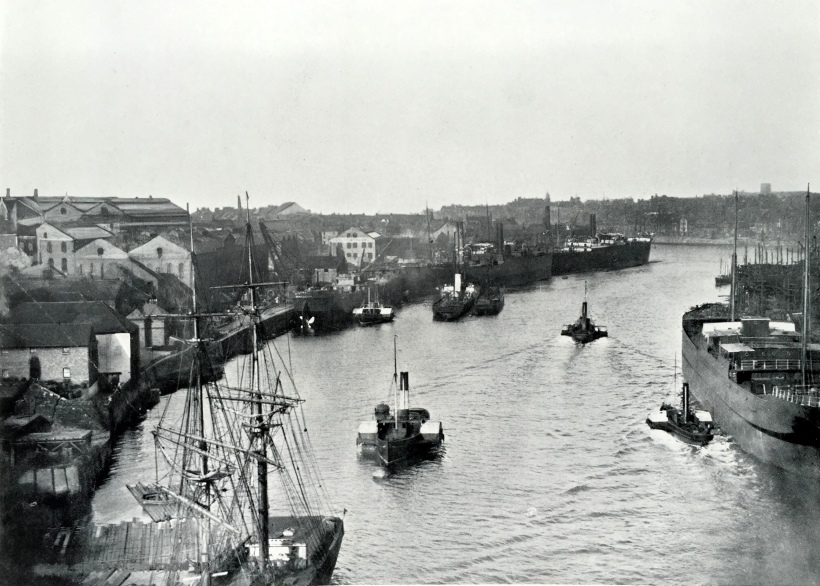
The River Wear
View of the River Wear
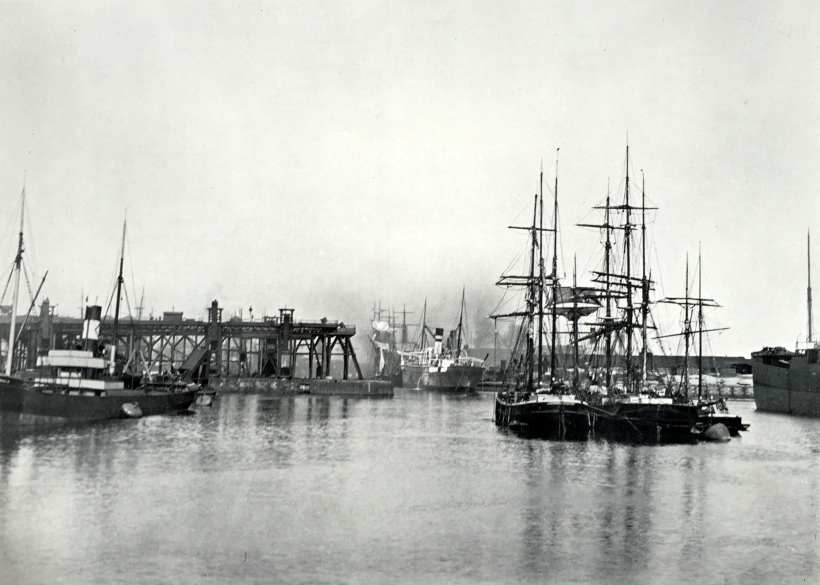
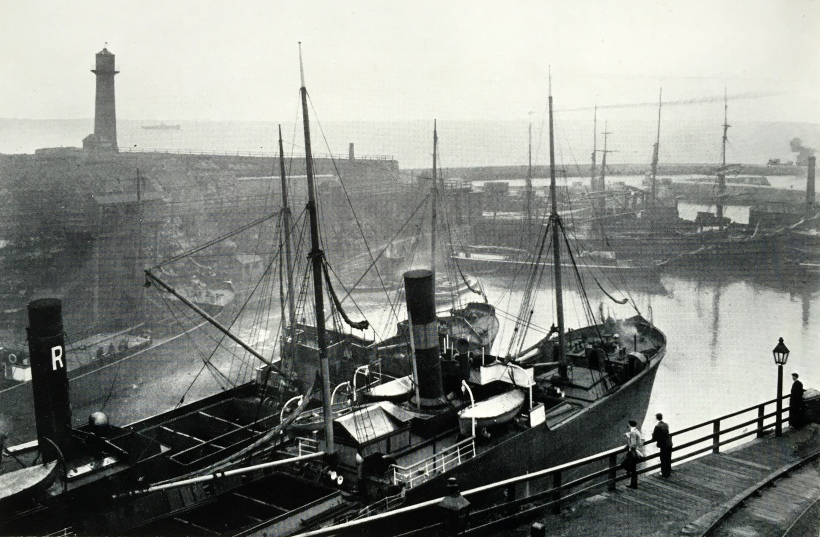
The Docks
The Docks
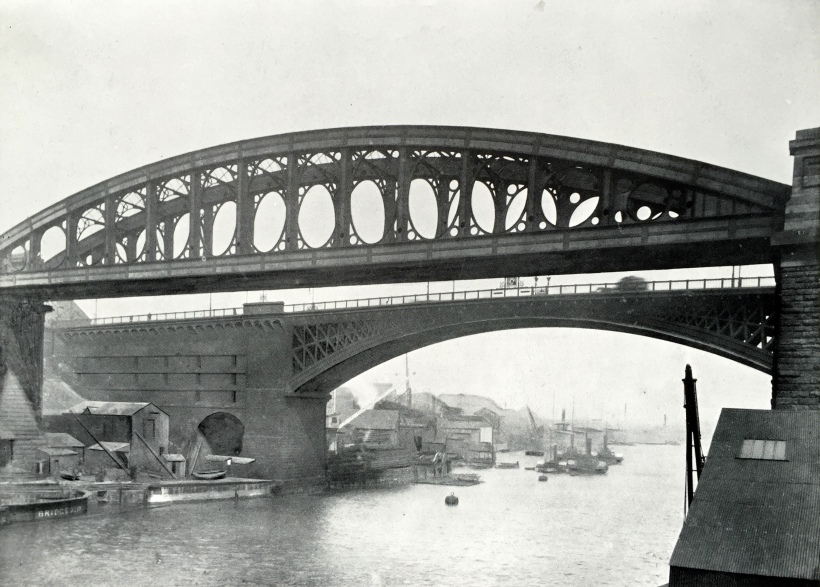
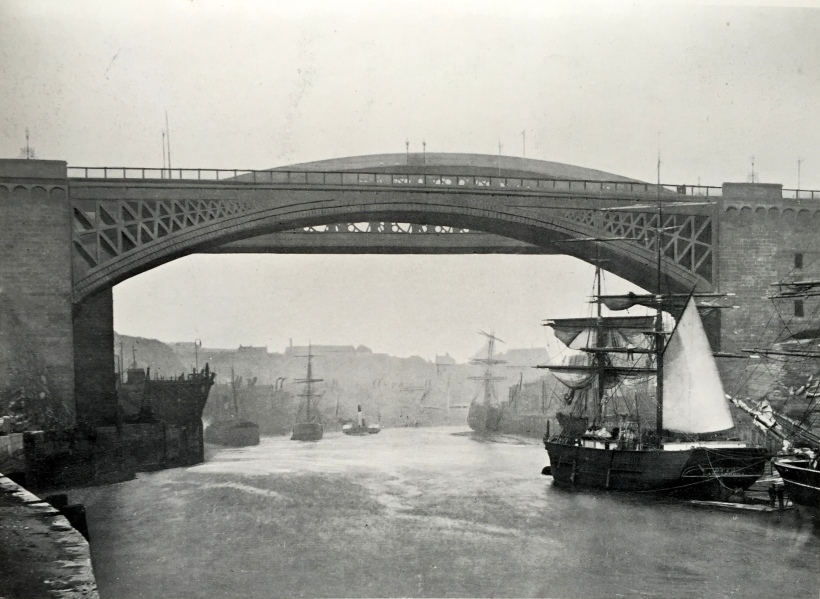
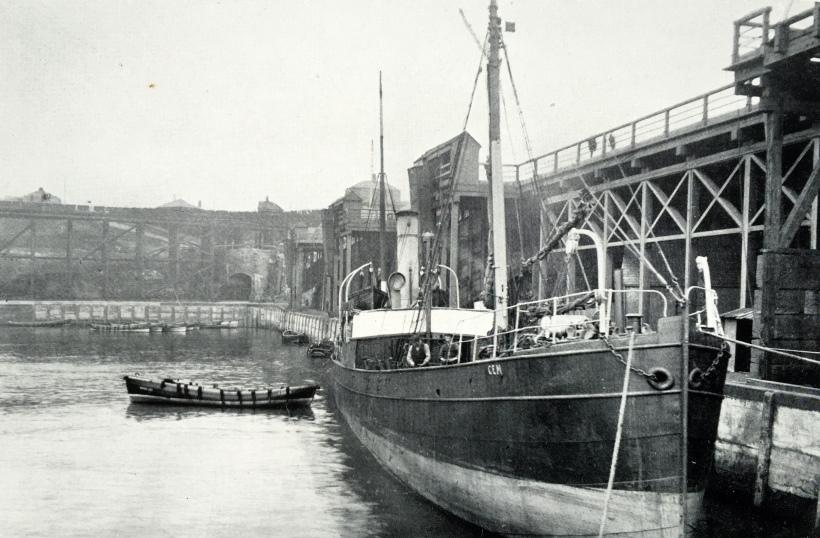
The Briges Over the Wear 1
The Bridges Over the Wear
The Bridges Over the Wear 2
The Bridges Over the Wear
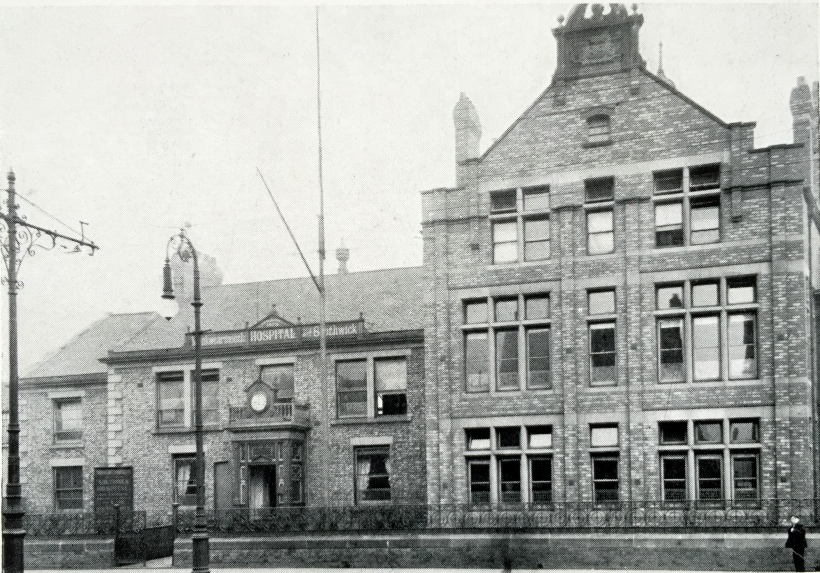
Monkwearmouth Hospital
Roker
Roker
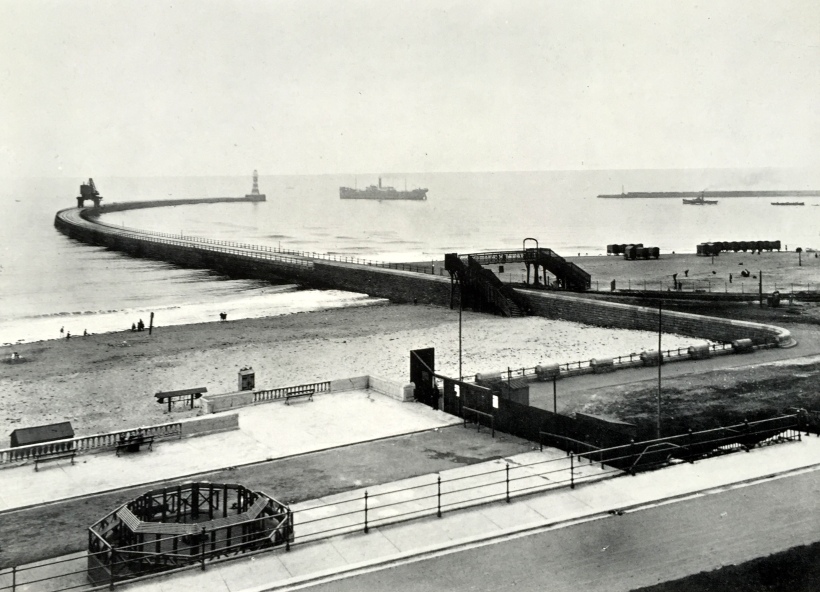
The New Pier Roker
The New Pier, Roker
Roker From the Pier
Roker from the Pier
Holey Rocks Roker
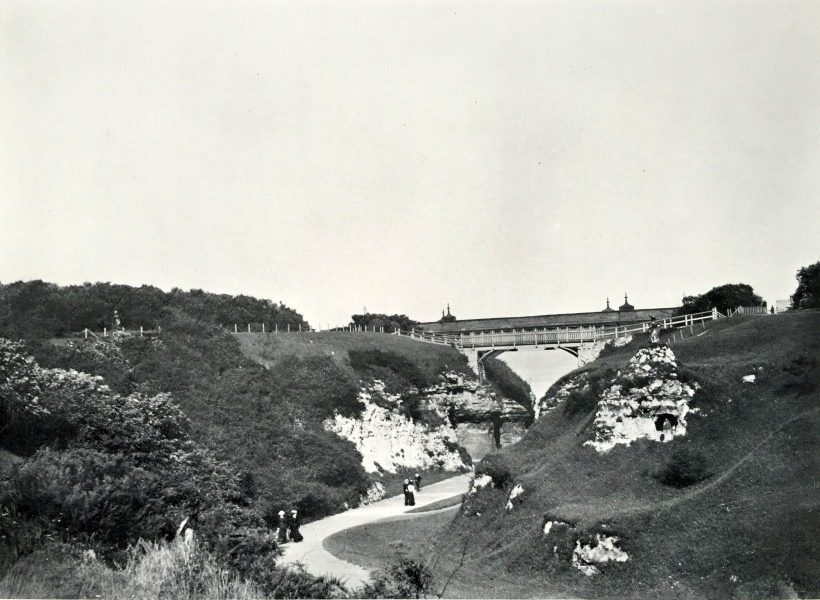
Holey Rocks, Roker
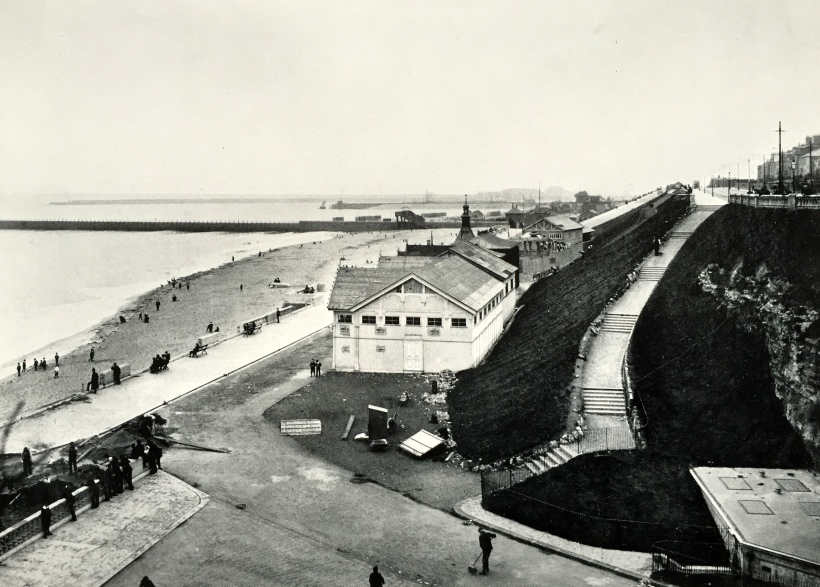
Lower Promenade and Sands Roker
Lower Promenade and Sands , Roker
The Terrace Roker
The Terrace, Roker
The Sands Roker
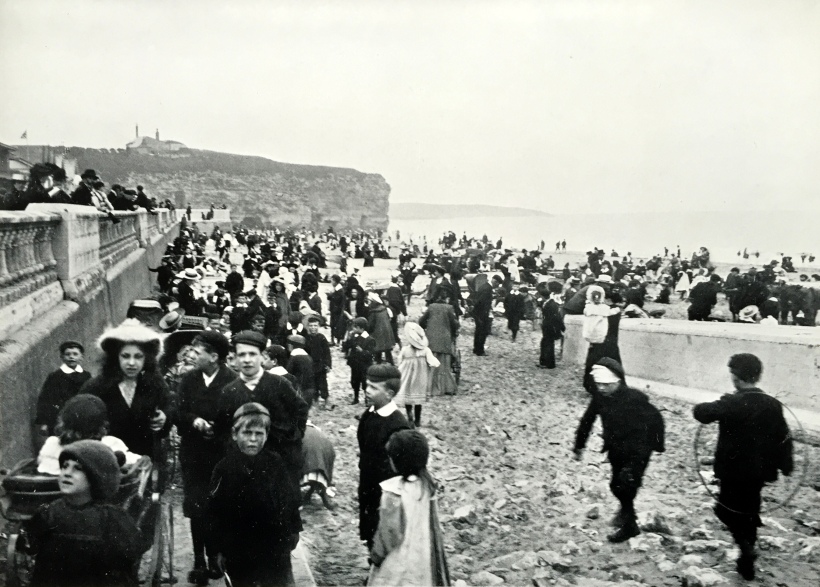
The Sands, Roker
Roker Park
Roker Park
The Band Stand Roker Park
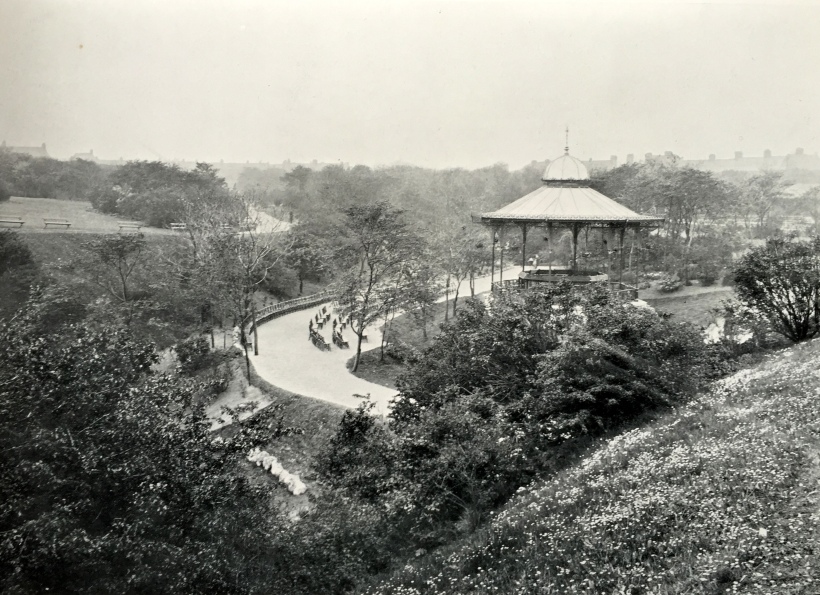
The Bandstand, Roker Park
Whitburn Village
Whitburn Village
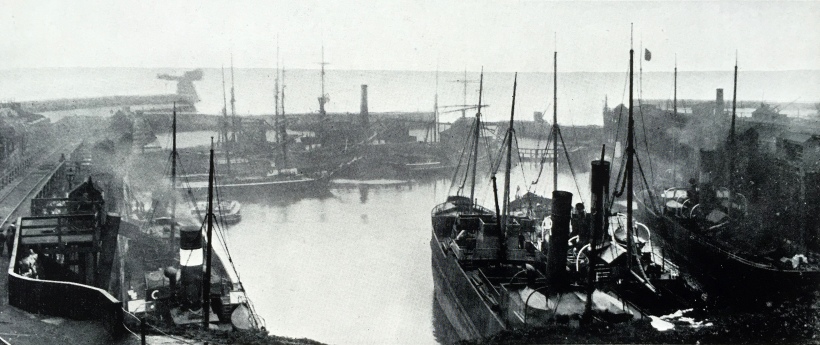
The North Dock Seaham Harbour
The North Dock, Seaham Harbour
The New Dock Seaham Harbour
The New Dock, Seaham Harbour
The Docks Seaham Harbour
The Docks, Seaham Harbour


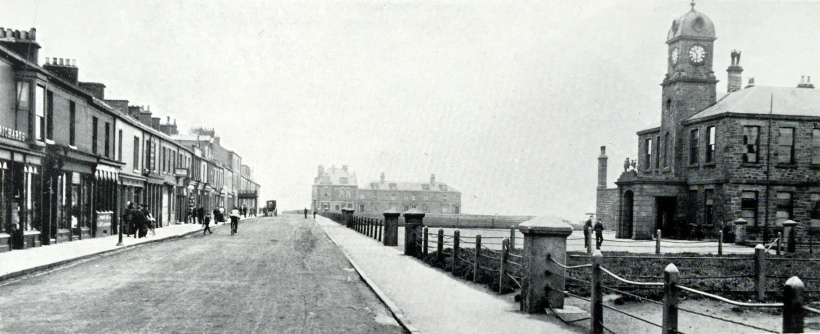
North Terrace Seaham Harbour
North Terrace, Seaham Harbour
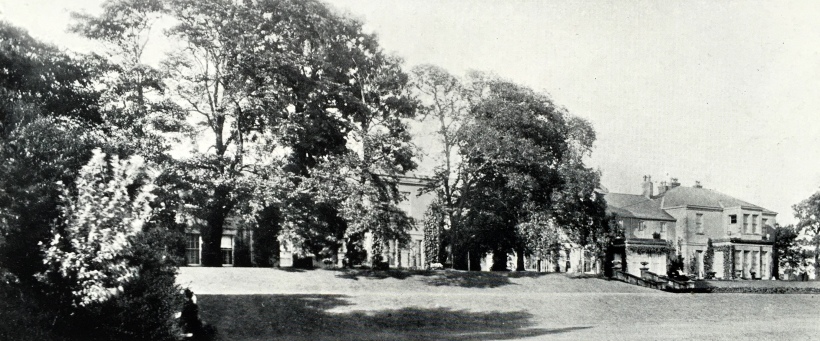
Seaham Hall
Seaham Hall

The Construction of Roker Pier and Lighthouse

Britain from Above

Following my visit to the Roker Pier and Lighthouse I was really interested to find out some of the history of this structure. I’ve been very lucky to get some superb images to share which help to tell the story. It’s such a well-known and much loved landmark. Along with Penshaw Monument, the Wear Bridges and the Stadium of Light it is one of those structures that you just associate with Sunderland. From a distance it looks picturesque and elegant, the red and white tower precariously perched at the end of a sinew of red granite. But then, as you walk out along the North Pier you start to take in the magnitude of this feat of Victorian engineering. You notice the weather worn, rusted iron railings and the masonry worn smooth by the pounding of the sea. This is a structure that has taken a beating. Indeed, it’s very purpose was to absorb those powerful waves and protect the mouth of the wear and allow a safe haven for the ships which allowed trade and commerce to flourish. The story of the Roker Pier and Lighthouse is much more than a story of Victorian ingenuity to tame the sea. It’s the story of why such a structure was required and why so much effort and expense was justified, which is kind of the story of Sunderland itself.

First we need to take all this in context. Why was it considered necessary to invest so much to protect the mouth of the River Wear?

“Sunderland is situated near the mouth of the River Wear, in 54° 55’ of latitude, and 1° 22’ of longitude, West of Greenwich. It is contiguous to an extensive district of coals, of first rate quality, the shipment of which forms the principal trade of the place. The export of lime to Yorkshire, and the eastern part of Scotland, forms another branch of its commerce. Its foreign trade, also, is considerable, and is rapidly increasing. Ship-building is carried on to a greater extent than in any other port of the British Empire; upwards of three hundred vessels, of various burthens, having been launched there in one year. Several manufacturers of earthen-wear, iron, glass, rope and other articles are established on the banks of the river. Trade thrives under the influence of a busy population, whose unremitting exertions, it may fairly be inferred, will add still further to the prosperity of the town and neighbourhood”

Sir John Rennie, May 11, 1847.

Sunderland was indeed a thriving port in the mid nineteenth century and had been for some considerable time. In 1384 King Richard II granted permission to the inhabitants of the county of Durham, to export the produce of their mines, without the payment of duty to the Corporation of Newcastle. As Sunderland was the main port for the County of Durham this freedom allowed for the development of commerce at the mouth of the Wear. Progress was initially slow until the reigns of Elizabeth I and later James I. A real change came during the Civil War when, during the Siege of Newcastle in 1644, no coal was allowed to be exported from the Tyne and exports from Sunderland began to boom. Efforts were made to rebalance the trade after the Civil War but Sunderland was on its way to becoming one of the most important ports in the British Isles. The increasing importance of Sunderland, as a place of trade, was viewed with extreme jealousy by the Corporation of Newcastle. In 1706, when a proposal was submitted to Parliament, for the improvement of the River Wear, it was opposed by the Master and Brethren of the Trinity House in Newcastle. When a Bill for these purposes was introduced in 1716, the mayor, aldermen and common-council of Newcastle petitioned against it. Despite this an Act was obtained in 1717. It appointed Commissioners for twenty-one years, who were charged with the conservancy of the harbour and they were empowered to raise money, by a tonnage duty on ships entering the port, for the purpose of making the river navigable to Newbridge and building a pier at its mouth.

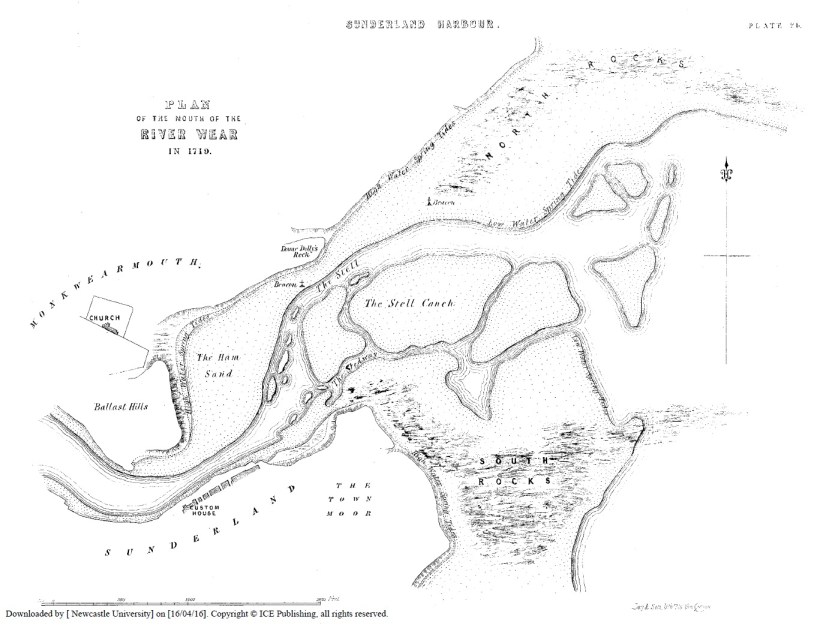
At that time the mouth of the Wear was completely unprotected and must have been a hazardous route to navigate. A pair of beacons were the only marks of guidance for vessels entering and departing from the port. The risk to shipping, the life-blood of commerce and prosperity needed to be protected.

River Wear Plan 1719

Construction of a pier on the south bank at the mouth of the river commenced in 1723 and was completed by 1726.

In July 1748 Mr. Charles Labelye, the engineer of Westminster Bridge was of the opinion that;

“the goodness both of the River and harbour was greatly impaired by many injurious circumstances.

i. Several shoals and banks of sand, which interrupted the navigation of keels down the river;
ii. By the rubbish, filth, mud, which fell into the river from the town;
iii. The increasing contraction of the river nearly opposite to the Custom House (by the tide continuing to wash the ballast heaps down into the river), which, if suffered to proceed, would be the utter ruin of the haven and also greatly endanger the wharfs and buildings adjoining;
iv. The next prejudice was the Stell, which consisted of a bed of gravel and sand, with some larger beach stones and was so shallow that a ship, drawing 9 feet or 10 feet of water, could not safely pass over it;
v. The water at the Stell dividing its self into many channels or streams;
vi. The great danger which the shipping was exposed to in the harbour, by tempestuous seas, when violent winds blew from the NE to E;
vii. Ballast cast in the roads, which the flood tides drove into the river and thereby increased the prejudice of the sands.”

He proposed a number of remedies and improvements, including dredging and deepening of the various channels at the mouth of the river and the construction of a pier on the northern bank. Work on the northern pier began in 1786 and completed ten years later in 1796. The pier was extended in 1803 and an octagonal stone lighthouse was erected at the end to replace the old reflector light. The new lighthouse, Sunderland’s first, was 78ft high with 9 gas burners and reflectors and was visible 12 miles out to sea. The lighthouse was later moved, in 1841 when the pier was extended (a huge undertaking which I wrote a blog on previously). It was replaced in 1856 with a cast iron lighthouse which remained in position until 1983 when it was moved to its present location on the cliff tops above Roker beach.

Improvements were made throughout the rest of the 18th century and most of the 19th century as trade and ship building boomed. Docks, locks and ship building yards sprang up on both sides of the river. The Hudson South and Hendon Docks covered an area over 3 miles long. By the late 19th century Sunderland had taken its place as the largest ship building town in the world supporting a host of secondary industries and serviced by a numerous and skilled labour force. By this time, at almost 100 years old, the original two piers at the mouth of the river were proving inadequate to protect the docks and shipping.

An ambitious plan was hatched to construct two much larger piers (the North Pier is 2,000 feet or 610m long!), projecting out to create a 125-acre area of protected water for ships entering and exiting the river. On 27th June 1883, an Act of Parliament was passed sanctioning the construction of the new North Pier, known later as Roker Pier.

HYW153 Henry Hay Wake
Henry Hay Wake


Construction of the new pier was the brainchild of Henry Hay Wake, Chief Engineer of the River Wear Commission. He was born in Sunderland on 2nd January 1844, and in 1860 entered, as a pupil, the service of Mr. Thomas Meik who was at that time engineer to the River Wear Commissioners. In 1868, at the comparatively early age of twenty-five, he was appointed engineer to the said Commissioners upon the retirement of Mr. Meik, and he therefore remained practically the whole of his lifetime in the service of the River Wear Commission.

On 14th September 1885, the foundation stone of the new North Pier was laid by Sir James Laing, Chairman of the River Wear Commission. The pier took 18 years to complete at a cost of £290,000.

It was an incredible feat of engineering. Construction began with the removal of sand above the bedrock at a depth of approximately 60 – 120 feet. Once the sand was removed, bags of concrete were lowered into place. Each bag weighed 56 – 116 tons and was dropped dry to solidify in the salt water. Upon this foundation the pier was constructed of granite blocks surrounded by concrete. The blocks were lifted into place by a huge “Goliath” gantry crane which trundled along purpose build tracks which can still be seen on the surface of the pier today. When first built, the crane was the largest in the world and dominated the Roker seafront for 18 years.

Space was left in the centre of the pier for a tunnel, which ran the full length of the pier to the basement of the lighthouse. This was initially constructed to carry the gas and water pipes for the crane and was later used by the lighthouse keepers to reach the Lighthouse in bad weather. Glass skylights were added at 60ft intervals which can been seen when walking along the pier.

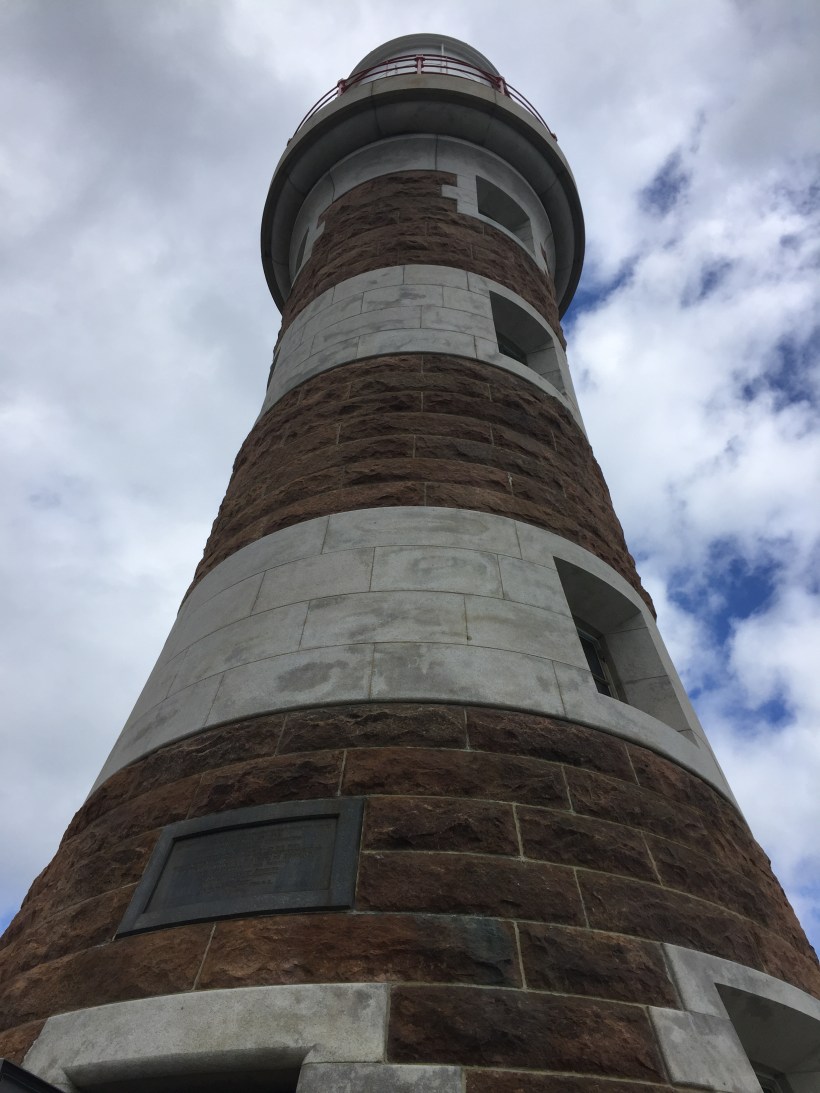
Once the main arm of the pier was complete, work began on the construction of the roundhead for the lighthouse. Henry Wake laid the final stone, embedded in the lighthouse parapet walkway, on 14th July 1903. The Roker Lighthouse was built of alternating red and grey Aberdeen granite. The lighthouse has never been painted and the colouring is natural. It has weathered and dulled over time but must have been vibrant when first constructed. The Grade II listed structure stands 82 feet tall and is equipped with a fog horn and lantern, which is visible some 26 miles out to sea.

The Pier and Lighthouse was heralded as an engineering masterpiece and garnered national attention drawing crowds of people when it was completed.

Work on the south pier began in 1893 and, after construction was disrupted during the First World War, was completed in 1922. It was shortened so as not to restrict access to the river and is smaller than the north pier. The sister lighthouse, which was intended for the New South Pier, was never constructed with a column and fixed light being used.

Roker Pier and Lighthouse have stood guard over the mouth of the River Wear for the last 103 years. They’ve bore witness to many changes over that time. As well as performing it core functions of protecting shipping it has been a tourist attraction and was even used to mount a torpedo battery during World War Two. The concrete casemates are still present to be seen at the end of the pier. It’s fantastic that Sunderland City Council has invested in the restoration of this magnificent structure, which will allow it to be experienced as never before!

I’d like to thank the following sources for the information and images used in this blog.

  • Matt Storey Project Co-ordinator for the restoration of Roker Pier and Lighthouse at Sunderland City Council (http://www.rokerpier.co.uk/) for providing the majority of the images in this blog and allowing me to visit the lighthouse;
  • Matthew Town and Penny Middleton at Northern Archaeological Associates Limited (http://www.northernarchaeologicalassociates.co.uk/) for allowing me to reference their superb Roker Pier and Lighthouse: Conservation Management and Maintenance Plan;
  • Paintings were posted on Facebook by Sunderland Remembered;
  • Britain from Above (http://www.britainfromabove.org.uk/);
  • Journal of Marine Engineering.

A Visit to Roker Pier & Lighthouse

IMG_2056
Looking towards Sunderland and the mouth of the Wear from the top of the Lighthouse


Whilst taking a gentle stroll along Roker Pier last week I was lucky enough to bump into Matt Storey, the Roker Pier Restoration Project Co-Ordinator.  I had met Matt at the first What Next Sunderland Meeting and we had got talking about the restoration of the Lighthouse and tunnel which runs the length of the pier.

Over the past three years Roker Pier and Lighthouse has undergone an extensive restoration program, with the council investing over £1.35m to conserve the lantern house and repair the pier deck.

The most recent works have been jointly funded by the council and Heritage Lottery Fund and included the restoration of the lighthouse interior, repair of the tunnel floor and drains, and the improvement of access. The final phase of this work to build a new entrance structure is due to commence  later this year, with a view to then opening the structure to the public for the first time in the pier’s one hundred and twelve year history.

While this work is ongoing the council will be supporting the recently formed Roker Heritage Group to operate tunnel and lighthouse tours, ensuring that when the structure is opened it becomes a popular attraction that can engage people with Sunderland’s rich maritime heritage.

http://www.rokerpier.co.uk/

https://www.facebook.com/RokerPier1

https://www.twitter.com/RokerPier

So, after bumping into Matt, he very kindly offered to give me a sneaky tour of the Lighthouse!  I was just a little bit excited!  What an amazing opportunity to have a look around one of the best known and loved Sunderland landmarks!  It’s an amazing structure and the restoration works are looking fantastic so I thought (with Matts permission) I would share some of the photos from my visit.

I intend to write a further blog, which I am currently researching, covering the history of the Pier and Lighthouse following.  In the mean time you might like to take a look at a previous post from back in October which told the story of the moving of the lighthouse on the Southern Pier (https://northeastlore.wordpress.com/2015/10/10/vol-1-no-6-august-1887-sunderland-lighthouse/), so stay tuned!

IMG_2067
View along the North Pier to the Lighthouse


Top Left:  The restored and original Milton Hollins tiles which are on the ground floor (for anyone interested Topps Tiles are offering these designs in their current range (http://www.toppstiles.co.uk/tprod47050/mh-roker-volcanic-splash-bevel-tile.html)

Top Right:  The new lantern

Bottom:  View of the South Pier from the second floor window showing the restored brass fixings.

Top Left:  The basement which is accessed from the tunnel which runs the length of the pier.  It contains the large air compressor for the original fog horn.  This has now been replaced by a small orange box, a sign that whilst technology has moved on the requirement to warn shipping is the same as it was when the Lighthouse was constructed!

Top Right:  When you gotta go, you gotta go!

Bottom:  View up the stairs from the basement to the ground floor.

Left:  Access to the central shaft which held the winding gear for the original lantern.

Middle:  Central shaft and stairs on the second floor.

Right:  Stair case with restored railing (the original fixings were stolen and needed to be replaced).

Top Left:  A view along the North Pier from the first floor window.

Top Right:  One of the original vents to help air circulate through the Lighthouse.

Bottom:  The lantern room.

IMG_2065
View from the base of the Lighthouse

The Cauld Lad of Hylton

Hylton Castle has long had the reputation of being haunted by a bar-guest or local spirit, of the same genus as used formerly to haunt almost every old feudal residence in the kingdom. The goblin was seldom seen, but was heard nightly by the servants, who got so accustomed to him that they were not the least frightened. If the kitchen had been left in perfect order on their retiring to rest, they would hear him amusing himself by hurling the pewter about in all directions, and throwing everything into confusion. But if, on the contrary, the apartment had been left in disarray (a practice which the maids found it both prudent and convenient to adopt), the indefatigable goblin set about arranging everything with the greatest precision, so that what was “confusion worse confounded” the night before, was in “apple-pie order” on the following morning. But though the Cau’d Lad’s pranks seem to have been at all times perfectly harmless, they at length became wearisome to the servants, who determined to banish him from the castle by the usual means employed in such cases, that is, not by priestly exorcism, but by leaving, for his express use, some article of clothing, or some toothsome delicacy to tempt his palate. The Cau’d Lad somehow got an inkling of their intentions, and was frequently heard to recite, in the dead of the night, in fancied security, the following consolatory stanzas:

Wae’s me, wae’s me,
The acorn is not yet
Fallen from the tree
That’s to grow the wood
That’s to make the cradle
That’s to rock the bairn
That’s to grow a man
That’s to lay me.

However, the goblin reckoned without his host; for the usual means of banishment were provided, viz., a green cloak and a hood, which were laid before the kitchen fire. At the dead hour of midnight the sprite glided gently in, stood by the smouldering embers, and surveyed the garments provided for him very attentively, then tried them on, and appeared delighted with their graceful cut, frisking about the room, and cutting sundry somersaults and gambadoes; until at length, on hearing the first crow of the cock, twitching his green mantle tightly round him, he disappeared with the appropriate valediction of

Here’s a cloak and here’s a hood,

The Cau’d Lad o’ Hilton will do no more good!

But long after this, although he never returned to disarrange the pewter or set the house in order, yet his voice was often heard at midnight singing a melancholy melody:

Here’s a cloak and here’s a hood,

The Cau’d Lad o’ Hylton will do no more good!

The genuine brownie is supposed to be an unembodied spirit, that has never borne the human form; but the Cau’d Lad has, through the common process of myth-development, been identified with the apparition of an unfortunate domestic who was slain by one of the barons of Hylton in a moment of passion or intemperance. This baron, having ordered his horse to be ready on a particular occasion, and it not being brought out in time to soothe his ruffled impatience, proceeded to the stable, where he found the boy fast asleep and the horse unsaddled. Seizing a hay-fork, he struck the lad a blow which proved mortal. Horrified at what he had done, he Covered the body with straw till night, and then threw it into a pond, where, many years afterwards, in the last baron’s time, the skeleton of a boy was discovered, which was held to be a confirmation of the tale. This pond was afterwards drained, and a cottage was built on the site.

Perhaps this story, which was communicated to Robert Surtees, the compiler of the “History of Durham,” by Mr. J. B. Taylor, may have had its origin in the fact recorded of a coroner’s inquest having been held, on the 3rd July, 1609, on the body of Roger Skelton, who was killed with the point of a scythe, accidentally, by Robert Hylton, of Hylton, for which that gentleman obtained a free pardon on the 6th of September following.

The ballad of “The Cau’d Lad o’ Hylton” a quite modern production tells how the murdered lad, Roger Skelton, used to pace o’nights round the castle hall, with his head literally in his hand, singing, “soft and low,” notwithstanding the severance of the larynx from the lungs, the following prophetic words of dread:

Hylton’s line dishonoured falls;
Lay with the dust proud Hylton’s walls.
Murder blots the household sword;
Strip the lands from Hylton’s lord, etc., etc.

If we are to believe Surtees’s informant, however, the Cau’d Lad held full possession of the house several years after the death of the last Baron Hylton, and was not finally exorcised until the beginning of this century by the hospitality of the late Mr. Simon Temple, a wealthy coalowner, from whom Templetown, at the high end of South Shields, takes its name, who for some years occupied the castle, which, but for his interposition, would have been demolished, it having been condemned to be taken down for the sake of the materials.

If the ballad – writer speaks truth, the Cau’d Lad did not confine his pranks wholly to the castle. He tells us in a note that the goblin sometimes took a fancy to row people across the Wear at night, in the ferry boat stationed near. He would take them over half way, and then of a sudden disappear, leaving the passengers, though they might be women and children, to shift for themselves; then, after some time, he would make his reappearance, and after rowing them up and down the river a mile or two, would land them on the same side they started from, always making them, however, pay their fare, though what he could do with the money no man could tell. In pursuing this sort of mischievous amusement, the Cau’d Lad seems to have displayed rather the characteristics of the Scottish kelpie than the brownie, only that he does not seem ever to have gone the length of drowning the passengers he deceived, as the kelpie would at least have tried to do. Another freak of his was to sit astride a beer barrel in the cellar to guard the precious liquor. When John, the butler, went down to tap a cask, he often averred that he had found him there. But this latter circumstance is probably borrowed from similar tales told of the familiar spirits in various parts of Scotland and Ireland.

Another supernatural visitant is reported to have appeared in the castle shortly before the death of the last baron. When that dignitary was one night entertaining a large company, a greyhound, which nobody had previously seen, rushed into the dining-room, and, neglecting those present, fawned upon the baron, who saw round its neck a collar of gold, inscribed with magical characters, which he alone could read, and which were found to purport that his father, who had been dead twenty-five years, had sent the dog to him to announce his approaching death, and also the speedy downfall of the Hylton family, after a series of twenty descents, stretching through five centuries. The dog disappeared before morning as unaccountably as it came; but the event soon proved the truth of the dismal warning.

Hylton and the Hyltons

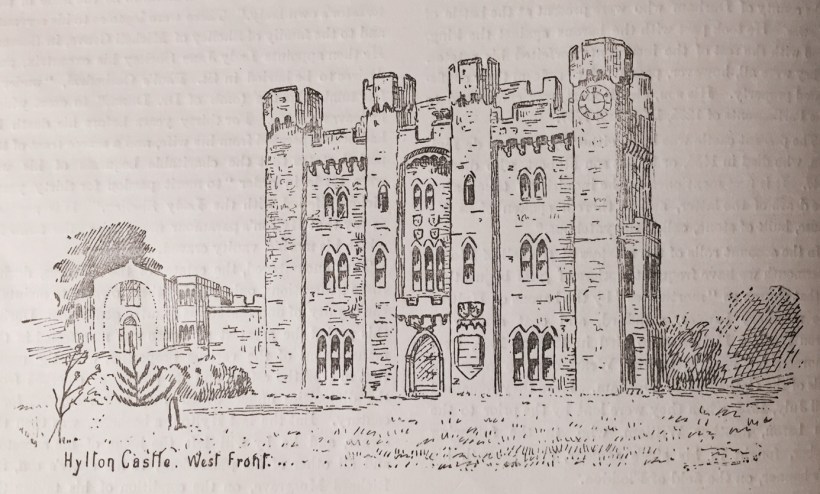
Hylton Castle West Front

Less than a hundred yards from the old turnpike road from Monkwearmouth to Gateshead stands Hylton Castle, for more than six centuries the home of one of the oldest, richest, most powerful, and best allied families in the county of Durham. The Hyltons had a fabulous genealogy, extending back to the times of Athelstan, and a genuine pedigree which commenced in the reign of Henry II. The origin of the family is unknown. There is, however, a legend that, whilst the Saxon lord of Hylton was far away in Eastern lands making love to a Syrian maid, his daughter, left

In her gloomy hall by the woodland wild, was wooed and won by a Danish knight, who first came to her in the disguise of a raven. Fair Edith, “in her saddest mood,” had climbed to the battlements of her ancestral home

A gentle breath comes from the vale,
A sound of life is on the gale;
And see a raven on the wing
Circling around in airy ring,
Hovering about in doubtful flight
Where, where will the carrier of Odin alight?
The raven has lit on the flagstaff high
That tops the dungeon tower,
And he has caught fair Edith’s eye,
And gently, coyly, venturing nigh,
He flutters round her bower.
For he trusted the soft and maiden grace
That shone in that sweet young Saxon face;
And now he has perched on her willow wand,
And tries to smooth his raven note,
And sleeks his glossy raven coat,
To court the maiden’s hand.
And now, caressing and caressed,
The raven is lodged in Edith’s breast.
‘Tis innocence and youth that makes
In Edith’s fancy such mistakes;
But that maiden kiss hath holy power,
O’er planet and sigillary hour!
The elvish spell hath lost its charms,
And the Danish knight is in Edith’s arms:
And Harold, at his bride’s request,
His barbarous gods foreswore
Freya, and Woden, and Balder, and Thor.
And Jarrow, with tapers burning bright,
Hailed her gallant proselyte.

The story is pretty, and may have led the last baron of Hylton to adopt the raven as his badge, and with gigantic representations in wood of Odin’s messenger to mantle the east and west doors of his mansion. In history, however, we first meet with the Hyltons in the year 1157, when Romanus, “the Knight of Heltun,” agreed with the prior and convent of St. Cuthbert, at Durham, that he and his heirs might have a priest appointed to his chapel at Hylton. The ruined chapel, a few yards north of the castle, can scarcely have any portion which is older than the present castle itself, of the date and builder whereof I shall speak presently, unless it be a few courses of masonry in the east wall of the chancel, which have certainly a Norman look about them, and may well be believed to have been raised at the will of that ancient knight, Romanus.

One William de Hylton, almost certainly the grandson of Romanus, about 1198 married one Beneta, daughter and heiress of Germanus Tison, the great-grandson of Gilbert Tison, who is described as the great standard-bearer to William the Conqueror.

William’s son and heir, Alexander, was one of a number of English nobles, who in 1241, “took leave of their friends, and, commending themselves to the prayers of religious men, set out in great pomp on their way towards Jerusalem.” From this expedition, there is every reason to believe, Alexander de Hylton never returned.

In 1264, Robert de Hylton was one of the knights of the county of Durham who were present at the battle of Lewes. He took part with the barons against the king, and with the rest of the insurgents forfeited his estates. They were all, however, permitted to redeem their confiscated property. His son, also Robert, was summoned to the Parliaments of 1295, 1296, and 1297.

The present castle was built either by William de Hylton, who died in 1435, or by his son Robert, who died in 1447. It is first mentioned in the inquisition taken after the death of the latter, and is therein spoken of as “a house, built of stone, called the yatehous.”

In the account rolls of the masters of the cell of Monkwearmouth we have frequent notices of gifts bequeathed to that church as “mortuaries” by the barons of Hylton. The mortuary banner, standard, and coat armour of Baron William Hylton, who died in 1505 or 1506, were removed a few years later from Wearmouth to grace the walls of the Cathedral of Durham. Here they remained until July, 1513, when they were lent by the prior to the then baron, another William, who, in the following October, fought in his sire’s armour, and beneath his sire’s banner, on the field of Flodden.

This latter William’s son, Sir Thomas Hylton, joined in the famed Pilgrimage of Grace in 1536. In the reign of Philip and Mary he was Governor of Tynemouth Castle. In 1558, a complaint was made against him that he had illegally detained a vessel from Flanders laden with salt, and that he was in the habit of taking such wares out of ships passing Tynemouth on their way to Newcastle as he was wishful to possess or dispose of to his own advantage.

Sir Thomas Hylton died in 1561, and was succeeded in the Hylton estates by his brother William. Sir Thomas had patronised a certain Dr. Bulleyn, an eminent physician of that day. Whilst Bulleyn was in London, Sir Thomas died, and his brother accused the doctor of having poisoned him. Bulleyn was arraigned before the Duke of Norfolk, but was honourably acquitted.

The misanthrope of the family, however, was one Henry Hylton, who died in 1641. By his will he left the whole of his paternal estate for ninety-nine years to the Lord Mayor and four senior aldermen of London, in trust, that they should pay thereout £24 per annum to each of 38 parishes, £28 a year to the Mayor of Durham, £50 a year to the Vicar of Monkwearmouth, an annuity of £100 to his brother Robert Hylton, and £50 a year to his brother John. The residue he leaves to the city of London, charging them to bind yearly five children of his own kindred to some honest trade. They were to raise £4,000 out of Hylton rents, the interest whereof was to be employed in apprenticing orphans born in the manors of Ford, Biddick, and Barmston. After 99 years, his estates and the first-mentioned £4,000 were to go to his heir-at-law, “provided he be not such a one as shall claim to be the issue of the testator’s own body.” There were legacies to his servants and to the family of Shelley of Michell Grove, in Sussex. He then appoints Lady Jane Shelley his executrix, and desires to be buried in St. Paul’s Cathedral, “under a fair tomb, like the tomb of Dr. Dunn,” to erect which he leaves £1,000. For thirty years before his death he had been separated from his wife, and a scarce tract of the period states that the charitable bequests of his will were made in order “to merit pardon for thirty years’ vicious life led with the Lady Shelley.” It is needless to say that Hylton’s paramour never raised the tomb for which his morbid vanity craved.

Thus encumbered, the estates of the Hyltons, during three generations, only enabled their owners to maintain the dignity of unostentatious country gentlemen. During this period the greatest prudence was manifested in the management of the various properties, with the result that in 1739 the estate and its possessors emerged from the difficulties under which they had struggled for a century. But the last Hylton, a bachelor, was then the owner, and he by will left the home of his ancestors and all other of his possessions, to his sister’s son, Sir Richard Musgrave, on the condition of his taking the Hylton name. The last baron died in 1746, and was buried in the chapel at Hylton. In 1750 Sir Richard Musgrave obtained an Act of Parliament enabling him to sell the estates by auction. These estates covered 5,600 acres, and the annual rental was estimated at a little over £3,000. The Hyltons, it is said, owned almost all the land which could be seen from the battlements of their own castle.

It only now remains to describe the castle and the ruined chapel. The architectural features of the former indicate that its erection took place shortly before the middle of the fifteenth century. It is described in 1447 date as “the gatehouse,” though there is evidence to show that the rest of the castle buildings stood north and south of a courtyard before its grand west front. Hylton castle is noted for its heraldry. Besides the royal arms of England as borne from the reign of Henry V. to that of Elizabeth, we have on the west front the banner of the Hyltons beneath a ledge of canopied work, and the shields of the many noble families with which the Hyltons were allied. On the east front is a fine sculptured roebuck, at one time the Hylton badge. Beneath is the Hylton shield under a helmet, over which is the later Hylton crest, a head of Moses in profile, horned with triple rays. Of the origin or meaning of this extraordinary heraldic bearing I can offer no suggestion.

The west front is surmounted by four octagonal turrets with machicolations on every side. There is a round turret at each end of the east front. The central oblong tower of the east front rises a story higher than the rest of the building, and has a floor on the level of the leads, which we may conveniently call the guard room. Each turret has independent access from the roof. The octagonal turrets are even provided for defence against an enemy who might have climed to the battlements.

Hylton Castle East Front

The portion of the chapel which remains is only the chancel of the original structure, and was probably built by Sir William Hylton, who died in 1457. Its two transepts are additions of Tudor date. Each is of two stories, though the dividing floors are gone. The upper stories were reached through doorways in the east wall, now closed with masonry. The western extremity now is the ancient chancel arch, walled up in the last baron’s days, with a doorway altogether of his time beneath, and portions of what was probably the nave’s western window clumsily utilized above. Within the walls of this now ruined and abandoned though episcopally consecrated edifice, the mortal part of many of the barons of Hylton, their wives and their children, found rest. Their retainers were consigned to the graveyard outside. The chancel vault is now broken open, and the bones of the Hyltons have been scattered, no one caring whither. A thigh bone, said to have been that of the last baron, is preserved in the castle, (now the property and residence of Colonel Briggs), and the whereabouts of some other osseous reliques is known.

J. R. BOYLE.

The Lighting of Towns

Street Lighting

The lighting of towns in our island, by combined effort, is of modern date. Even in the metropolis it had no existence prior to the last century. So far back as the reign of the hero of Agincourt, there was, indeed, street-lighting; but in a sorry, makeshift sort of way. When Christmas was at hand, in the year 1418, as festivities would then be on foot, and wine would be in and wisdom out, an order was made that each honest person dwelling in the City should set “a lantern, with a candill therein,” before his house, in promotion of the public peace. An expedient of the like homely kind was also resorted to at Newcastle in the seventeenth century, more especially in seasons of civil commotion.

Whether systematic street-lighting was first adopted in England or on the Continent is an open question. “Of modern cities,” says Beckmann, “Paris, as far as I have been able to learn, was the first that followed the example of the ancients by lighting its streets.” Yet in 1524 it was still content with lights exhibited before the door by the citizens; but about the middle of the century there were brasiers in the thoroughfares, with blazing pitch, rosin, &c., dispelling (or at least mitigating) the murkiness of the atmosphere by night. Almost immediately afterwards, in 1558, came street lanterns; and in little more than a hundred years, an enterprising Italian abbe was in Paris, letting out lamps and torches for hire, and providing attendants. His operations were extended also to other cities; while not only was all Paris now lighted by its rulers, but even the outskirts: for nine miles of lamps extended as far as Versailles. In London, meanwhile, in the latter years of the seventeenth century, householders were admonished as of yore to hang out a light every night from Michaelmas to Lady Day. It was a device by which the gloom of the metropolis after nightfall was but imperfectly relieved. How it fared with the citizens in their benighted paths may be conceived from the pages of the poet Gay, who published his “Trivia, or the Art of Walking the Streets,” in the reign of Queen Anne. To all who might stumble into danger unwarily, he gave this word of caution:

Though thou art tempted by the linkmairs call,
Yet trust him not along the lonely wall;
In the mid-way he’ll quench the flaming brand,
And share the booty with the pilfering band;
Still keep the public streets, where oily rays,
Shot from the crystal lamp, o’erspread the ways.

The ineffectual fires of these crystal flickerers hardly served to make visible the increasing accumulations that addressed themselves, in almost every town of the time, to the more prominent feature of the face. “I smell you in the dark,” muttered Johnson to Boswell, passing along the High Street of Edinburgh on an autumn night of 1773; and Gay sounded his warning note in London:

Where the dim gleam the paly lantern throws
O’er the mid-pavement, heapy rubbish grows.

There were also roysterers of the night, ready for a brawl, yet respecters of persons; topers who, observant of the better part of valour,

Flushed as they are with folly, youth, and wine,
Their prudent insults to the poor confine;
Afar they mark the flambeau’s light approach,
And shun the shining train and golden coach.

So sung Johnson in his “London” in the year 1738, when Parliamentary powers had recently been obtained for the establishment of corporate lighting by night. A Bill was introduced for street-lighting in 1736; and in the ninth year of the reign of George II. the Royal Assent was given to “An Act for the Better Enlightening the Streets of the City of London.”

When the eighteenth century, whose midnights had been visited by the glare of flambeaux and the glimmer of oil-lamps, closed its course, it was casting before it the splendour of gas. A hundred years earlier, indeed, the Dean of Kildare, Dr. Clayton, had liberated ” the spirit of coal.” “Distilling coal in a retort, and confining the gas produced thereby in a bladder, he amused his friends by burning it as it issued from a pin-hole.” It afterwards became a common amusement to fill a tobacco pipe with crushed coal; thrust the bowl into the fire; and light the gas jet as it flowed from the stem. This was a toy. But William Murdock, a native of Ayrshire, put gas to work in earnest. In 1792, residing at Redruth, in Cornwall, as the representative there of Boulton and Watt, he lighted up his house and offices with “the spirit of coal,” and in the general illumination of 1802, in celebration of the Peace of Amiens, he wrapped the whole front of the famous Soho Works in a flaming flood of gas, dazzling and delighting the population of Birmingham, and publishing the new light to the world! Its success was so decided that the proprietors had their entire manufactory lighted with gas; and several other firms, in various parts of the country, followed their example.

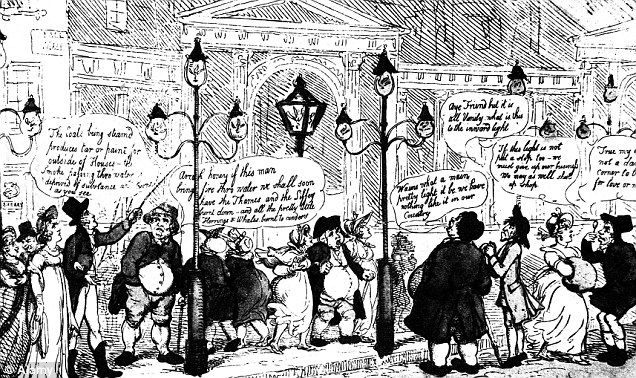
“New lights” have ever to contend with old. However brilliant their promise, there is the shadow of incredulity, the gauntlet of ridicule. Oracular heads were shaken at gas. As well think of lighting a town with “clipped moonshine,” was their contemptuous conclusion; while the alarmists anxiously inquired, “if gas were adopted, what would become of the whale fishery?” The world, careless whether the whale should survive the change, listened to Murdock.

One of Murdock’s most enthusiastic disciples Winsor, a German introduced the light into London in 1807. Winsor applied to Parliament for a Bill, and Murdock was examined before the committee. “Do you mean to tell us,” asked one member, “that it will be possible to have a light without a wick?” “Yes, I do, indeed,” answered Murdock. “Ah, my friend,” said the legislator, “you are trying to prove too much.” It was as surprising and inconceivable to the honourable member as George Stephenson’s subsequent evidence before a Parliamentary Committee to the effect that a carriage might be drawn upon a railway at the rate of twelve miles an hour without a horse. Even Sir Humphry Davy ridiculed the idea of lighting towns with gas, and asked one of the projectors if it were intended to take the dome of St. Paul for a gasometer! The first application of the “Gas Light and Coke Company” to Parliament in 1809 for an Act proved unsuccessful; but the “London and Westminster Chartered Gas Light and Coke Company” succeeded in the following year. The company, however, did not prosper commercially, and was on the point of dissolution, when Mr. Clegg, a pupil of Murdock, bred at Soho, undertook the management, and introduced a new and improved apparatus. Mr. Clegg first lighted with gas Mr. Akerman’s shop in the Strand in 1810, and it was regarded as a great novelty. One lady of rank was so much delighted with the brilliancy of the gas-lamp fixed on the shop-counter, that she asked to be allowed to carry it home in her carriage, and offered any sum for a similar one. Mr. Winsor, by his persistent advocacy of gas-lighting, did much to bring it into further notice; but it was Mr. Clegg’s practical ability that mainly led to its general adoption. When Westminster Bridge was first lit up with gas in 1812, the lamplighters were so disgusted with it that they struck work, and Mr. Clegg had himself to act as lamplighter. (Smiles’s “Lives of Boulton and Watt.”)

One of the earliest provincial towns to adopt the new light was Newcastle-upon-Tyne. This was in 1818; of which year Smiles has a characteristic anecdote relating to Murdock. He had come to Manchester to start one of Boulton and Watt’s engines, and, with Mr. William Fairbairn (from whom the biographer had the story), was invited to dine at Medlock Bank, then at some distance from the lighted part of the city. “It was a dark winter’s night, and how to reach the house, over such bad roads, was a question not easily solved. Mr. Murdock, however, fertile in resources, went to the gas-works, where he filled a bladder which he had with him, and, placing it under his arm like a bagpipe, he discharged through the stem of an old tobacco-pipe a stream of gas, which enabled us to walk in safety to Medlock Bank.”

Before going any further, let us observe that public lighting is of considerable antiquity on the Tyne. In the month of November, 1567, a dozen years before Parliament was considering a Bill for maintaining a light on Winterton steeple, “for the more safety of such ships as pass by the coast,” the Corporation of Newcastle was paying 3s. “for 4lb. of waxe maid in candell for the lanterne of Sancte Nyciolas Churche, and for the workynge.” Such items were not uncommon. Here is another, of the month of December ensuing: “For 2lb. of waxe, wrought in candell for the lanterne in Sancte Nycholas Churche, 1s. 6d.” There were lights aloft on the church tower for the comfort and guidance of wanderers over the open country, whose feet were in anxious search of the Metropolis of the North.

In town and country men had then to grope their way by night. At a much later date than the reign of Elizabeth, how darksome were the streets of Newcastle!

There is an instructive anecdote of Lord Eldon, reviving the days when the future Lord Chancellor was on the threshold of his teens, and lighting by Act of Parliament was unknown on the Tyne. He and his schoolfellows would forgather on a winter’s night at the Head of the Side, on boyish freaks intent. It was a time when shops were unglazed, the windows open to the outer air, and the interior feebly lighted by a lamp or a “dip.” Down the Side the youngsters would start for the Sandhill; and first one, then another, would drop on his knees at a tradesman’s door, creep across the floor, lift up his lips, and blow out the flame! Hasty then was the retreat; and the merry band were off in pursuit of another victim, till all the shopkeepers in the row were reduced to dipless darkness.

The reign of George II. had to pass away before the aid of Parliament was successfully invoked for lighting the streets of Newcastle. The Common Council, which in 1717 had applied for an Act, again took up the matter; and soon after the accession of George III. powers were obtained. In the spring of 1763, Newcastle obtained an Act for lighting and watching the town, and regulating the hackney-coachmen and chairmen, the cartmen, porters, and watermen; and on Michaelmas Day the oil lamps were a glow to the best of their ability.

Whether the Act of 1763 spoiled the fun of Young Newcastle, and threw oil on the troubled waters of the tradesmen, our annalists do not say. But doubtless the schoolboys of the good old days “when George the Third was King” found abundant channels in which to gratify their love of mirth and mischief. For half a century and more the ladder of the lamplighter was in alliance with the harpoon of the whaler. But when the age of gas had arrived, the metropolis of the coalfield could not hold back, whatever came of the whale-fishery. In the dawn of the long reign of George III., Newcastle had received powers for lighting by oil; and near its close it was applying for an Act for lighting by gas. The requisite powers were granted. On the 10th of January, 1818, on which day the Savings Bank was first opened, gas-lighting also began. “In the evening,” says Sykes, “a partial lighting of the gas-lights took place in such of the shops in Newcastle as had completed their arrangements. The lamps in Mosley Street were not lighted till the 13th (Tuesday evening), when a great crowd witnessed their first lighting up, and a loud cheer was given by the boys as the flame was applied to each burner.” Collingwood Street had its illumination on the 26th; and the Old Assembly Rooms in the Groat Market, occupied by the Literary and Philosophical Society, were lighted on the 27th. Before the end of the month gas-lighting was becoming general. “This beautiful light,” says the Newcastle Chronicle, “is now introduced into most of the shops in the streets through which the pipes have been carried, and thus the thorough-fares are rendered in the evening beautifully resplendent.” The theatre was first lighted with gas on the 3rd of March.

Newcastle having led the way, other Northern towns were not slow to follow. North Shields was lighted with gas in 1820; Berwick-upon-Tweed and Stockton-upon-Tees in 1822; Durham in 1823; Sunderland in 1824; South Shields in 1826; and Darlington in 1830. Gas had passed into general favour. Instances occurred, however, in which tradesmen were admonished that if they had the “new light” in their shops they must not expect to see their old customers; and some cautious folk, providing for their safety, retired to watering-places or elsewhere ere the gas-lamps were lighted! They would have had their neighbours walk in the ancient ways, and stand by the whale.

Slowly street-lighting had moved onward in the olden time. Through long generations the householders were contributing each his candle to the public service. Twinkling stars of light strove through “the blanket of the dark,” producing an effect on which the “sickly glare” of oil was subsequently thought to be an improvement! But the rate of progress has been accelerated in modern days. Half-a-century sufficed to make an end of oil in the streets of Newcastle; and now, after less than four-score years more, gas is in controversy with the electric flame.

It was in June, 1850, that Mr. W. E. Staite, a pioneer and patentee of electric lighting, exhibited his light from the South Pier, Sunderland. Mr. Staite had been invited by the Commissioners of the River Wear to show his invention, in order that, if found suitable, it might be adopted as the permanent means of illuminating the New Dock. Great interest was manifested in the exhibition throughout the town; and towards evening thousands thronged the piers and quays, while many availed themselves of trips to sea so as to witness the effect of the light several miles from land. The apparatus was erected upon a temporary platform, raised a few feet above the lighthouse, the galvanic battery being placed in a shed below. At ten o’clock exactly the spectators on shore were gratified by the first glimpse of the light, which was shown with a parabolic reflector. It was directed towards Hartlepool, Seaham, and Ryhope, and then brought gradually northwards by the reflector being moved slowly round. The light was then sent successively upon the Docks, St. John’s Chapel, the quays, piers, and then towards Roker and Whitburn. A few nights later, between eleven and twelve o’clock, on the 25th of June, 1850, Mr. Staite exhibited the light at the Central Railway Station, Newcastle, to the directors of the company and a numerous party. The inventor had been asked to give a tender for lighting the station, which he did, but the directors did not see their way to adopt it.

Mr. Staite’s visits were naturally recalled to mind on the eve of the first lecture of our townsman. Mr. J. W. Swan, whose name is now everywhere familiar. This lecture was given before the Literary and Philosophical Society of Newcastle early in 1879. Not a few were then present who remembered how, on the occasion of the marriage of the Prince and Princess of Wales in 1863, Mr. Swan threw down from the Shot Tower and St. Mary’s the flooding light of

The shining sun that mocked the glare
Of envious gas, struck pale and wan.

And the whole of the brilliant audience brought together in 1879 saw the same docile flame hermetically imprisoned, like some genius of the Arabian Nights, within walls of glass, and diffusing around it the soft lustre which the drawing-room desires.

The world is ever making new conquests, while not throwing aside the old. Society is not unthrifty. It adds to its roll of handmaids. Further arrivals do not foreshadow the departure of their forerunners. There was, as we have seen, in a former generation, an alarm for the whale fishery; and yet, the cry was so groundless. that it has given place to a fear lest the whale fishery, in the persistent and growing consumption of oil, should become extinct. Oil, indeed, is in such demand that the earth itself has been harpooned. On land as on sea oil is struck; and the mineral supply sheds its serene light over a million firesides. Oil, and gas, and candle have yet a long lease of social service to run; while the electric light has before it a career but dimly seen in our brightest dreams.

The First Mayor of Sunderland

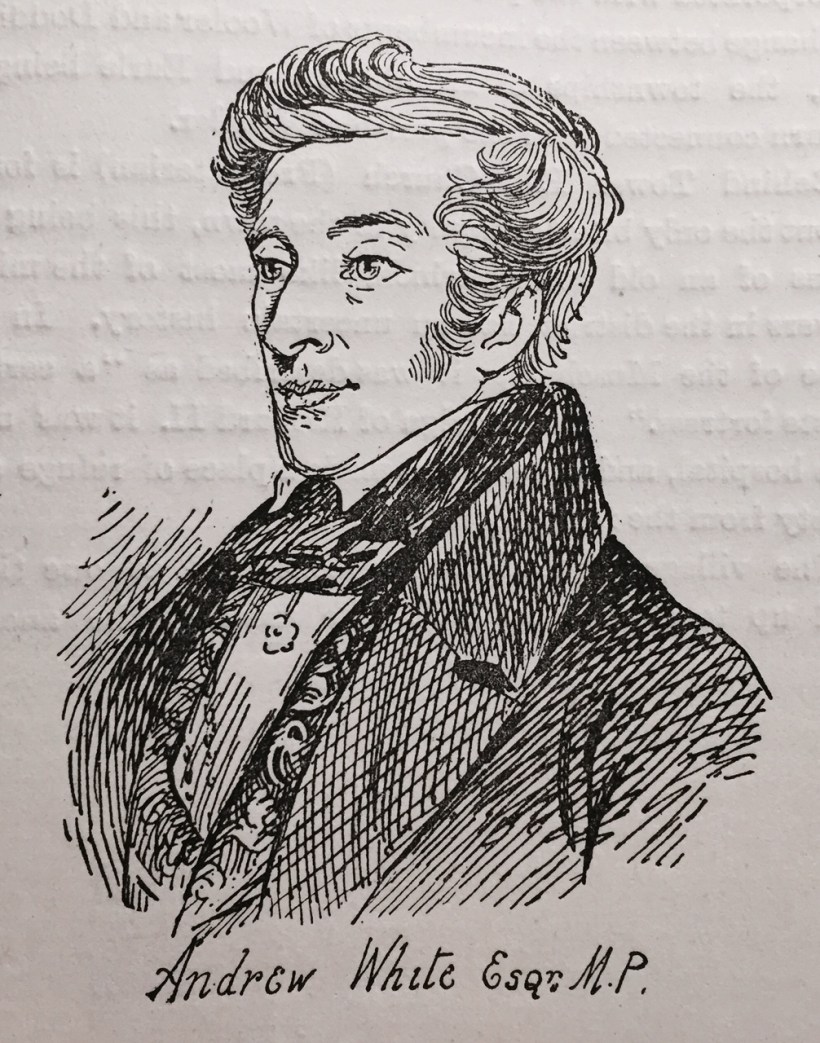
Andrew White Esq MP

Andrew White, of Frederick Lodge, Sunderland, and Tunstall Lodge, county Durham, first and three times Mayor of Sunderland, Member of Parliament, Borough and County Justice, and a Deputy-Lieutenant for the county of Durham, was born in Sunderland in the year 1788. He was a son of John White, of Thorny Close, Durham, the most extensive shipowner in Sunderland at that time, a colliery owner, and the proprietor of the Bishopwearmouth Iron Works a gentleman of large means and philanthropic spirit, who built at his own cost the Wesleyan Schools in Hendon Road.

After receiving a sound education (he was a pupil of Rev. John Hayton), Andrew White early entered upon a business and public career. Together with his brother Richard, he was taken into partnership by his father, and the firm became John White and Sons. Endowed with more than average ability, and the happy possessor of a genial and polished manner, he was not long in making his influence felt in the good town of Sunderland. When in 1835 an agitation arose for taking advantage of the Municipal Reform Act, he was the chosen champion of the Municipal party. Although Bishop Morton had in 1634 vested the government of the town in a “Mayor, twelve Aldermen, and Commonalty” all duly elected and acknowledged by the State the charter had fallen into disuse, and a strong faction now objected to the formation of a council without a special Act of Parliament. Mr. White, however, presided at a meeting on the 16th December, 1835, and, strengthened by the opinion of the then Attorney-General, the meeting unanimously resolved to take advantage of the Act. An opposition meeting was held on the 17th, when Mr. R. Pemberton, Mr. Fenwick, and Mr. Featherstonehaugh, together with some of their friends, strongly opposed the resolution adopted at the previous meeting. Their objections were, however, overruled, and on December 26, 1835, the first election of councillors for the newly-constituted borough of Sunderland took place.
The subject of our sketch was returned at the head of the poll for two wards the Bishopwearmouth and the West Wards his brother Richard being returned for the Ward of St. Michael, also at the head of the poll.

The first meeting of the Council was held on December 31st, and at a subsequent meeting on New Year’s Day, 1836, Mr. Andrew White was chosen first Mayor, and Mr. Ritson Town Clerk. On this occasion the ladies of Sunderland presented the Mayor with an elaborate silken banner on which was emblazoned in letters of gold the statement that he was “the pride of his native borough.” This banner, at a later date, Mr. White presented to the Corporation, and it now occupies a conspicuous position in the New Municipal Buildings.

The chief magistracy, however, was not to be an enviable position, for on the first occasion that Mr. White took his seat at the head of the Bench he was hustled, and a demonstration was made, more against the office than the occupier of it. The county magistrates declined to recognise the Mayor’s authority, and the battle waged long and furiously; but Mr, White held his court at a different hour to the opposition until he was left in undisputed possession of the field. He was re-elected Mayor on the 9th Nov. 1836, but retired in July, 1837, to fill the more important position of Member of Parliament for the borough. The new member sat in the Whig interest, his colleague being Mr. Thompson, a Conservative. As showing the contrast between past and present elections, it may be mentioned that Mr. White’s election expenses on that occasion amounted to £16,000!

From this time new honours came thick and fast. Mr. White was made a deputy-lieutenant of his county, was present at the coronation and marriage of his Sovereign, and presented her with a congratulatory address from the borough of Sunderland on the occasion of the birth of the Princess Royal. For many years he held a prominent position in the county, taking a leading part in all philanthropic movements. It was an annual custom of his at Christmas time to entertain to dinner in his town house, Frederick Lodge, the whole of the chimney sweeps of Sunderland a portion of the community at that time in anything but affluent circumstances.

Severe losses in winning coal came upon him in the closing years of his life, and he retired from all public work. Mr. White, who died in 1856, had no offspring, and the only male representative of his family in the North of England is Mr. John White, of Claremont Terrace, Newcastle, who is the only son of Andrew’s brother and partner, Mr. Richard White (Mayor of Sunderland in 1840). Some younger brothers went to reside in the South of England early in life, and many of their progeny now occupy exalted positions in the Church and Army.

Our portrait is taken from an engraving of Bewick’s painting of Mr. White whilst Member for Sunderland, now in the possession of his great-nephew, Mr. J. Holmes White, of Newcastle.

Katy’s Coffee House, Newcastle

Entrance to the Side from Sandhill, Newcastle with Katy's Coffee House, the Lort Burn etc

On the site now occupied by the Royal Insurance Buildings stood, till the autumn of 1843, one of those quaint overhanging structures in which Newcastle was formerly so rich and of which even now, despite the energy of Town Improvement Committees and the desire for more showy premises and larger rents on the part of property owners, the city possesses some excellent specimens. The building to which I refer was known for more than 120 years as Katy’s Coffee House. Not that Katy herself lived so long, for she died in 1767, at the age of three score years and ten; but there was about her and her management of the house half tavern, half club an individuality and character which fastened her name even on the very building itself. That building was long since destroyed; but the name remains, for who; Novocastrian has not heard of Katy’s Coffee House?

In the stirring times of the great national struggle between the people of England and their king, in the seventeenth century, this house was the residence of Alderman Thomas Bonner, a merchant who was thrice Mayor of Newcastle, and a zealous Puritan. He was chosen Mayor for the first time on the 2nd October, 1648. The Common Council Books record that on this day “Thomas Bonner, Esq., Mayor elected, coming from the Spittle to go to his dwelling-house upon the Sandhill, the Serjeants carrying torches lighted in their hands, one Edmund Marshall [doubtless an over-zealous Royalist, a genuine Church and King man] threw a long stick at the said lighted torches, and struck divers of them out; and, it being dark, stones, &c., were flung.” The new Mayor had clearly stayed late at the Spittle. But his was then the ascendant party, though its ascendency was a thing of recent date, and there had doubtless been rejoicing amongst the aldermen quiet, sober rejoicing, though, as befitted Puritans.

But distinction awaited the new Mayor in the near future. Just a fortnight after his election, Oliver the Protector reached Newcastle on his way back from Scotland. Here, writes one of Cromwell’s generals, “we were received with very great acknowledgments of love; stayed three days, partly to give our army a little rest, also for the having our train come up to us from Berwick.’

A contemporary writer says that the army, coming hither, “was entertained with great guns, and ringing of bells and feasting.” “The 19th,” says the general just quoted, “we were very sumptuously feasted by the new Mayor of Newcastle,” in his old house on the Sandhill of course. During the repast, tradition tells us, “the town’s waits or musicians” cheered the company with their harmonic strains. The Lort Burn, then an open stream, flowed down the lower part of the Side, past the Mayor’s door, and across the Sandhill into the Tyne. Opposite Bonner’s house it was spanned by a narrow bridge, whereon the musicians stood whilst displaying their skill.

Bonner’s first mayoralty was inaugurated by a riot on the Sandhill. His last mayoralty was terminated by a riot at the Spittle. The Restoration came during his term of office, and Sir John Marley, who had been under a cloud since the memorable siege of 1644, was now once more to the fore, and, as he was the last Royalist Mayor when the first Charles’s sun was setting, he was chosen for the first Royalist Mayor when the sun of the second Charles was rising. But, as the biographer of Ambrose Barnes tells us, “the worthy Mayor of Newcastle (Thomas Bonner, that is, of the Sandhill), making scruple to surrender the staff to Sir John Marley, who was thought a fit person to succeed him, was so pushed and bruised in the Spittle, that he was carried out in his chair half dead, such was the violence of the faction.” The riot proved fatal to our worthy. He died “of the hurt he received in the Election House,” and was buried on the 12th October, 1660, that is, just eleven days after the riot. Barnes’s biographer tells us that Bonner, as Mayor, ” to this day never had his equal in the town.”

Bonner had been dead more than half a century before Katy’s arrival on the Sandhill. She came in the early days of George I. Not more than twenty summers had passed over her head when she assumed the management of what became by her prudent care a prosperous and respectable Coffee House. Hers was a house frequented by the ancient dignitaries of Newcastle, who went in and out at her front door, boldly and unashamed. Here lawyers met their clients, and hero valuable properties were sold by auction but “by inch of candle.” Katy, whose real name, by the way, was Kate Jefferson, maintained the fame of her house a full half century, and died, a spinster, on the 10th day of January, 1767. A spinster she could only have been by her own fixed and resolute determination. What stories Katy could have told, and doubtless did tell, to her customers stories not only of the overtures of seekers after a single landlady of a successful house, but stories of the many odd and ordinary, good-humoured and ill-humoured characters who had frequented her house during her fifty years of mistress-ship! What would we not give for Katy’s autobiography!

A contemporary newspaper, recording her death, says: “The great resort of company to her house did not prevent her industry in other respects, particularly in spinning, in which she excelled. One web, of nineteen yards, she brought to the fineness that she refused to take half-a-guinea a yard for it, which was offered her by a lady. But it is to be observed that she worked on the web no less than twenty years.”

The accompanying view of Katy’s Coffee House as it is supposed to have appeared about 1640 is reproduced from Richardson’s “Table Book”

J. R. Boyle, F.S.A.

Madame Tomsett, Vocalist

Madame Tomsett, a well-known Tyneside soprano, is a native of Sunderland. At an early age she was found to possess a phenomenally full and round voice. Before reaching her teens she was taken in hand by Canon Bamber for his choir at the Catholic Church, Bridge Street, Sunderland, where she was a leading singer for some years. She first took lessons with the late Mr. Robert Ferry, a prominent local basso, who subsequently engaged her to lead the chorus of the Sunderland Philharmonic Society. On the occasion of that body giving a performance of Handel’s “Alexander’s Feast,” the solo soprano from London became indisposed before the concert commenced, and, at a moment’s notice, Miss Tomsett was called upon to take her place, which she did with the greatest credit and to the satisfaction of the audience.

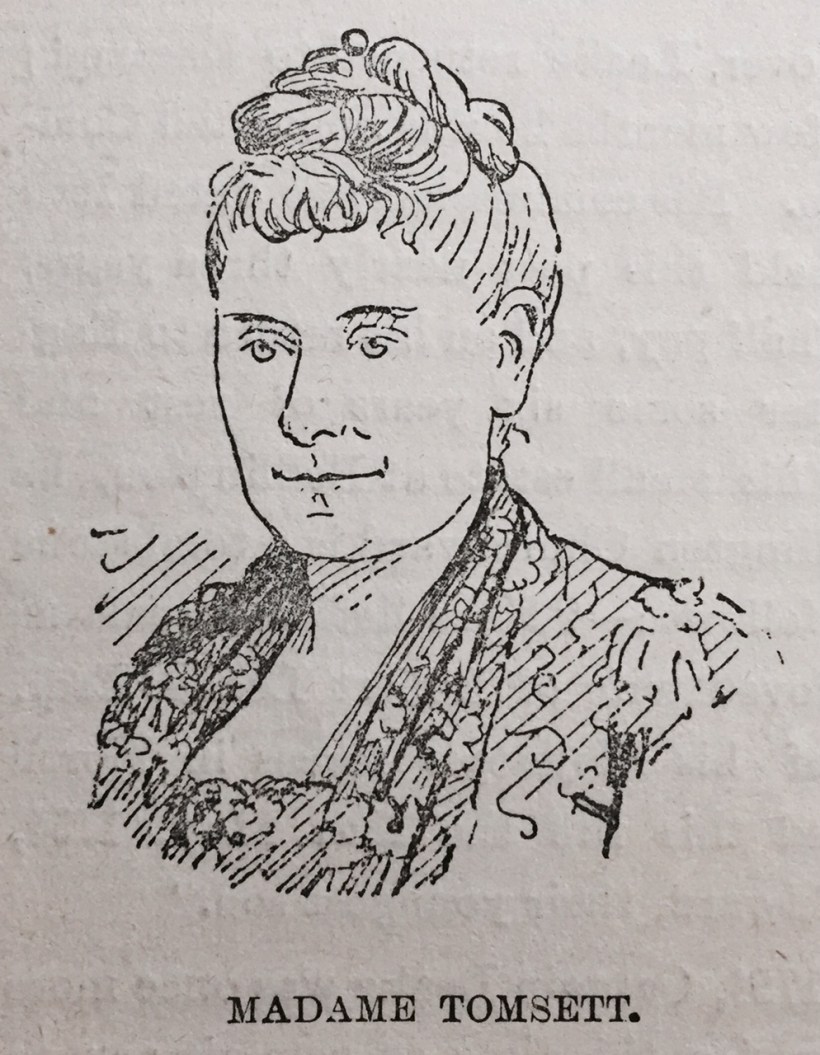
Madame Tomsett

After remaining with Mr. Ferry for some time, it was decided to send the youthful vocalist to London to acquire a thorough musical training. She was placed under the late Dr. Wylde, principal of the London Academy of Music, where she also received lessons in singing from Signor Lablache, who entertained a high opinion of her vocal powers. After barely nine months tuition, she was entered as a candidate to compete for the Crystal Palace prizes at the National musical meetings, among other competitors at that time being Miss Leonora Braham, Miss Bolingbroke, Miss Adeline Paget, Miss Jessie Jones, Mr. Leslie Crotty, and Mr. Herbert Thorndike. Notwithstanding that she had had much less experience than the other competitors, she managed not only to sing into the first half-dozen who were selected for final adjudication, bat carried off the certificate for “excellence in singing, voice, and expression” (similar to that won by Mr. Crotty in the baritone class), which certificate was signed by the judges. Sir Julius Benedict, Luigi Arditi, and Wilhelm Ganz. The London papers were very lavish in their praise of the wonderful progress the Sunderland soprano had made in so short a time. The Standard said: “Miss Tomsett was nervous, but the resonant qualities of her beautiful ringing voice completely filled the Crystal Hall. This young lady is a student of the London Academy, and her progress is nothing short of marvellous, considering that she has received scarcely a year’s tuition. A brilliant future is before this vocalist if she but husbands the splendid resources at her command.”

Miss Tomsett afterwards sang with great acceptance at Gresham College for Dr. Wylde; at the St. James’s Hall and Crystal Palace concerts with Mr. Mann’s orchestra (notably on the occasion of the first visit of the Shah of Persia); at operatic recitals with Madame Elena Coraui and Mr. J. W. Turner; at Signor Arditi’s, and elsewhere. Instead of remaining in London, however, she returned home, and her services have since been much in request for oratorios and concerts in the North of England and in Scotland. For some years she has been principal soprano at St. Michael’s Catholic Church, Newcastle. She married a local journalist, Mr. William Heenan, and has a daughter who is already a talented pianist.

The accompanying portrait is from a photograph by Mr. James Bacon, of Northumberland Street, Newcastle.